With Warren Buffett retiring six weeks ago, value investors are looking for a new talisman. Step forward, Mohnish Pabrai.
As of Tuesday (10 February), the Pabrai Wagons ETF (NYSE:WAGN) is traded on the New York Stock Exchange. But who exactly is Pabrai and should investors consider buying in?
Mohnish Pabrai
A lot of investors model themselves on Warren Buffett’s investment principles – taking a long-term view, looking for undervalued stocks, and so on. But Mohnish Pabrai has a better claim than most.
Followers of the Berkshire Hathaway annual shareholder meetings will be familiar with Pabrai as someone who’s asked questions on more than one occasion. But there’s more to it than this.
After winning a charity lunch auction in 2008, Pabrai maintained a strong relationship with Buffett and his investing co-pilot Charlie Munger. So there’s a closer connection than most can point to.
So the connection to Warren Buffett is more than just a marketing slogan. With that in mind, what can investors expect from the Wagons Fund – Pabrai’s newest investment vehicle?
The Wagons Fund
With exchange-traded funds (ETFs), investors need to be careful to not pay management fees for something that closely resembles an index. The Pabrai Wagons ETF definitely doesn’t do this.
Source: Pabrai Wagons ETF Investor Presentation
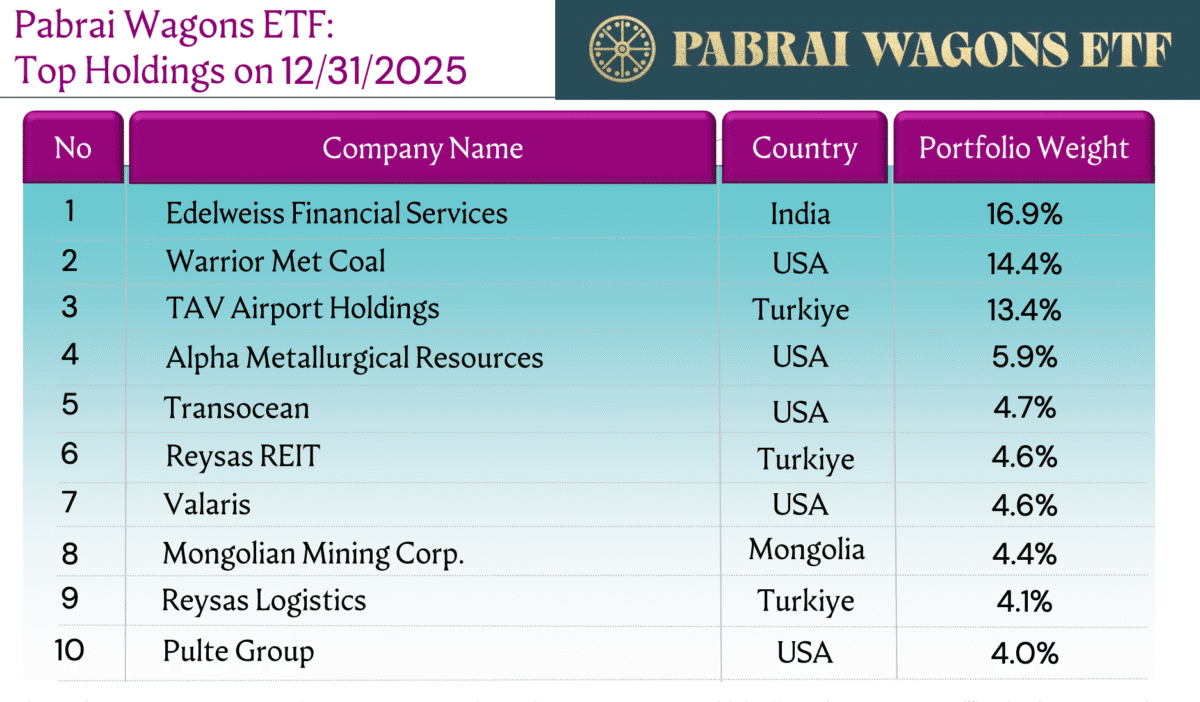
It’s a concentrated fund of specific opportunities that don’t get much coverage from analysts at all. These include businesses based in Turkey, metallurgical coal, and airports.
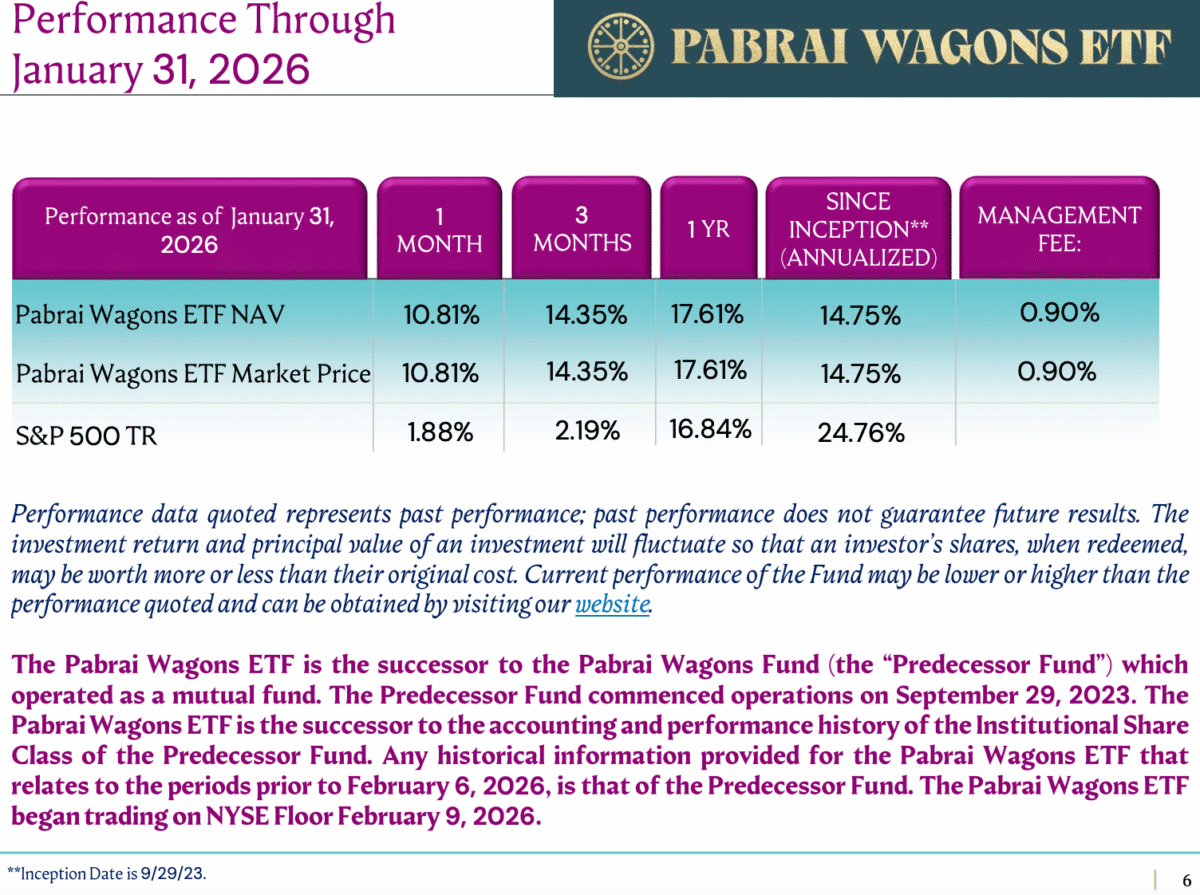
The fund’s record reveals it has underperformed the S&P 500 since its inception (it has existed as a mutual fund since 2023). But investors shouldn’t be too quick to write it off on those grounds.
Source: Pabrai Wagons ETF Investor Presentation
It doesn’t take a long memory to recall critics writing Warren Buffett off when interest rates went to zero. And the last few years have been tough for a lot of investors, not just Pabrai.
Reservations
I think the Pabrai Wagons ETF could be an interesting idea for an investor who’s looking to diversify a portfolio that’s mostly based on passive indexes. But I do have some reservations.
One is the concentrated nature of the fund. I don’t mind that by itself, but it raises the question of why investors would want to pay a 0.9% management fee instead of buying the stocks themselves.
The Pabrai Wagons ETF is also importantly different to Berkshire Hathaway. Being smaller means it can consider opportunities that aren’t big enough for Berkshire, but there is a downside.
Specifically, it’s limited to shares in publicly traded companies. The kind of private deals that Warren Buffett has managed to do over the years aren’t likely to be available for the fund.
The new Warren Buffett? Or the old one?
The Pabrai Wagons ETF aims to focus on firms with strong growth prospects – in line with Buffett’s later approach. But its largest holding looks much more like an old-style Buffett holding to me.
The investment thesis behind Edelweiss is that it’s set to raise four times its market value through a series of divestitures. That might be true but doesn’t make the firm a long-term compounder.
My overall view is that the Pabrai Wagons ETF is a welcome addition to the value investing universe. But in terms of my own portfolio, I still prefer Berkshire Hathaway.