With interest rates falling, many Britons will be thinking about how they can make their money work harder. And one possibility is investing. Through flexible and highly liquid investment decisions, investors can build their wealth and eventually draw a life-changing second income.
So what’s the catch?
Really, there’s no catch. The only thing would-be investors need to understand is that no investment’s risk free. However, those who invest wisely can experience returns many times greater than they would achieve in a savings account.
How to get started?
The easiest way to get going is to open a Stocks and Shares ISA — maximum annual contribution of £20,000 — and start contributing to it. These ISAs are available on all major UK brokerages and some cater to those looking to contribute relatively small figures — eg less than £100 a month.
From there, it’s all about making informed and sensible investment decisions. For me, this means investing using data and not based on gut feelings.
And it’s amazing how these investments can grow over time. Imagine starting with £20,000 and then choosing to contribute another £250 a month. Here, I’m going to suggest an investor’s looking to grow their portfolio by 8% annually.
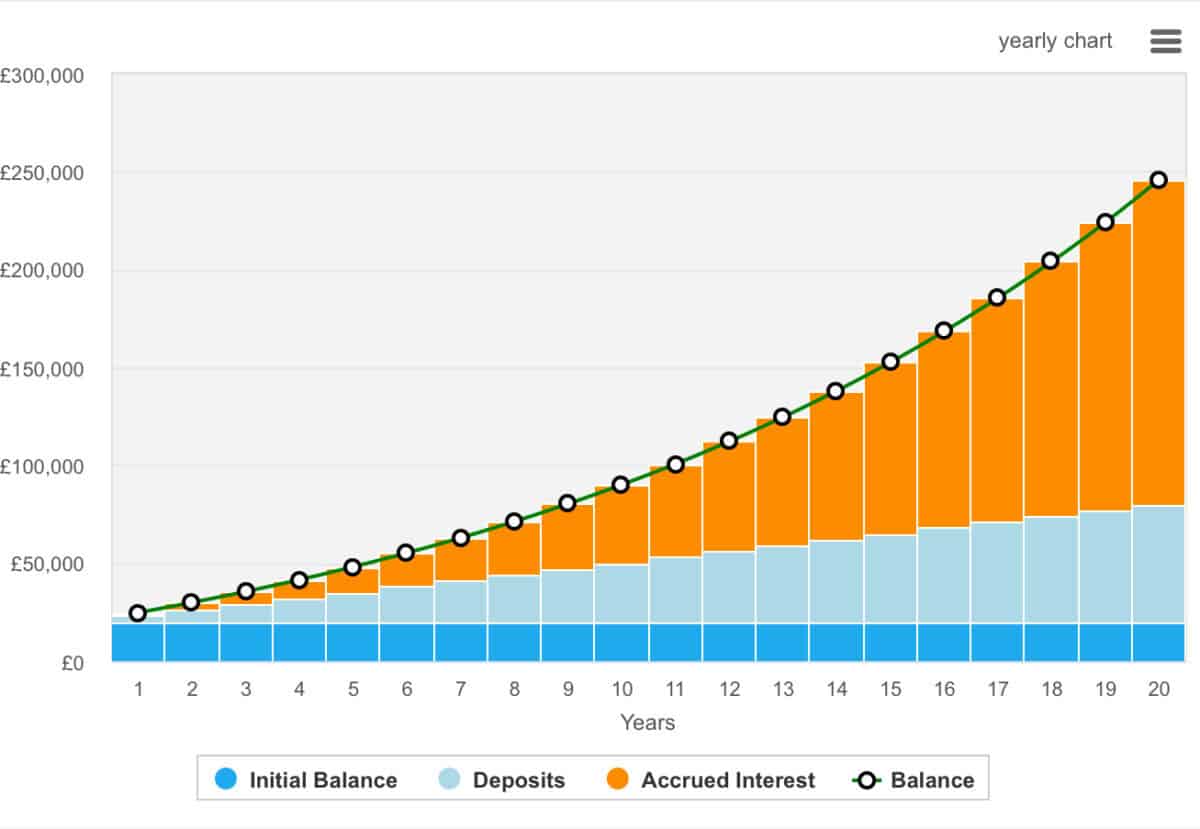
As we can see, over a 20-year period, the portfolio value would potentially push up from £20,000 to almost £250,000. That’s a considerable increase and one that would allow the investor to eventually take a second income worth around £12,500 a year.
Personally, I think that’s a very solid return, although many investors will be more ambitious. The challenge is matching that ambition with an appreciation of risk.
Where to invest?
Building a portfolio is never easy. Those new to investing may want to start by building diversification through exposure to funds, trusts and ETFs.
But what about stocks? Well, here I prefer a data-based approach. And one of the best ranked stocks using multiple quantitive models is Fresh Del Monte (NYSE:FDP).
The company looks an interesting proposition for investors seeking exposure beyond the crowded technology trade. As enthusiasm for AI begins to cool, capital may rotate back into essential industries with tangible assets — and food production fits that bill.
The company’s a vertically integrated supplier of fresh and prepared produce, operating farms, shipping networks, and distribution centres across multiple continents. It also owns tens of thousands of acres of farmland.
Analysts expect earnings per share to rise from $2.8 in 2025 to $3.1 in 2026, with net profit climbing from $137.8m to $146.6m.
At roughly 12.5 times forward earnings, the valuation’s undemanding, especially when coupled with the 3.4% dividend yield. What’s more, the average price target suggests the stock’s undervalued by 28%.
One risk is that persistent cost inflation — particularly in fuel and fertiliser — could erode margins. Even so, with strong fundamentals and tangible real assets, Fresh Del Monte’s worth considering.