
Here’s what I’d consider doing if ISA allowances plunge!

Potential changes to the Cash ISA allowance could create an opportunity for Britons to make better returns from shares. Royston Wild explains.

| More on:
Rear view image depicting two men hiking together with the stunning backdrop of Seven Sisters cliffs in the south of England.

Image source: Getty Images

When investing, your capital is at risk. The value of your investments can go down as well as up and you may get back less than you put in.

Read More

The content of this article is provided for information purposes only and is not intended to be, nor does it constitute, any form of personal advice. Investments in a currency other than sterling are exposed to currency exchange risk. Currency exchange rates are constantly changing, which may affect the value of the investment in sterling terms. You could lose money in sterling even if the stock price rises in the currency of origin. Stocks listed on overseas exchanges may be subject to additional dealing and exchange rate charges, and may have other tax implications, and may not provide the same, or any, regulatory protection as in the UK.

You’re reading a free article with opinions that may differ from The Motley Fool’s Premium Investing Services. Become a Motley Fool member today to get instant access to our top analyst recommendations, in-depth research, investing resources, and more. Learn More.

The Cash ISA is a good product to build wealth. The tax protections it offers can over time significantly boost the returns savers make on their contributions.

It’s unfortunate, then, that annual allowances — that is, contribution limits — on these tax wrappers look like they might be slashed. Rumours have been swirling of rule changes as the government seeks to encourage Britons to invest rather than save. Current talk is that Cash ISA allowances will be halved to £10,000.

But as the saying goes, when life gives you lemons, make lemonade. My hope is — as a Stocks and Shares ISA investor — these changes will mean more people investing in the stock market where they can target better returns.

Please note that tax treatment depends on the individual circumstances of each client and may be subject to change in future. The content in this article is provided for information purposes only. It is not intended to be, neither does it constitute, any form of tax advice. Readers are responsible for carrying out their own due diligence and for obtaining professional advice before making any investment decisions.

Wealth gap

Don’t get me wrong. I use a Cash ISA myself, and I’m not especially keen on those rumoured allowance cuts. I think a carrot rather than a stick approach is the best way to encourage people to pursue better returns.

However, the vast majority of my extra money each month is used to buy shares, investment trusts and exchange-traded funds (ETFs). Given the superior returns on offer, it’s a no-brainer decision for me.

Moneyfacts data shows that the average Stocks and Shares ISA user made an average annual return of 9.64% over the last decade. Cash ISA savers, meanwhile, made a paltry 1.21%.

Based on these numbers, someone who put £500 every month in the latter would have roughly £63,700 to show for it today. The return on the investing ISA would have blown that out of the water, at around £100,300.
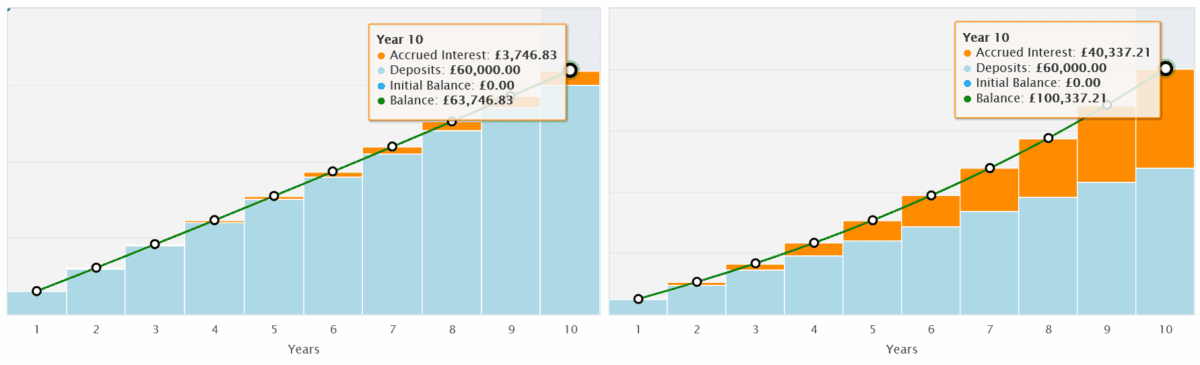
Possible Cash ISA and Stocks and Shares ISA returns
Cash ISA vs Stocks and Shares ISA returns. Source: thecalculatorsite.com

Stretched over a number of decades, the difference would be even starker, given the compounding effect where returns generate further returns over time.

A balanced approach

I love the advantages that a Cash ISA offers. It’s simple, and provides a guaranteed return. By comparison, stock ISAs are higher-risk and can go up and down.

But over a longer time horizon, the bumps that share investors experience tendsto be ironed out, allowing the full power of the stock market to shine through. What’s more, with a wide range of assets to choose from, Stocks and Shares ISA investors can significantly reduce the risks to their cash now and in the future.

I myself own a range of investment trusts and ETFs including the HSBC S&P 500 (LSE:HSPX) fund. This particular one diversifies across hundreds of US shares with footprints in different sectors and regions.

It’s an approach that’s paid off handsomely. Over the last decade, it’s delivered an average annual return of 15%.

These huge returns largely reflect the fund’s large contingent of high-growth tech shares. This tilt towards technology can result in volatility during economic downturns. However, it can also deliver blockbuster returns as digital trends like artificial intelligence (AI) and robotics take off.

Holdings here include Nvidia, which became the world’s first $4trn company this year.

I think a diversified portfolio of stocks, trusts and funds like this — balanced with some money held in savings — could be an effective way to target long-term wealth. It’s the path I’d consider taking if I was a Cash ISA saver today.



Should you invest, the value of your investment may rise or fall and your capital is at risk. Before investing, your individual circumstances should be assessed. Consider taking independent financial advice.

Royston Wild has positions in Hsbc ETFs Public - Hsbc S&P 500 Ucits ETF. The Motley Fool UK has no position in any of the shares mentioned. Views expressed on the companies mentioned in this article are those of the writer and therefore may differ from the official recommendations we make in our subscription services such as Share Advisor, Hidden Winners and Pro. Here at The Motley Fool we believe that considering a diverse range of insights makes us better investors.

More on Investing Articles

Snowing on Jubilee Gardens in London at dusk
Investing Articles

Will the stock market crash before Christmas?

Christmas is fast approaching. Could the uncertainty in the markets lead to a stock market crash before presents get opened?

Read more »

Portsmouth, England, June 2018, Portsmouth port in the late evening
Investing Articles

What will happen to the UK stock market in 2026? Here’s what experts think

UK stocks have had one of the best years of the century, but can that momentum continue into 2026? Our…

Read more »

Illustration of flames over a black background
Investing Articles

Why are investors on this trading platform piling in to an AI-threatened US stock?

James Beard tries to work out why this US stock’s attracting a lot of interest even though it could be…

Read more »

piggy bank, searching with binoculars
Investing Articles

Prediction: in 12 months the Persimmon share price and dividend could turn £10,000 into…

James Beard examines whether the Persimmon share price could stage a major recovery in 2026. And he looks at the…

Read more »

Percy Pig Ocado van outside distribution centre
Investing Articles

As the Ocado share price crashes, could it be a bargain?

The Ocado share price has plummeted -- and for a clear reason. Our writer considers whether this could be a…

Read more »

A front-view shot of a multi-ethnic family with two children walking down a city street on a cold December night.
Investing Articles

How on earth did this world-beating blue-chip growth stock crash 50% in five years?

Harvey Jones was a huge fan of this FTSE 100 growth stock for years but lately it has only inflicted…

Read more »

Businessman hand flipping wooden block cube from 2024 to 2025 on coins
Investing Articles

I asked ChatGPT to build the perfect Stocks and Shares ISA portfolio and it said…

Artificial intelligence (AI) may have its uses but when Harvey Jones asked it to build the ideal Stocks and Shares…

Read more »

Friends and sisters exploring the outdoors together in Cornwall. They are standing with their arms around each other at the coast.
Investing Articles

I asked ChatGPT what dividend shares I should buy for retirement. Its answer was amusing

Mark Hartley isn't convinced by ChatGPT’s attempt at picking dividend shares for retirement. But the results were entertaining nonetheless.

Read more »