
How much money do you need in a SIPP for a £38k passive income at 65?

With generous levels of tax relief, a SIPP can be a powerful weapon to target a long-term passive income, as Royston Wild explains.

| More on:
Senior Couple Walking With Pet Bulldog In Countryside

Image source: Getty Images.

When investing, your capital is at risk. The value of your investments can go down as well as up and you may get back less than you put in.

Read More

The content of this article is provided for information purposes only and is not intended to be, nor does it constitute, any form of personal advice. Investments in a currency other than sterling are exposed to currency exchange risk. Currency exchange rates are constantly changing, which may affect the value of the investment in sterling terms. You could lose money in sterling even if the stock price rises in the currency of origin. Stocks listed on overseas exchanges may be subject to additional dealing and exchange rate charges, and may have other tax implications, and may not provide the same, or any, regulatory protection as in the UK.

You’re reading a free article with opinions that may differ from The Motley Fool’s Premium Investing Services. Become a Motley Fool member today to get instant access to our top analyst recommendations, in-depth research, investing resources, and more. Learn More.

I don’t know about you, but I have no plans to leave my financial fate in retirement up to outside forces. With the future of the State Pension coming under increased scrutiny, I plan to build enough wealth for a healthy passive income to supplement any state benefits I’ll receive.

Given enough time, investing regularly in a Self-Invested Personal Pension (SIPP) could be one of the best ways for individuals to generate enough money for retirement. Generous tax breaks and government top-ups can supercharge long-term compounding, helping your savings to grow faster.

They mean that even those late to the investing party can build a large passive income for later on.

Please note that tax treatment depends on the individual circumstances of each client and may be subject to change in future. The content in this article is provided for information purposes only. It is not intended to be, neither does it constitute, any form of tax advice. Readers are responsible for carrying out their own due diligence and for obtaining professional advice before making any investment decisions.

Building income

According to Shepherds Friendly, the average Briton has £514 at the end of each month to invest. Thanks to tax relief, those who use a SIPP to buy shares, funds and trusts have even more money to use to grow their wealth.

Tax relief on these products ranges from 20% for basic-rate taxpayers. That rises to 40% and 45% for those on the higher-rate and additional-rate tax bands respectively. For those investing around half a grand each month, that’s a tidy little bonus can make an enormous difference.

Let’s say we have a higher-rate taxpayer with that £514 to put in the stock market each month. Thanks to tax relief, the amount they actually have to invest is bumped up to £857.

If they started investing this at the age of 40, they could have £960,802 sitting in their SIPP by the time they reach 65. That’s based on an average annual return of 9%.
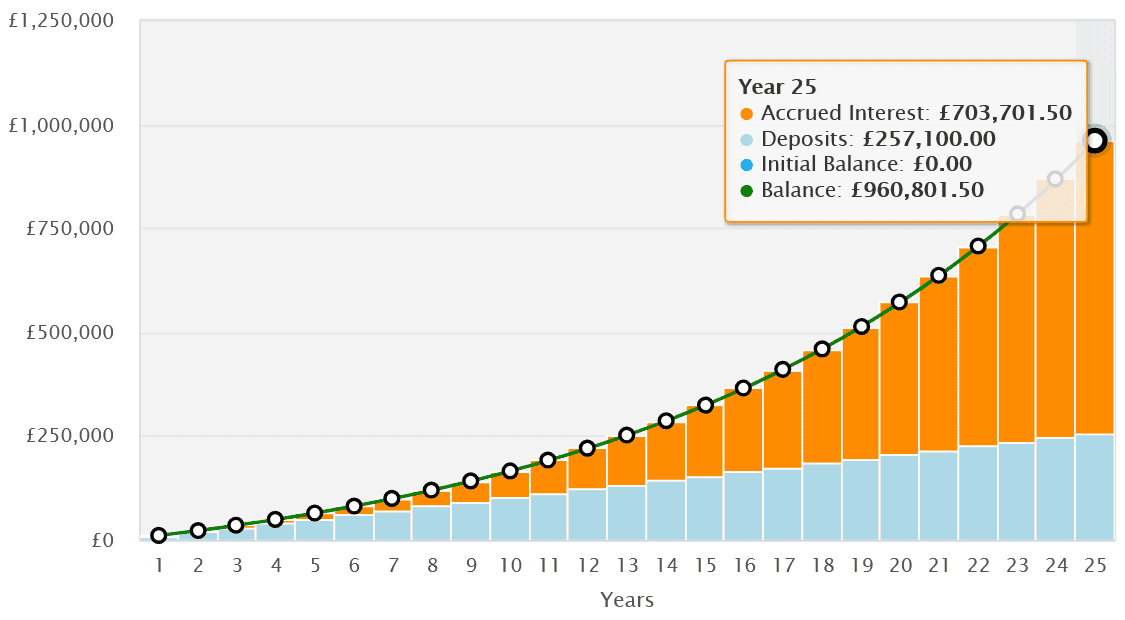
Building wealth for passive income in retirement using a SIPP
Source: thecalculatorsite.com

Such a sum would produce a passive income of just over £38,000 if our investor drew down 4% of their fund each year (£38,432, to be precise).

What would their SIPP look like without tax relief? After 25 years, they’d have a portfolio worth £576,257, which would produce a lower income of roughly £20,000 a year, based on the same withdrawal rate.

Targeting retirement wealth

But just how realistic is it for the average investor to achieve that 9% annual return and build a nest egg like this? History shows that patience and a balanced portfolio spread across the stock market can deliver solid long-term growth, though past performance isn’t a guarantee of future results.

I’ve increased my own holdings in diversified products like exchange-traded funds (ETFs) to grow my retirement fund. The iShares Digital Security ETF (LSE:LOCK) is one I’ve added to my SIPP in recent weeks.

During the past five years, it’s delivered an 11.7% average annual return, ahead of our target 9%.

A focus on cyclical tech shares means the fund could underperform during economic downturns. But I’m convinced it will continue delivering knockout returns over the long term as the cyber security market grows.

What’s more, with holdings in 110 different companies, this iShares ETF can harness this opportunity without overreliance on individual companies to drive growth.

For any SIPP investor targeting a large passive income, I think it’s worth serious consideration.



Should you invest, the value of your investment may rise or fall and your capital is at risk. Before investing, your individual circumstances should be assessed. Consider taking independent financial advice.

Royston Wild has positions in iShares IV Public - iShares Digital Security Ucits ETF. The Motley Fool UK has no position in any of the shares mentioned. Views expressed on the companies mentioned in this article are those of the writer and therefore may differ from the official recommendations we make in our subscription services such as Share Advisor, Hidden Winners and Pro. Here at The Motley Fool we believe that considering a diverse range of insights makes us better investors.

More on Investing Articles

Night Takeoff Of The American Space Shuttle
Investing Articles

3 FTSE 250 shares to target a 14.8% annual return

Discover which FTSE 250 growth shares have torn higher over the last decade -- and why Royston Wild thinks they…

Read more »

Middle aged businesswoman using laptop while working from home
Investing Articles

I asked ChatGPT to design a 5% yielding passive income ISA from 5 FTSE 250 shares and it said…

Harvey Jones asked artificial intelligence to create a passive income stream from a balanced portfolio from medium-sized UK companies. The…

Read more »

Snowing on Jubilee Gardens in London at dusk
Investing Articles

Will the stock market crash before Christmas?

Christmas is fast approaching. Could the uncertainty in the markets lead to a stock market crash before presents get opened?

Read more »

Portsmouth, England, June 2018, Portsmouth port in the late evening
Investing Articles

What will happen to the UK stock market in 2026? Here’s what experts think

UK stocks have had one of the best years of the century, but can that momentum continue into 2026? Our…

Read more »

Illustration of flames over a black background
Investing Articles

Why are investors on this trading platform piling in to an AI-threatened US stock?

James Beard tries to work out why this US stock’s attracting a lot of interest even though it could be…

Read more »

piggy bank, searching with binoculars
Investing Articles

Prediction: in 12 months the Persimmon share price and dividend could turn £10,000 into…

James Beard examines whether the Persimmon share price could stage a major recovery in 2026. And he looks at the…

Read more »

Percy Pig Ocado van outside distribution centre
Investing Articles

As the Ocado share price crashes, could it be a bargain?

The Ocado share price has plummeted -- and for a clear reason. Our writer considers whether this could be a…

Read more »

A front-view shot of a multi-ethnic family with two children walking down a city street on a cold December night.
Investing Articles

How on earth did this world-beating blue-chip growth stock crash 50% in five years?

Harvey Jones was a huge fan of this FTSE 100 growth stock for years but lately it has only inflicted…

Read more »