Could the BT share price take off?

Since October 2020, the BT share price has risen over 70%. But has the business made any progress since its stock was first offered to the public?

| More on:
Exterior of BT Group head office - One Braham, London

Image source: BT Group plc

When investing, your capital is at risk. The value of your investments can go down as well as up and you may get back less than you put in.

Read More

The content of this article is provided for information purposes only and is not intended to be, nor does it constitute, any form of personal advice. Investments in a currency other than sterling are exposed to currency exchange risk. Currency exchange rates are constantly changing, which may affect the value of the investment in sterling terms. You could lose money in sterling even if the stock price rises in the currency of origin. Stocks listed on overseas exchanges may be subject to additional dealing and exchange rate charges, and may have other tax implications, and may not provide the same, or any, regulatory protection as in the UK.

You’re reading a free article with opinions that may differ from The Motley Fool’s Premium Investing Services. Become a Motley Fool member today to get instant access to our top analyst recommendations, in-depth research, investing resources, and more. Learn More.

The BT (LSE:BT.A) share price has been a steady performer since the pandemic. In October 2020, its shares were changing hands for just over 100p. Today (9 October), they sell for around 185p. This five-year performance just about puts it in the top third of those currently on the FTSE 100.

Then and now

The sale of BT shares to the public in 1984 was the first major privatisation of the Thatcher government. The idea was to free the telecoms group from state control and let it compete internationally without being held back by bureaucracy and union power.

But a look at the 1984 sales prospectus suggests that the group’s made little progress since. At the time, it was valued at £7.8bn — or £25.6bn in today’s terms. Now, its market cap is ‘only’ £18.2bn.

During the year ended 31 March 1984 (FY84), it made a profit after tax of £990m (£3.25bn in current money). Forty years later, in FY25, it reported adjusted post-tax earnings of £1.83bn.

So in real terms, it’s now worth less and isn’t as profitable as it was over four decades ago. Also, its dividend is less generous. In 1984, the stock was yielding 7.1%. Based on amounts paid over the past 12 months, it’s now offering a return of 4.4%. This is a reminder that payouts are never guaranteed.

Sectoral challenges

This disappointing performance is symptomatic of the telecoms industry, where the infrastructure is expensive and the returns are poor.

In 2023, Vodafone published research from Barclays that showed the ratio of capital expenditure to sales was the highest of any industry. The sector also had one of the lowest returns on capital employed (ROCE).
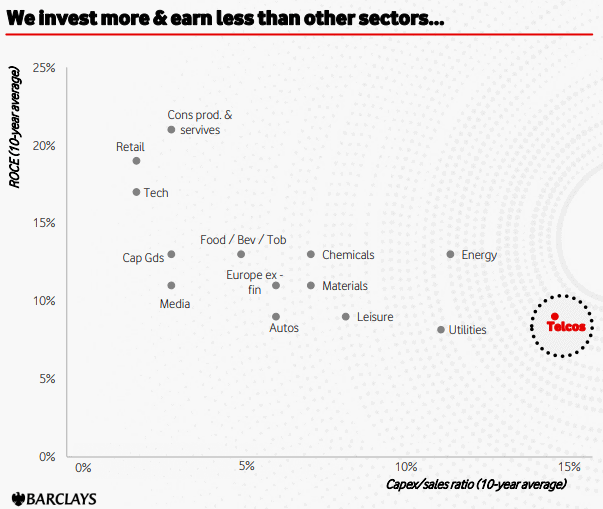
Source: 2023 Vodafone investor presentation

This is also evident from BT’s accounts. At the end of FY84, it had fixed assets of £8.8bn and debt (including leases) of £3.9bn. By the end of FY25, these had increased to £42.6bn and £23.3bn, respectively. Over the same period, its ROCE has fallen. And it’s remained largely unchanged over the past five financial years (FY21-FY25) fluctuating between 8.3% and 8.7%.

Pros and cons

One bright spot has been its adjusted EBITDA (earnings before interest, tax, depreciation and amortisation). It’s increased from £7.42bn in FY21 to £8.21bn in FY25. Although this is the group’s preferred measure of profitability, it can be controversial. Warren Buffett has described it as a “very misleading statistic” that “can be used in pernicious ways”. Pithily, he once asked: “Does management think the tooth fairy pays for capital expenditures?” This seems to be a highly relevant question in an industry where, as we’ve seen, the infrastructure isn’t cheap.

Adjusted earnings per share is probably a more reliable indicator. But in FY21, this was 18.9p. In FY25, it was slightly lower at 18.8p. The business appears stuck to me.

But brokers are optimistic. They have a 12-month share price target that’s 15% higher than its current value. And BT has some impressive names on its share register. The largest chunk of stock (24.5%) is held by Bharti Overseas. In my opinion, the group also retains a strong brand.

However, this isn’t sufficient to make me want to invest. BT looks like too much of a plodder in an industry that demands deep pockets. I think there are better opportunities for me elsewhere.


Should you invest, the value of your investment may rise or fall and your capital is at risk. Before investing, your individual circumstances should be assessed. Consider taking independent financial advice.

James Beard has positions in Vodafone Group Public. The Motley Fool UK has recommended Barclays Plc and Vodafone Group Public. Views expressed on the companies mentioned in this article are those of the writer and therefore may differ from the official recommendations we make in our subscription services such as Share Advisor, Hidden Winners and Pro. Here at The Motley Fool we believe that considering a diverse range of insights makes us better investors.

More on Investing Articles

One English pound placed on a graph to represent an economic down turn
Investing Articles

3 FTSE 100 best-sellers I won’t touch with a bargepole

These FTSE 100 shares have been selling like hotcakes in 2025. But our writer Royston Wild plans to keep avoiding…

Read more »

A senior group of friends enjoying rowing on the River Derwent
Investing Articles

2 FTSE shares that could beat the S&P 500 over the next 12 months

US stocks could underperform in 2026, while some FTSE shares look primed to surge. Here are two that could be…

Read more »

Mature black woman at home texting on her cell phone while sitting on the couch
Investing Articles

These are some of the cheapest UK stocks in November

Cheap UK stocks arguably have less room to fall and more potential to rise. Dr James Fox details some of…

Read more »

Rear view image depicting two men hiking together with the stunning backdrop of Seven Sisters cliffs in the south of England.
Investing Articles

2 FTSE 250 stocks that experts are calling ‘Strong Buys’

These FTSE 250 stocks are being overlooked by most investors, but expert analysts are paying attention to these exciting discounted…

Read more »

Array of piggy banks in saturated colours on high colour contrast background
Investing Articles

The FTSE 100 nears 10,000, but this little-known stock is down 71% – could it be a hidden gem?

The FTSE 100 is roaring ahead, yet one stock has lagged – this writer explains why he’s becoming increasingly bullish…

Read more »

Bus waiting in front of the London Stock Exchange on a sunny day.
Investing Articles

Could this be the next FTSE 100 stock to be taken over?

There's a rumour circulating that a takeover approach could soon be made for this struggling FTSE 100 stock. James Beard…

Read more »

Midnight is celebrated along the River Thames in London with a spectacular and colourful firework display.
Investing Articles

Prediction: these FTSE 250 growth stocks are set to explode

Looking for the best stocks to buy this November? Here are two proven growth heroes from the FTSE 250 to…

Read more »

Red briefcase with the words Budget HM Treasury embossed in gold
Investing Articles

History suggests the FTSE 100 will do this after the UK Autumn Budget

Whatever happens in the fast-approaching Autumn Budget, this FTSE 100 stock could be set to outperform and deliver solid gains…

Read more »