
Share your opinion and earn yourself a free Motley Fool premium report!

We are looking for Fools to join a 75 minute online independent market research forum on 15th / 16th December.

To find out more and express your interest please click here

8.6% dividend yield! See how much a £10,000 investment in Phoenix shares could potentially grow to

In search of high-yielding dividend stocks, Andrew Mackie assesses whether Phoenix shares would be a good addition to his Stocks and Shares ISA.

| More on:

The content of this article was relevant at the time of publishing. Circumstances change continuously and caution should therefore be exercised when relying upon any content contained within this article.

Little girl helping her Grandad plant tomatoes in a greenhouse in his garden.

Image source: Getty Images

You’re reading a free article with opinions that may differ from The Motley Fool’s Premium Investing Services. Become a Motley Fool member today to get instant access to our top analyst recommendations, in-depth research, investing resources, and more. Learn More.

There are only a handful of shares in the FTSE 100 that offers a dividend yield north of 8% and Phoenix Group (LSE: PHNX) is one of them. But exactly how much could an investor turn a £10,000 investment in to?

Compounding returns

Compounding one’s returns is the secret sauce that can supercharge a portfolio’s returns. As the chart below highlights, reinvesting dividends along the way would more than double one’s money in 10 years. This is significantly more than the £18,600 ‘flat’ return without compounding.
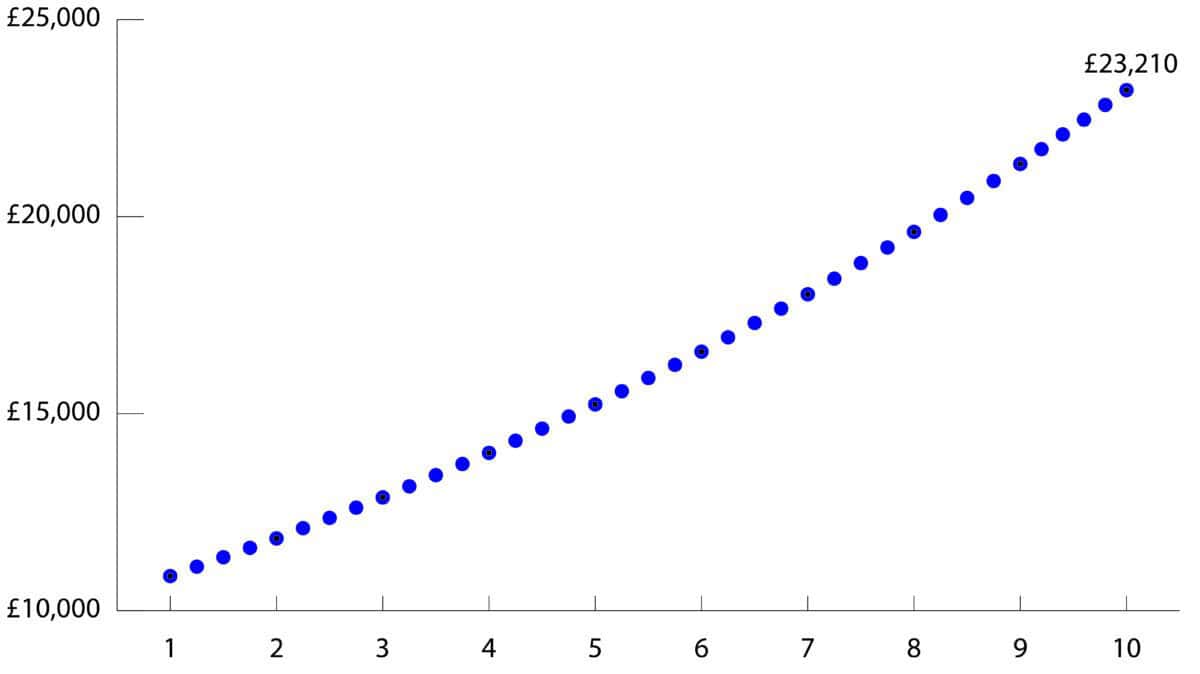
Chart generated by author

But even this calculation is not strictly right as it assumes there is no share price movement or change in dividend. With regards to the latter, over the last 10 years, the life insurer has raised its dividend from 40.8p per share to 54p, an increase of 32%.

Future dividends

The business uses three financial metrics as a basis for determining future dividend increases. These are operating cash generation (OCG), shareholder capital coverage ratio, and the parent company distributable reserves. My favoured metric is to focus on cash generation, as it is easier to understand.

On 8 September, at H1 results, it reported an increase of 9% in OCG to £705m. This amount more than covered the dividend payment and other recurring uses (e.g., interest expense and operating costs). At full-year results, it’s guiding for total excess cash to be approximately £300m.

Accounting mismatch

One issue that spooked investors during its H1 results (causing a 5% drop on the day) was a decline in statutory accounting (known as IFRS) shareholders’ equity. On the surface, this could potentially suggest problems sustaining the dividend.

Phoenix explained the decline as a result of an “accounting mismatch” between the balance sheets based on IFRS and its preferred reporting method, Solvency II.

One major difference between the accounting standards is the way they treat an investment contract, like an annuity. Under IFRS, such contracts are valued using locked-in economic assumptions fixed at a specific time. Under Solvency II, however, they are treated more like capital, and consequently revalued at each balance sheet date.

Although quite technical, such differences are extremely important. When adjusted for such variances, shareholders’ equity came in at £3.5bn, significantly more than the £768m reported under IFRS.

Growth drivers

Personally, I am sceptical when a business deploys creative accounting solutions to explain away discrepancies in the balance sheet. Clearly, if IFRS shareholders’ equity does not grow in the medium term, as management expects, then the stock could come under pressure.

Putting this issue aside, the business does have significant growth opportunities in the years ahead. A shift from defined benefit (DB) to defined contribution (DC) workplace pensions is one mega trend.

A DC pension puts the onus on an employee to both pick their own funds and to ensure that they have an adequate pension pot at retirement. Today, it is estimated that one in seven will have a shortfall at retirement. And with so few people presently taking financial advice at retirement, Phoenix looks well placed to capitalise.

I am sorely tempted to buy Phoenix for the dividend yield alone. However, given I am already heavily invested in another high-yielding rival, I do not want my portfolio to be over exposed to just one sector.


Andrew Mackie has no position in any of the shares mentioned. The Motley Fool UK has no position in any of the shares mentioned. Views expressed on the companies mentioned in this article are those of the writer and therefore may differ from the official recommendations we make in our subscription services such as Share Advisor, Hidden Winners and Pro. Here at The Motley Fool we believe that considering a diverse range of insights makes us better investors.

More on Investing Articles

Middle aged businesswoman using laptop while working from home
Investing Articles

Down 9% in a month with a P/E below 8 – time to consider buying IAG shares?

When IAG shares fell earlier this year Harvey Jones filled his boots. Now the FTSE 100 airline has slipped again.…

Read more »

Tesco employee helping female customer
Growth Shares

Here’s where the experts think the Tesco share price could finish next year

Jon Smith sets his sights on the Tesco share price direction for 2026 and muses over the forecasts being offered…

Read more »

Lady taking a carton of Ben & Jerry's ice cream from a supermarket's freezer
Investing Articles

Should I scoop up some Magnum Ice Cream shares for my ISA? 

The world's largest ice cream business started trading on the London Stock Exchange today. Is this the next buy for…

Read more »

A young black man makes the symbol of a peace sign with two fingers
Investing Articles

2 incredible FTSE 100 shares I can’t stop buying!

Discover the two FTSE 100 shares our writer Royston Wild's been piling into -- and why he expects them to…

Read more »

Close-up as a woman counts out modern British banknotes.
Investing For Beginners

This FTSE 100 share has a P/E ratio less than half the index average! Is it a bargain buy?

Jon Smith points out a FTSE 100 share with a P/E ratio of just 7.37, as he continues his hunt…

Read more »

Person holding magnifying glass over important document, reading the small print
Investing Articles

Why this FTSE banking gem may hold a lot more value than we think

This FTSE banking giant may be hiding more value than investors expect -- with rising dividends, buybacks, and growth potential…

Read more »

Tesla building with tesla logo and two teslas in front
US Stock

I asked ChatGPT where Tesla stock will be in a year’s time and this is what it said…

Jon Smith got an underwhelming response from ChatGPT regarding Tesla stock's 2026 potential performance, and provides his viewpoint on the…

Read more »

A pastel colored growing graph with rising rocket.
Investing Articles

I’ve made this much from 417 shares in this FTSE 100 dividend income gem since 2020…

My £10k investment in this FTSE 100 heavyweight has grown hugely since 2020. With dividends up and the shares still…

Read more »