
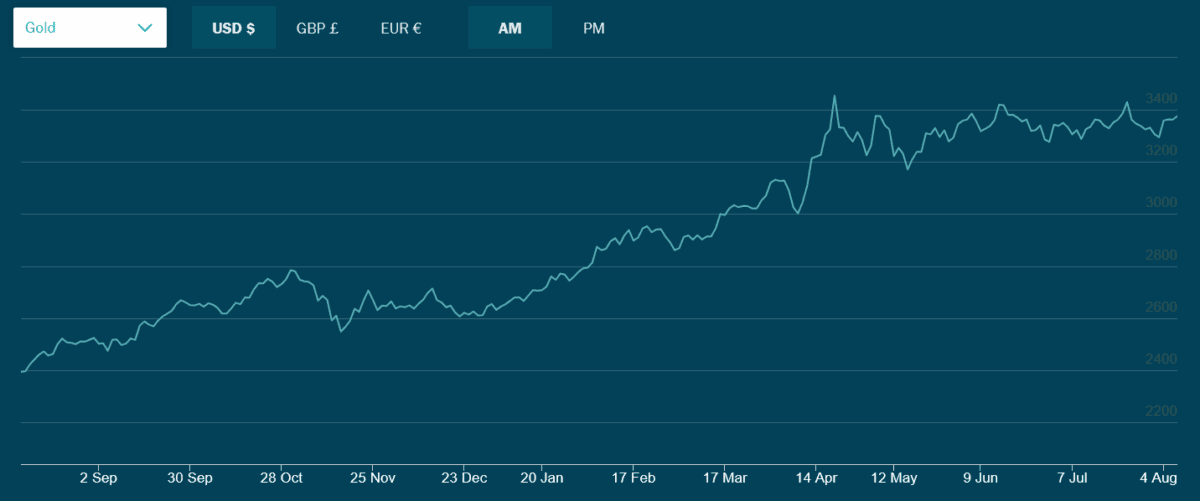
Gold prices remain in a holding pattern after falling from April’s record highs. But I think they could be about to spring higher, making gold stocks and funds attractive assets to consider for the rest of 2025.
The yellow metal’s surge above $3,500 per ounce four months ago prompted heavy bouts of profit-taking from investors. Gold had appreciated 47% in the 12 months to 22 April on heightened macroeconomic and geopolitical concerns.
But bullion demand has begun creeping higher again in recent weeks. World Gold Council (WGC) data shows inflows into gold-backed exchange-traded funds (ETFs) “are currently on pace for their second strongest year on record“. Fund holdings are currently at record peaks of $386.4bn.
Central bank gold demand is also steadily rising as they diversify their reserves and prepare for potential shocks.
The WGC thinks investor demand will continue rising “as signs that tariff effects trickle through more meaningfully to growth and/or inflation“. In my opinion, other potential drivers include prolonged US dollar weakness, fears over government debt levels, and concerns about stretched stock market valuations.
A fine fund
So what should individuals consider buying to capitalise on another potential price rise? Price-tracking ETFs like iShares Physical Gold (LSE:SGLN) are lower-risk assets that attract strong interest from investors.
Unlike gold stocks, they’re not vulnerable to operational challenges that could damage returns. Sure, they can still fall when prices of the precious metal drop. A recovering US dollar or improving market confidence are two factors that could pull precious metals lower again.
However, fund holders don’t have to worry about production outages, disappointing drilling results, and other common problems that can hammer miners’ profits.
Investors can enjoy the same benefits by buying physical gold like bars and coins. But these assets are far less liquid, and buyers typically incur costs to store their metal.
Buying and selling a gold-backed ETF is far more straightforward and pretty cost effective, too. The annual management fee on this iShares fund, for instance, is just 0.12%.
Top gold share
That said, the higher risk associated with gold stocks may be acceptable when weighed up against the benefits during bull markets. While a gold producer’s costs stay relatively fixed, any rise in the bullion price can dramatically increase its revenues.
As a consequence, profits can grow much faster than the price of gold itself, and by extension funds that track the yellow metal.
Take Pan African Resources (LSE:PAF) as an example. Its share price has rocketed 122% over the last 12 months. By contrast, the iShares Physical Gold ETF has risen a more modest (if still pretty solid) 33%.
Pan African’s shares have been driven by record first-half production, reflecting project ramp-ups across its South African mine portfolio. Debt reduction and a new share buyback programme have also boosted the gold stock’s price.
Gold stocks offer another significant advantage over price-tracking ETFs and physical metal: the potential for passive income. Pan African is one such dividend-paying stock. And its forward dividend yield is a solid 4.8%.
I think gold’s investment case is compelling in the current landscape. In my view, both ETFs and gold stocks are attractive options for investors considering gaining exposure.