
We have some exciting news to share! The Motley Fool UK has now become an independent, UK-owned company, led by our long-serving UK management team — Mark Rogers, Chris Nials and Heather Adlington. In practical terms, it’s the same team you know, now fully focused on serving our UK readers and members.

Just as importantly, our approach remains unchanged: long-term, jargon-free, and on your side. We’ll be introducing a new name and brand over the coming weeks — we're very excited to share it with you and embark on this new chapter together!

Should I lock in a 5.38% yield for 30 years of passive income?

With UK government bonds offering higher yields than the FTSE 100, should investors look beyond the stock market for passive income opportunities?

| More on:

The content of this article was relevant at the time of publishing. Circumstances change continuously and caution should therefore be exercised when relying upon any content contained within this article.

You’re reading a free article with opinions that may differ from The Motley Fool’s Premium Investing Services. Become a Motley Fool member today to get instant access to our top analyst recommendations, in-depth research, investing resources, and more. Learn More.

Closeup of "interest rates" text in a newspaper

Image source: Getty Images

UK 30-year government bonds currently come with a 5.38% yield. With the FTSE 100 offering a dividend yield of 3.36%, that could be interesting for investors looking for long-term passive income.

While bonds are relatively low-risk investments (the chances of the UK government not paying its debts are pretty remote) there’s a catch. The annual return can’t go up over time – and that’s a concern.

Inflation

At today’s prices, a £10,000 investment in 30-year UK government bonds is set to return £538 per year. For context, this is around eight times what investors could have earned five years ago.
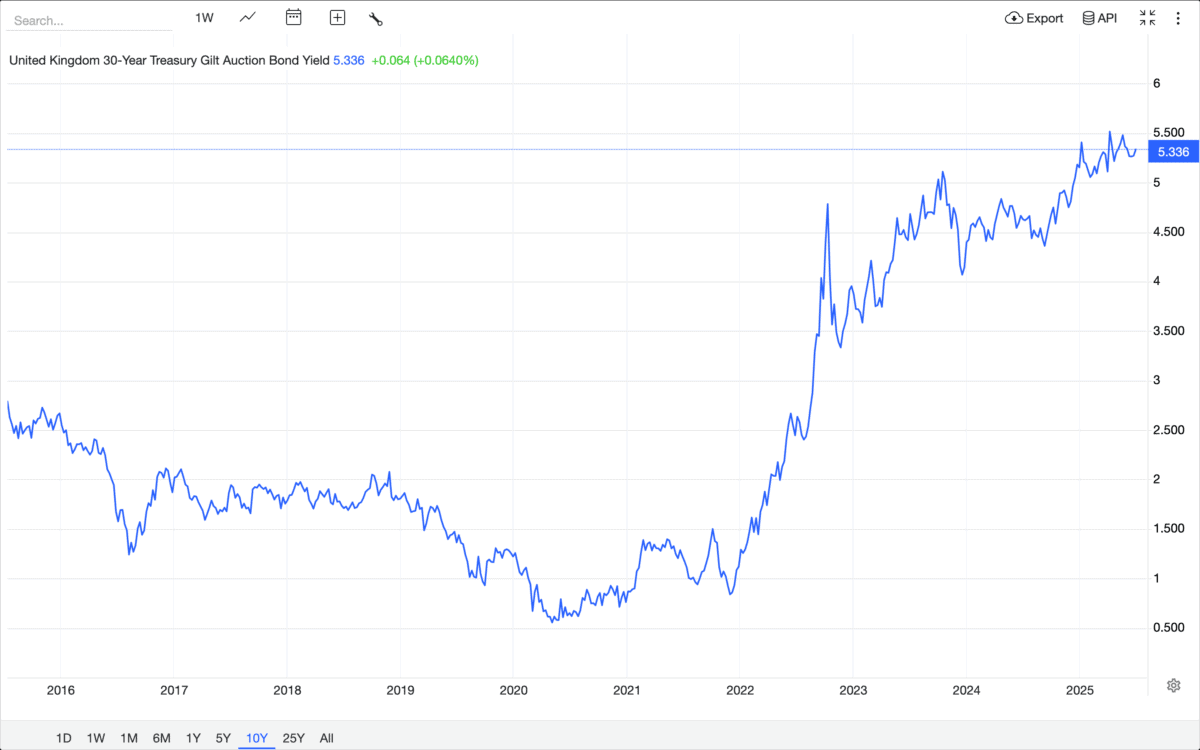
Source: Trading Economics

One issue with bonds, however, is inflation. And there are a couple of reasons why this is important. 

The first is that rising prices typically result in higher interest rates, which cause the value of long-term bonds to fall. So if rates rise, today’s 30-year bond might be worth less in the future.

From an income perspective, this is the smaller issue. Whatever happens in the markets, the bond matures after 30 years and – barring something extreme – investors get their money back.

The bigger issue is the effect on real returns. Over the last three decades, the UK Consumer Price Index (CPI) has increased by 145.7%, which implies an inflation rate of just over 3% per year. 

If that continues, it could seriously cut into real returns over the next 30 years. Put simply, getting £538 in 2055 would be like getting £219 today – and that’s an issue for passive income investors.

The stock market

An alternative approach to passive income involves the stock market. That allows investors to buy ownership stakes in companies and receive a share of the profits in the form of dividends.

The obvious risk with this is that earnings are much more likely to go down than bonds. But with the best businesses, there’s also a chance their net income rises faster than inflation.

Unilever (LSE:ULVR) is a good example. Over the last decade, the firm’s dividend growth has outpaced the CPI, leading to better results for investors, even accounting for inflation.

There is, however, no guarantee of this continuing. One of the risks with Unilever is that it’s easy for people to change to other products, meaning a constant battle to stay ahead of competitors.

The company, however, has two key strengths when it comes to meeting this challenge. The first is its brand portfolio, which customers recognise and trust.

The second is the firm’s vast scale, which allows it to negotiate preferential terms with suppliers and retailers. Together, these make a powerful long-term combination.

Locking in

Unusually high bond yields offer an unusually high passive income return that’s very unlikely to disappear in the next three decades. But investors should be careful about locking this in.

With a return that can’t go up, inflation is a big risk over the long term. By contrast, businesses can – when things go well – increase their dividends over time to offset this threat. 

Unilever shares have a 3.5% dividend, which is below the 30-year bond. But with scope to grow as inflation cuts into gilt returns, I think investors should consider the stock over the bond.


Stephen Wright has positions in Unilever. The Motley Fool UK has recommended Unilever. Views expressed on the companies mentioned in this article are those of the writer and therefore may differ from the official recommendations we make in our subscription services such as Share Advisor, Hidden Winners and Pro. Here at The Motley Fool we believe that considering a diverse range of insights makes us better investors.

More on Investing Articles

Close-up of a woman holding modern polymer ten, twenty and fifty pound notes.
Investing Articles

Some pros and cons of buying dividend shares for passive income

Dividend shares can seem appealing, but they also carry risks. Christopher Ruane looks at what passive income potential -- and…

Read more »

Housing development near Dunstable, UK
Investing Articles

Down 73%, Vistry’s the worst-performing FTSE 250 share in my portfolio. Time to sell?

Mark Hartley outlines how UK housing market woes have driven down the price of one his core FTSE 250 holdings,…

Read more »

Aerial shot showing an aircraft shadow flying over an idyllic beach
Investing Articles

Just how cheap could IAG shares get this summer?

If the world runs out of jet fuel this summer then IAG shares could take a beating, says Harvey Jones.…

Read more »

Night Takeoff Of The American Space Shuttle
Investing Articles

Up 130% in 2026, can FTSE space stock Filtronic continue to soar?

Edward Sheldon thought that FTSE share Filtronic would do well in 2026. He wasn’t expecting it to shoot up 130%…

Read more »

British flag, Big Ben, Houses of Parliament and British flag composition
Investing Articles

Are investors still using an outdated playbook to value Lloyds shares?

Andrew Mackie looks beyond the standard rate-sensitive narrative around Lloyds shares to question whether we're missing a more resilient earnings…

Read more »

Hydrogen testing at DLR Cologne
Investing Articles

Is £15 the next stop for the Rolls-Royce share price?

Where will the Rolls-Royce share price go from here? Is a £15 price target for the next 12 months totally…

Read more »

Two female adult friends walking through the city streets at Christmas. They are talking and smiling as they do some Christmas shopping.
Investing Articles

How much is £7,620 saved in a Cash ISA a decade ago worth today?

Cash ISA savers have received an average of 4% over the last decade, but Harvey Jones says the average Stocks…

Read more »

Close-up as a woman counts out modern British banknotes.
Investing Articles

702 shares in this FTSE 100 stalwart earn a £100 a month second income

Unilever shares come with an unusually high dividend yield. Should investors looking for a second income grab the opportunity with…

Read more »