
Here’s what the Warren Buffett indicator says about the stock market

The Warren Buffett indicator suggests that shares are expensive. But Stephen Wright feels investors should think carefully about what to do.

| More on:

The content of this article was relevant at the time of publishing. Circumstances change continuously and caution should therefore be exercised when relying upon any content contained within this article.

You’re reading a free article with opinions that may differ from The Motley Fool’s Premium Investing Services. Become a Motley Fool member today to get instant access to our top analyst recommendations, in-depth research, investing resources, and more. Learn More.

Three signposts pointing in different directions, with 'Buy' 'Sell' and 'Hold' on

Image source: Getty Images

Billionaire investor Warren Buffett has a well-known metric for measuring stock market valuations. And it indicates that share prices – specifically US ones – are expensive at the moment. 

Given that US companies account for almost 70% of the global equities, it’s probably fair to say this means stocks as a whole are expensive. But what should investors do about this?

The Buffett indicator

Buffett’s famous metric involves comparing the market value of equities with gross domestic product (GDP). And on this basis, US equities look unusually expensive at the moment.
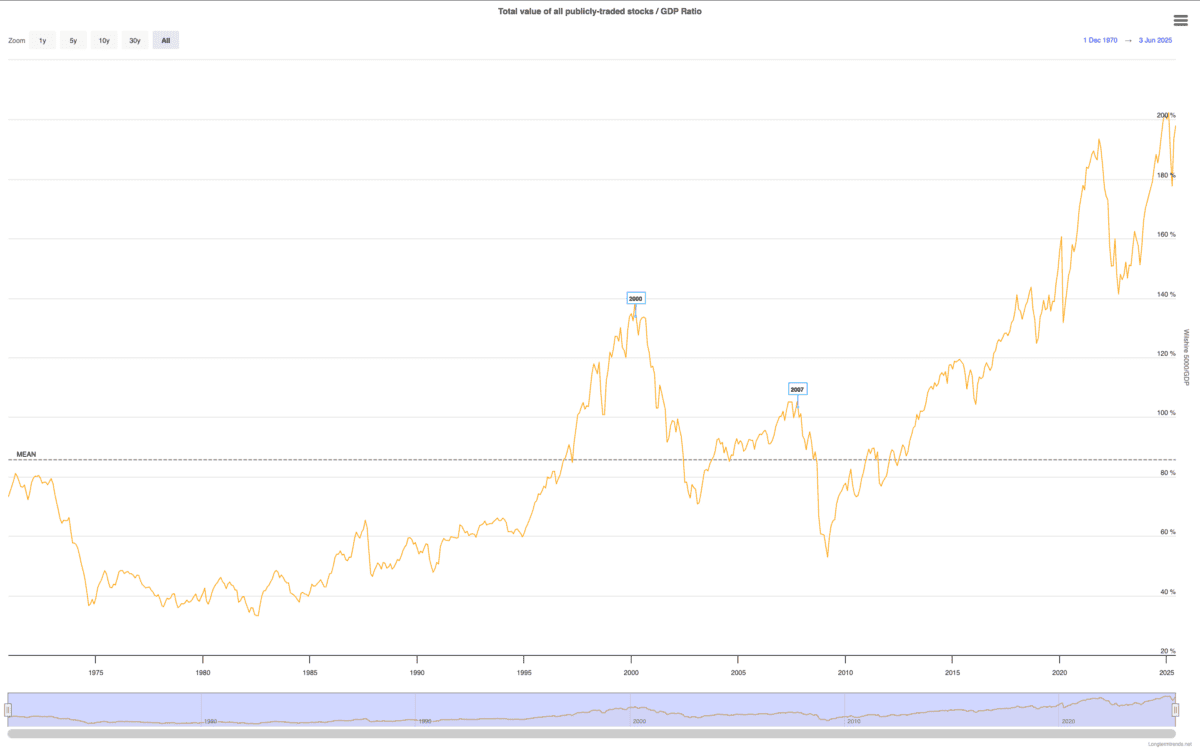
Source: Longtermtrends

The so-called Buffett indicator has a decent history of being a good indicator of a stock market crash. Unusually high levels have often been followed by a sharp downturn in share prices.

Right now, the metric is the highest it has ever been, but I’m wary of making predictions on this basis. The main reason is that it’s been high for some time.

The Buffett indicator has been at unusually high levels since 2019. But the only stock market crashes in that time have been attributable to other things – Covid-19 and US trade tariffs.

Valuations

I don’t think valuation metrics are a good indication of what stocks are going to do in the near future. But they do mean that the effect on share prices can be dramatic if something happens.

From a long-term perspective, the picture is slightly different. One reason for this is that there can be cases where valuation multiples don’t give a good indication of how expensive an individual stock is. 

Polaris (NYSE:PII) is a good example. The firm is one of the leading manufacturers of recreational vehicles, including boats, motorcycles, and snowmobiles.

At a price-to-earnings (P/E) ratio of 56, the stock looks very expensive. But I think this is a case where things aren’t quite what they seem at first sight.

A stock that’s cheaper than it looks

Polaris relies on consumers having disposable income. And a lot of its sales involve financing, which means high interest rates can dampen demand and weigh on margins, leading to profits falling away. 

This is what has been happening recently and that’s the risk with this business. Furthermore, it makes the firm’s dividend look unsustainable if things don’t pick up reasonably quickly.

If this trend reverses however, the stock could look very cheap at today’s prices. And Polaris has generated average annual earnings per share of just over $5 over the last 10 years. 

On this basis, the current share price implies a P/E ratio of around 8, which looks much more reasonable. So despite the high valuation multiple, I don’t actually think the stock is that expensive.

Investing in an expensive market

I think the Buffett indicator is worth paying attention to. But I’m not making plans for a stock market crash based on the historically high reading at the moment.

Instead, I’m looking for individual stocks to buy. And one type of opportunity is where unusually low earnings are making share prices look more expensive than they are.

Polaris is one example I think is worth considering right now. The P/E ratio might be high, but there’s a clear reason why this shouldn’t necessarily put investors off.


Stephen Wright has no position in any of the shares mentioned. The Motley Fool UK has no position in any of the shares mentioned. Views expressed on the companies mentioned in this article are those of the writer and therefore may differ from the official recommendations we make in our subscription services such as Share Advisor, Hidden Winners and Pro. Here at The Motley Fool we believe that considering a diverse range of insights makes us better investors.

More on Investing Articles

British union jack flag and Parliament house at city of Westminster in the background
Investing Articles

Is Raspberry Pi the next Nvidia stock?

The Raspberry Pi (LSE:RPI) share price exploded 46% higher in the FTSE 250 today. Might this be the start of…

Read more »

Senior woman potting plant in garden at home
Investing Articles

Thinking of stuffing a SIPP with high-yield shares? 3 things to consider

A SIPP filled with shares offering juicy dividends can seem tempting. Christopher Ruane explains some potential pros and cons of…

Read more »

ISA coins
Investing Articles

Does this weekend’s ISA deadline make now a good time to start buying shares?

With a key ISA deadline looming this weekend, does it make a difference whether someone starts buying shares now or…

Read more »

National Grid engineers at a substation
Investing Articles

If inflation soars, can the National Grid dividend keep up?

With the risk of higher inflation getting stronger, our writer weighs up whether the National Grid dividend might earn the…

Read more »

Lady taking a bottle of Hellmann's Real Mayonnaise from a supermarket shelf
Investing Articles

Could getting out of the food business help the Unilever share price?

Unilever and McCormick today announced a transformational corporate deal. Our writer weighs some of its attractions and risks.

Read more »

UK financial background: share prices and stock graph overlaid on an image of the Union Jack
Investing Articles

Why did Raspberry Pi shares just jump 35%?

Raspberry Pi shares have been in the doldrums in the past 12 months. But is that all changing, after a…

Read more »

Businessman hand stacking money coins with virtual percentage icons
Investing Articles

How much second income could investors earn with 9% dividends from Legal & General shares?

Investors looking to build up a second income portfolio have a good few FTSE 100 shares with big dividends to…

Read more »

Rolls-Royce engineer working on an engine
Investing Articles

£5,000 invested in Rolls-Royce shares just 2 years ago is now worth…

Rolls-Royce shares have fallen some way back from a recent 52-week peak, as global events impact them and the firm…

Read more »