
This 10%-yielding FTSE 250 dividend stock looks great! But does it have long-term promise?

Discover why this 10%-yielding FTSE 250 stock could be a strong long-term income investment – and what risks investors should watch out for.

| More on:

The content of this article was relevant at the time of publishing. Circumstances change continuously and caution should therefore be exercised when relying upon any content contained within this article.

You’re reading a free article with opinions that may differ from The Motley Fool’s Premium Investing Services. Become a Motley Fool member today to get instant access to our top analyst recommendations, in-depth research, investing resources, and more. Learn More.

Thin line graph

Image source: Getty Images

The FTSE 250 index is home to a diverse mix of mid-cap companies and investment funds, often offering a sweet spot between the global reach of FTSE 100 giants and the growth potential of smaller firms. For investors seeking long-term wealth accumulation, high-yield dividend stocks on the mid-cap index can be particularly attractive.

Not only can they deliver regular income but also the possibility of capital growth over time.

However, while a high dividend yield might be promising for shareholder returns, it can also be a red flag. Exceptionally high yields sometimes indicate a share price under pressure or unsustainable payout ratios. As such, investors should assess the underlying fundamentals carefully before relying on yield alone.

One FTSE 250 stock that’s caught my attention recently is Twenty Four Income Fund (LSE: TFIF). With a staggering dividend yield of almost 10%, it appears to offer both income and value – but does it have the resilience to deliver over the long term?

A top-performing FTSE 250 dividend gem
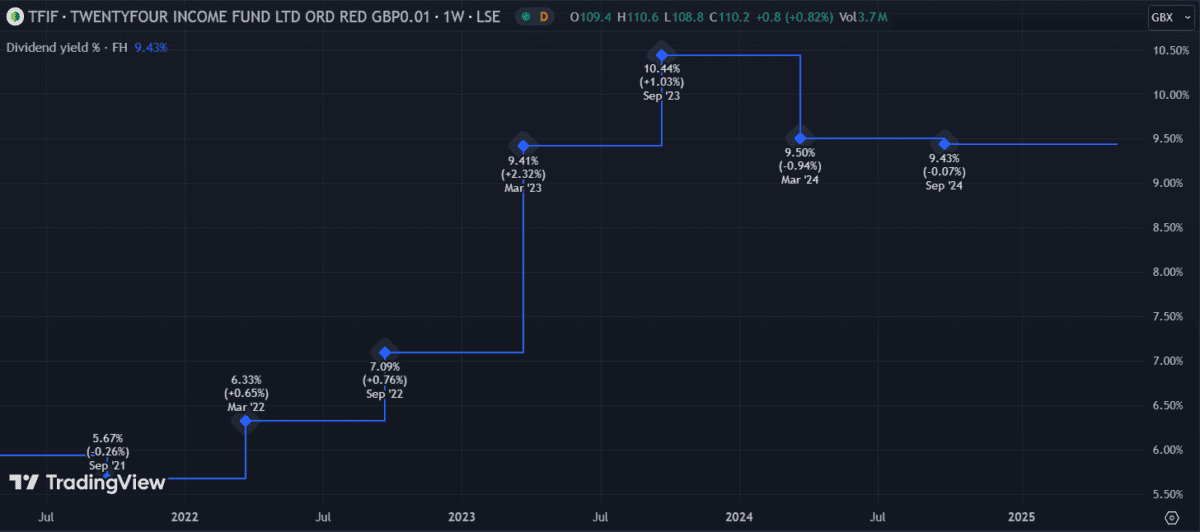
TFIF dividend yield
Created on TradingView.com

Twenty Four Income’s a closed-ended investment fund that focuses on asset-backed securities, primarily in the European and UK credit markets. It aims to provide attractive risk-adjusted returns while generating a high level of income for shareholders.

Over the past five years, the share price has risen by 22%, supported by strong performance and an experienced management team. Out of every 10%-plus-yielding FTSE 250 stock, it’s the only one that has enjoyed positive price growth over five years.

More impressively, its dividend has grown at an average annual rate of 5.23% over the past decade — a clear signal of sustainability and long-term commitment to income investors.

Latest results and ratios

In its latest full-year results, the fund posted revenue of £52.7m and a net profit of £136m, a significant turnaround from the £22.6m loss recorded the previous year. These figures point to robust management and an effective investment strategy during a period of rising interest rates and economic uncertainty.

With a price-to-earnings (P/E) ratio of just 6.2, the price looks undervalued with decent growth potential. This is further supported by a return on equity (ROE) of 16.65%, suggesting efficient use of capital.
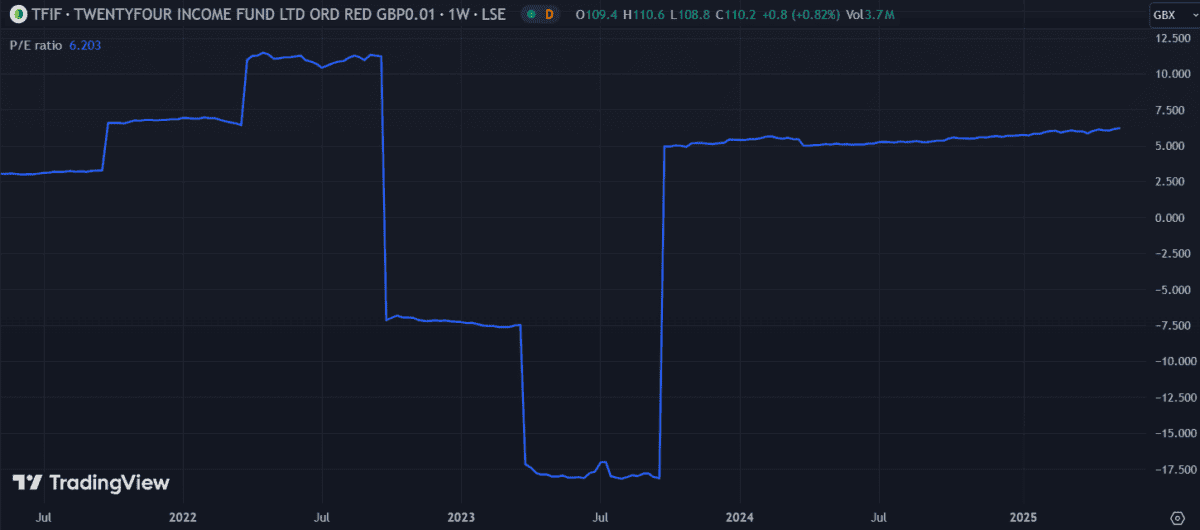
TFIF p/e ratio
Created on TradingView.com

What could go wrong?

As always, investments come with risk. Despite the attractive yield and solid performance, Twenty Four Income’s no exception. It invests in credit markets, which are sensitive to economic conditions, interest rate changes and liquidity fluctuations. Any deterioration in asset-backed security valuations or a spike in defaults could impact earnings and future dividends.

Additionally, high-yielding funds are often exposed to leverage and interest rate risk. While the fund has navigated recent volatility effectively, the outlook for fixed income markets remains uncertain.

An opportunity to consider?

For investors like myself who consistently search for reliable dividend stocks, I think Twenty Four Income Fund’s an intriguing option to consider. Its combination of double-digit yield, long-term growth and strong profitability suggests it could make a good addition to an income-focused portfolio.

That said, no investment should be made in isolation. It’s essential to conduct thorough market research and aim for a diversified portfolio to reduce sector-specific risk – especially when dealing with high-yield assets.


Mark Hartley has no position in any of the shares mentioned. The Motley Fool UK has no position in any of the shares mentioned. Views expressed on the companies mentioned in this article are those of the writer and therefore may differ from the official recommendations we make in our subscription services such as Share Advisor, Hidden Winners and Pro. Here at The Motley Fool we believe that considering a diverse range of insights makes us better investors.

More on Investing Articles

Investing Articles

As Rolls-Royce and Babcock rocket, has the BAE Systems share price finally run out of juice?

Harvey Jones is astonised at recent sluggish performance of the BAE Systems share price and wonders if there is better…

Read more »

Man hanging in the balance over a log at seaside in Scotland
Investing Articles

Down 31% and with a P/E of 8.8, is this FTSE 100 share too cheap to ignore?

Berkeley's share price has collapsed to its cheapest in roughly 10 years. Is the FTSE share now too cheap to…

Read more »

Investing Articles

10 dirt-cheap shares to consider after the correction

Investors keen to contribute to their ISA allowance before Sunday's deadline have a brilliant opportunity to buy cheap shares due…

Read more »

UK supporters with flag
Investing Articles

Why I think this super-cheap growth stock will lead the charge when the FTSE 100 recovers

Harvey Jones is seriously excited by this FTSE 100 growth stock but he also cautions that it can be very…

Read more »

Hydrogen testing at DLR Cologne
Investing Articles

Rolls-Royce’s share price is rallying again! But for how long?

Rolls-Royce's share price is the FTSE 100's best performer at the start of the new month. The question is, can…

Read more »

Lady taking a bottle of Hellmann's Real Mayonnaise from a supermarket shelf
Investing Articles

Value investors: Unilever shares are down 7% in a day!

Has the stock market’s reaction to Unilever’s deal to sell its food businesses left the reamining company as an undervalued…

Read more »

Close-up of children holding a planet at the beach
Investing Articles

The stock market is changing fundamentally — and most investors haven’t noticed

Andrew Mackie argues the FTSE 100 is being misread — beneath the volatility, investors are rotating into cash-generating businesses, not…

Read more »

British flag, Big Ben, Houses of Parliament and British flag composition
Investing Articles

FTSE 100 shares: the ‘old economy’ trade the market may be misreading

Andrew Mackie argues recent FTSE 100 volatility is masking a deeper shift, as investors rotate into cash-generative 'old economy' winners.

Read more »