
Share your opinion and earn yourself a free Motley Fool premium report!

We are looking for Fools to join a 75 minute online independent market research forum on 15th / 16th December.

To find out more and express your interest please click here

If a 45-year-old puts £700 a month into a SIPP, here’s what they could have by retirement

Even when starting in middle age, consistently contributing to a SIPP can lead to a substantial fund to call upon in retirement.

| More on:

The content of this article was relevant at the time of publishing. Circumstances change continuously and caution should therefore be exercised when relying upon any content contained within this article.

Thoughtful man using his phone while riding on a train and looking through the window

Image source: Getty Images

You’re reading a free article with opinions that may differ from The Motley Fool’s Premium Investing Services. Become a Motley Fool member today to get instant access to our top analyst recommendations, in-depth research, investing resources, and more. Learn More.

Regularly feeding money into a Self-Invested Personal Pension (SIPP) has the potential to significantly boost an individual’s retirement. That’s true even if the person is only just starting to invest in their middle age. 

To demonstrate, I want to look at how much someone could have by retirement by investing £700 a month in one of these DIY pensions. Let’s get started. 

Tax relief

A SIPP is a type of tax-efficient retirement investment account available to UK residents. The way it works is similar to a Stocks and Shares ISA, but a key difference is that funds cannot be accessed until at least age 55 (rising to 57 in 2028). 

Another difference is that there is tax relief on contributions. In other words, the UK government boosts pension savings by adding 20% tax relief for basic-rate taxpayers. Higher-rate (40%) and additional-rate (45%) taxpayers can claim even more relief through their self-assessment tax return. 

So, for someone investing £700 per month into a SIPP, the tax relief would add an extra £175, bringing the total investment to £875. 

However, it’s worth pointing out that only 25% of the pension pot can eventually be withdrawn tax-free. The remainder is then taxed as income upon withdrawal.

Please note that tax treatment depends on the individual circumstances of each client and may be subject to change in future. The content in this article is provided for information purposes only. It is not intended to be, neither does it constitute, any form of tax advice. Readers are responsible for carrying out their own due diligence and for obtaining professional advice before making any investment decisions.

£663k!

Putting this together then, a 45-year-old basic-rate taxpayer putting £700 into their SIPP every month (£10,500 per year thanks to tax relief) would have around £663,000 by age 68. 

This assumes an 8% return (after fees) over the long run. While not guaranteed, I think this rate of return is achievable for most people willing to carefully research their investments and build a diversified portfolio. 

It’s certainly not a bad result for someone starting at 45 and putting away £700 a month. Undoubtedly, it would be a nice supplementary boost in retirement.

Global index

SIPP accounts offer a wide range of investing options, including stocks, bonds, investment trusts, and exchange-traded funds (ETFs).

For many investors, a global index fund like the iShares Core MSCI World UCITS ETF (LSE: SWDA) will form a core part of their portfolio. This fund offers broad exposure to a wide range of global companies (1,355 holdings) within 23 developed countries.

Over the past decade, it has delivered an annualised total return of 9.9%. While it’s not assured to deliver that in future, I’m optimistic it can still return at least 8% over the long term.

Now, it’s worth mentioning that the US market has dominated returns and now makes up around 71% of the ETF’s total. So if the American economy enters a recession due to President Trump’s tariffs, the fund’s return could be lower than expected over the next few years. This is a key risk here. 
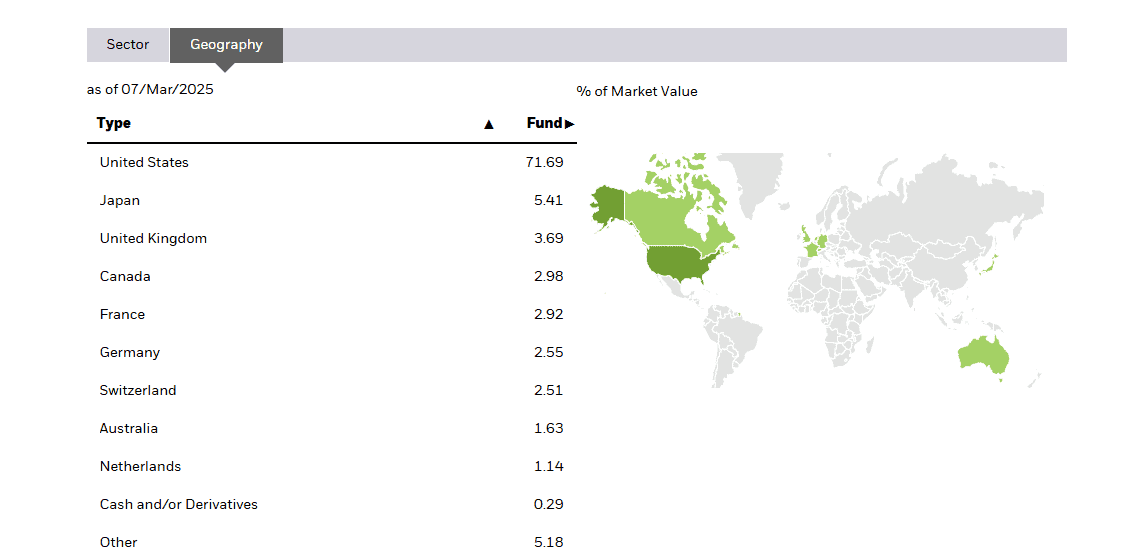
Source: iShares

Longer term however, I think it’s safe to assume that the tech revolution will only get stronger. Indeed, it could even accelerate dramatically as emerging fields like AI and (potentially) quantum computing take hold.

Such innovation should drive global economic expansion. A global index fund is the simplest way to capture this growth, in my opinion.

Of course, progress is not linear and there will be major volatility along the way. But with £875 to deploy each month, an investor will be picking up bargains during downturns, likely setting them up for strong future returns.


Ben McPoland has no position in any of the shares mentioned. The Motley Fool UK has no position in any of the shares mentioned. Views expressed on the companies mentioned in this article are those of the writer and therefore may differ from the official recommendations we make in our subscription services such as Share Advisor, Hidden Winners and Pro. Here at The Motley Fool we believe that considering a diverse range of insights makes us better investors.

More on Investing Articles

DIVIDEND YIELD text written on a notebook with chart
Investing Articles

Forget high yields? Here’s the smart way to build passive income with dividend shares

Stephen Wright outlines how investors looking for passive income can put themselves in the fast lane with dividend shares.

Read more »

Businessman hand stacking up arrow on wooden block cubes
Investing Articles

15,446 Diageo shares gets me a £1,000 monthly second income. Should I?

Diageo has been a second-rate income stock for investors over the last few years. But the new CEO sees potential…

Read more »

Investing Articles

2 FTSE 100 stocks to target epic share price gains in 2026!

Looking for blue-chip shares to buy? Discover which two FTSE 100 stocks our writer Royston Wild thinks could explode in…

Read more »

A row of satellite radars at night
Investing Articles

If the stock market crashes in 2026, I’ll buy these 2 shares like there’s no tomorrow

These two shares have already fallen 25%+ in recent weeks. So why is this writer wating for a stock market…

Read more »

British Pennies on a Pound Note
Investing Articles

How much money does someone really need to start buying shares?

Could it really be possible to start buying shares with hundreds of pounds -- or even less? Christopher Ruane weighs…

Read more »

Two gay men are walking through a Victorian shopping arcade
Investing Articles

With Versace selling for £1bn, what does this tell us about the valuations of the FTSE 100’s ‘fashionable’ stocks?

Reflecting on the sale of Versace, James Beard reckons the valuations of the FTSE 100’s fashion stocks don’t reflect the…

Read more »

A senior group of friends enjoying rowing on the River Derwent
Investing Articles

Want to stuff your retirement portfolio with high-yield shares? 5 to consider that yield 5.6%+

Not everyone wants to have a lot of high-yield shares in their portfolio. For those who might, here's a handful…

Read more »

Affectionate Asian senior mother and daughter using smartphone together at home, smiling joyfully
Investing Articles

How much do you need in a SIPP to target a £3,658 monthly passive income?

Royston Wild discusses a 9.6%-yielding fund that holds global stocks -- one he thinks could help unlock an enormous income…

Read more »