
Here’s how I’m trying to build my ISA to earn a £5,000 second income each month

One of the more enjoyable things in life is a second income, especially a tax-free one. Here’s how Dr James Fox is making his income goals a reality.

| More on:

The content of this article was relevant at the time of publishing. Circumstances change continuously and caution should therefore be exercised when relying upon any content contained within this article.

You’re reading a free article with opinions that may differ from The Motley Fool’s Premium Investing Services. Become a Motley Fool member today to get instant access to our top analyst recommendations, in-depth research, investing resources, and more. Learn More.

Playful senior couple in aprons dancing and smiling while preparing healthy dinner at home

Image source: Getty Images

The Stocks and Shares ISA is simply an excellent vehicle for building wealth and earning a second income. And that’s because it’s shielded from taxation. So if I double my money on a stock, there no capital gains tax. And if I want to take dividends from my holdings, there’s no income tax.

While millions of Britons use a Stocks and Shares ISA to invest, sadly a much greater proportion keep their money in savings accounts or simply have very little savings at all. And with savings accounts offering around 3% annualised growth on average, many Britons will struggle to build wealth.

Please note that tax treatment depends on the individual circumstances of each client and may be subject to change in future. The content in this article is provided for information purposes only. It is not intended to be, neither does it constitute, any form of tax advice. Readers are responsible for carrying out their own due diligence and for obtaining professional advice before making any investment decisions.

Even index-tracking investments beat savings

Index-tracking investments consistently outperform savings accounts, offering superior long-term returns. While savings accounts are safer and guaranteed, they provide minimal interest, often failing to keep pace with inflation, the MSCI World index delivered average annual returns of around 11.1% between 1978 and 2024.

This stark difference becomes evident over time. For instance, a £10,000 investment in the MSCI World index in 1979 would have grown to £960,000 in 2024. Index funds achieve this through broad market exposure, low fees, and passive management. They also provide an easy, diversified investment option that allows investors to benefit from overall market growth.

As such, and despite short-term market fluctuations, index funds have proven to be a more effective wealth-building tool than traditional savings accounts.

The maths add up

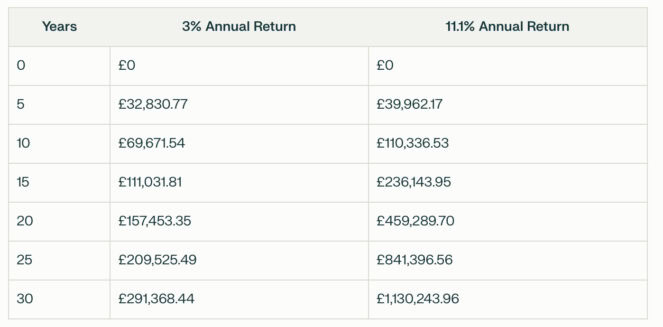
In the chart below, I’ve shown how my money (£500 of monthly contributions) would grow at 3% — representing a savings accounts — and 11.1% — reflecting the annualised growth of the MSCI World Index over the past 45 years. As we can see, the difference is relatively modest at first, but eventually the 11.1% pulls away over time. That’s simply because of compounding.

By the end of the 30 years, the index tracker’s growing by more than £100,000 a year (although that’s not guaranteed, of course). This is why it pays to start early, and also why my one-year-old has an ISA and a Self-Invested Personal Pension (SIPP)!

Moreover, with £1.1m, I could attempt to earn £60,000 annually in dividends by investing in stocks with an average yield just above 5%.
An investment to consider

Index trackers can be a great way to start investing, but something a little more exciting could be an exchange traded fund (ETF) or trust. And one of the most popular to consider in the UK is Baillie Gifford’s Scottish Mortgage Investment Trust (LSE:SMT).

It invests in growth-oriented stocks with SpaceX now representing the largest holding. It’s also the largest holding in Baillie Gifford’s Edinburgh Worldwide Investment Trust portfolio, indicating a lot of faith from the fund’s management. Scottish Mortgage’s tech-focused investments are also complemented by holdings in luxury stocks, including Ferrari.

The stock’s discounted by around 7.1% versus the estimated value of the fund’s assets. In other words, investors are buying SpaceX and Ferrari shares on the cheap. However, I know some investors will be put off by the valuations of some of the stocks held — like Tesla at 170 times forward earnings — and SpaceX, which isn’t listed and has no stock market-derived value.

Nonetheless, it’s a stock I’ll incrementally buy more of over the years. The managers have a great track record with the shares up 2,666% since inception in 1993.


James Fox has positions in Edinburgh Worldwide Investment Trust, and Scottish Mortgage Investment Trust Plc. The Motley Fool UK has recommended Tesla. Views expressed on the companies mentioned in this article are those of the writer and therefore may differ from the official recommendations we make in our subscription services such as Share Advisor, Hidden Winners and Pro. Here at The Motley Fool we believe that considering a diverse range of insights makes us better investors.

More on Investing Articles

A handsome mature bald bearded black man in a sunglasses and a fashionable blue or teal costume with a tie is standing in front of a wall made of striped wooden timbers and fastening a suit button
Investing Articles

Is NIO stock the next Tesla?

The NIO share price is up by more than 100% in the past year. Might this Chinese EV firm be…

Read more »

Two business people sitting at cafe working on new project using laptop. Young businesswoman taking notes and businessman working on laptop computer.
Investing Articles

Is this the beginning of a stock market recovery?

Dr James Fox explores whether a stock market recovery is truly on the cards after the US struck a deal…

Read more »

Smiling white woman holding iPhone with Airpods in ear
Investing Articles

Up just 1%: what’s going on with Tesco shares now?

Dr James Fox takes a closer look at Tesco shares after the stock rose less than the rest of the…

Read more »

Rear view image depicting a senior man in his 70s sitting on a bench leading down to the iconic Seven Sisters cliffs on the coastline of East Sussex, UK. The man is wearing casual clothing - blue denim jeans, a red checked shirt, navy blue gilet. The man is having a rest from hiking and his hiking pole is leaning up against the bench.
Investing Articles

How much do I need in a Stocks and Shares ISA to reach a £2,027 monthly passive income?

The new financial year is under way and that means new allowances for the Stocks and Shares ISA! How much…

Read more »

UK coloured flags waving above large crowd on a stadium sport match.
Investing Articles

Why is everyone suddenly buying this dirt-cheap growth stock?

This beaten-down UK growth stock has suddenly become the centre of attention as investors target its recovery potential. The Iran…

Read more »

Finger clicking a button marked 'Buy' on a keyboard
Investing Articles

Why is everyone buying Rolls-Royce shares?

Rolls-Royce shares jumped 10% today, even giving mining stocks a run for their money as the FTSE 100 index suddenly…

Read more »

Shot of a senior man drinking coffee and looking thoughtfully out of a window
Investing Articles

Up 8%: what’s going on with Lloyds shares today?

Dr James Fox takes a closer look at one of the stock market's biggest gainers on Wednesday 8 April after…

Read more »

piggy bank, searching with binoculars
Investing Articles

Fresnillo share price rebounds as a FTSE 100 top mover after a 30% sell-off — what’s next?

The Fresnillo share price has surged today — Andrew Mackie asks whether this FTSE 100 mover is signalling a turning…

Read more »