
Share your opinion and earn yourself a free Motley Fool premium report!

We are looking for Fools to join a 75 minute online independent market research forum on 15th / 16th December.

To find out more and express your interest please click here

Here’s how I’m trying to build up my ISA to earn £5,000 in passive income each month

Millions of Britons use their Stocks and Shares ISAs to build wealth and eventually draw a tax-free passive income. Dr James Fox explains how it works.

| More on:

The content of this article was relevant at the time of publishing. Circumstances change continuously and caution should therefore be exercised when relying upon any content contained within this article.

Close-up image depicting a woman in her 70s taking British bank notes from her colourful leather wallet.

Image source: Getty Images

You’re reading a free article with opinions that may differ from The Motley Fool’s Premium Investing Services. Become a Motley Fool member today to get instant access to our top analyst recommendations, in-depth research, investing resources, and more. Learn More.

For me, the very best way to earn a second income is by putting money in an ISA and following a well-trodden investment strategy in order build wealth. Of course, the more money an investor has, the easier it is to generate a large passive income.

Sadly, most Britons still elect to build wealth through savings accounts, which with annualised returns typically below 3%, that money isn’t growing very quickly.

Stock markets typically perform better than savings

Investing in stock markets typically yields significantly higher returns compared to traditional savings accounts. Many individuals, particularly beginners, opt for index-tracking funds, which aim to replicate the performance of major market indexes. Historical data underscores the long-term growth potential of such investments.

For instance, the FTSE 100 has delivered an average annual return of 6.3% over the past 20 years, with the FTSE 250 outperforming its large-cap counterpart. In the US, the S&P 500‘s averaged an impressive 10.5% annually since its inception in 1957, climbing to an even higher average of 13.3% in the decade leading up to 2024. Similarly, the Nasdaq posted an exceptional 19.8% average return over the past decade.

These figures starkly contrast with the comparatively modest interest rates offered by savings accounts, emphasising the advantage of stock market investments for building wealth over the long term.

Doing the maths

Personally, I prefer to pick individual stocks, trusts and specific funds, over index-tracking funds. That’s because I believe I can beat the market — after all, researching stocks is essentially what I do.

However, if an investor had chosen a tracker of any of the above major indexes over the last decade, they would have vastly surpassed the returns they could have achieved in a savings account. Let’s assume an investor puts £500 a month into an index tracker. Here’s how that money could perform in an S&P 500 tracker, based on the previously noted historical growth rates (but note, past performance is no guarantee of future success).
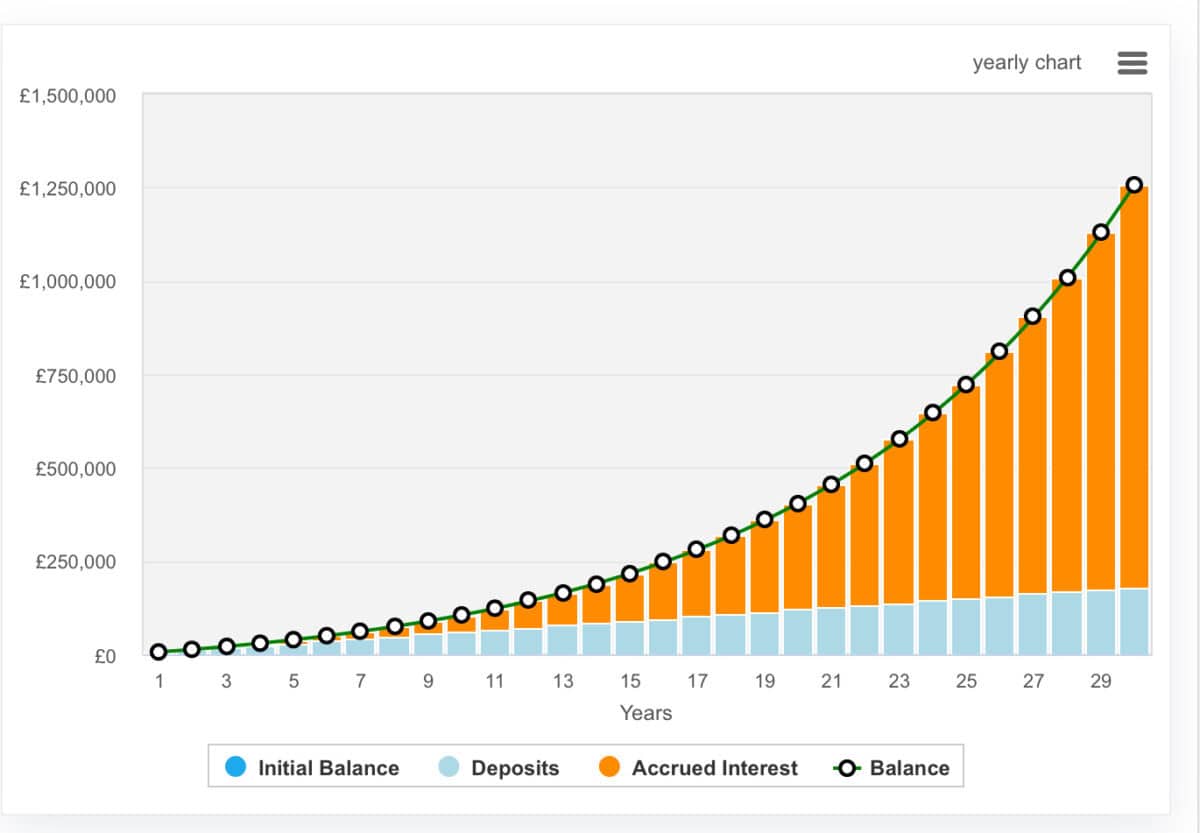
Thecalculatorsite.com

Why did I use the S&P 500 data? Well, because it quite conveniently works out to just over £1.2m over 30 years. Putting that money in stocks with an average dividend yield of 5% would generate £5,000 of monthly passive income — and tax-free. This is what I’m aiming to do, but by cherry-picking stocks, I’m hoping to grow my money faster.

Please note that tax treatment depends on the individual circumstances of each client and may be subject to change in future. The content in this article is provided for information purposes only. It is not intended to be, neither does it constitute, any form of tax advice. Readers are responsible for carrying out their own due diligence and for obtaining professional advice before making any investment decisions.

One to consider for the growth phase

While index trackers are a great way to start investing, investors may want to consider an exciting growth-oriented trust like Edinburgh Worldwide Investment Trust (LSE:EWI). It’s a Baillie Gifford-run fund — like the well-known Scottish Mortgage Investment Trust — and it’s a really interesting, albeit risky proposition. The fund aims to invest initially in entrepreneurial companies when they’re still nascent.

The trust’s largest investment is SpaceX, which represents a significant 12.3% of the portfolio. This is followed by PsiQuantum at 7.5% and Alnylam Pharmaceuticals. These are fairly high-risk investments, but given supportive trends in artificial intelligence (AI), space exploration, and even quantum computing, this could be the right time to take a diversified approach to emerging technologies.

However, some of its holdings aren’t publicly listed, and only listed companies are required to disclose earnings reports, which means crucial data on these private entities is scarce, heightening uncertainty for investors.


James Fox has positions in Edinburgh Worldwide Investment Trust and Scottish Mortgage Investment Trust Plc. The Motley Fool UK has no position in any of the shares mentioned. Views expressed on the companies mentioned in this article are those of the writer and therefore may differ from the official recommendations we make in our subscription services such as Share Advisor, Hidden Winners and Pro. Here at The Motley Fool we believe that considering a diverse range of insights makes us better investors.

More on Investing Articles

Little girl helping her Grandad plant tomatoes in a greenhouse in his garden.
Investing Articles

With single-digit P/E ratios, here are 3 of the FTSE 100’s cheapest-looking shares!

Only a few FTSE 100 shares are trading at single digit-multiples of earnings! And our Foolish author has highlighted what…

Read more »

Friends at the bay near the village of Diabaig on the side of Loch Torridon in Wester Ross, Scotland. They are taking a break from their bike ride to relax and chat. They are laughing together.
Investing Articles

How much do you need in an ISA to earn a £33,333 passive income?

Discover how to target a five-figure passive income in a Stocks and Shares ISA -- and a top 7.6%-yielding dividend…

Read more »

Tariffs and Global Economic Supply Chains
Investing Articles

Did Donald Trump just deliver fantastic news for Nvidia stock?

With artificial intelligence chip sales set to resume in China, is Nvidia stock worth looking at while it's trading under…

Read more »

A rear view of a female in a bright yellow coat walking along the historic street known as The Shambles in York, UK which is a popular tourist destination in this Yorkshire city.
Market Movers

£20,000 of British American Tobacco shares could generate dividends of…

British American Tobacco shares are tipped to deliver more huge dividends over the next three years. Does this make them…

Read more »

Tesla building with tesla logo and two teslas in front
Investing Articles

Tesla stock’s up 98% since April. Is that a warning?

Tesla stock's almost doubled in a matter of months -- but our writer struggles to rationalise that in terms of…

Read more »

One English pound placed on a graph to represent an economic down turn
Investing Articles

FTSE 100 shares are up 17% this year. Is it too late to invest?

The FTSE 100 index of leading British blue-chip shares is up by close to a fifth since the start of…

Read more »

Fans of Warren Buffett taking his photo
Investing Articles

What would $1,000 invested in Berkshire Hathaway shares when Warren Buffett took over be worth now?

Just how good has Warren Buffett been in driving up the value of Berkshire Hathaway shares in over six decades…

Read more »

A pastel colored growing graph with rising rocket.
Investing Articles

Investors can target £22,491 in passive income from £20,000 in this FTSE dividend gem

This ultra-high-yielding FTSE gem’s dividend is forecast to rise even higher in the coming years, driving high passive income flows…

Read more »