
Share your opinion and earn yourself a free Motley Fool premium report!

We are looking for Fools to join a 75 minute online independent market research forum on 15th / 16th December.

To find out more and express your interest please click here

If I’d invested £10,000 in an S&P 500 index tracker in 2009, this is how much I would have today!

As the S&P 500 continues to make new highs throughout 2024, Andrew Mackie assesses whether he should invest solely in an index tracker.

| More on:

The content of this article was relevant at the time of publishing. Circumstances change continuously and caution should therefore be exercised when relying upon any content contained within this article.

Businessman use electronic pen writing rising colorful graph from 2023 to 2024 year of business planning and stock investment growth concept.

Image source: Getty Images

You’re reading a free article with opinions that may differ from The Motley Fool’s Premium Investing Services. Become a Motley Fool member today to get instant access to our top analyst recommendations, in-depth research, investing resources, and more. Learn More.

Passive investing has become the vehicle of choice for most investors today. It’s easy to see why. At the depths of the global financial crisis in early 2009, the S&P 500 sat at 750 points. Since then, the index has gone on the biggest bull market in its history and now trades at over 6,000. A rise of over 700% means that a £10,000 investment made then would be worth £70,000 today.

Efficient market hypothesis

Passive investing can trace its roots back to the 1960s in an academic theory known as the efficient market hypothesis. The idea behind this theory is that are so many smart, active managers doing fundamental and valuation analysis that stocks always trade at their fair market value. This fact makes it difficult for active managers to consistently beat the market.

Initially confined to large pension funds, passive investing strategies began to go mainstream in the late 1990s. Today, index funds, and the more recent innovation of exchange-traded funds (ETFs), are marketed as a low-cost, diversified approach to investing.

S&P 500 bubble

Passive investing is a great strategy when a stock market is rising. But the inexorable rise of the US stock market over the past 15 years is, I believe, breeding complacency.

One area that has concerned me for some time is stock market concentration. If I invest in an S&P 500 tracker, I am supposedly buying into a broad basket of stocks across different sectors. But that isn’t the case anymore given that the top 10 holdings are predominantly in the technology space and account for 34% of the entire weighting.

Just because a passive investing strategy has worked so well in the past, doesn’t mean it will continue to do so. And one complete unknown today is that these types of investment vehicles have never been tested in a true bear market. After all, the 2020 decline lasted just a handful of weeks and the decline in 2022 lasted only 9 months.

I am still picking stocks

A small percentage of my Stocks and Shares ISA portfolio is allocated to an S&P 500 tracker. But for me now is not the time to be asleep, which is why I predominantly pick my own stocks.

One sector that I remain bullish on in the long term is energy. The following chart from Devon Energy, highlights how distorted the market has become. The combined weighting of the top three stocks, Apple, Nvidia, and Microsoft is five times the entire energy market. That to me screams opportunity.
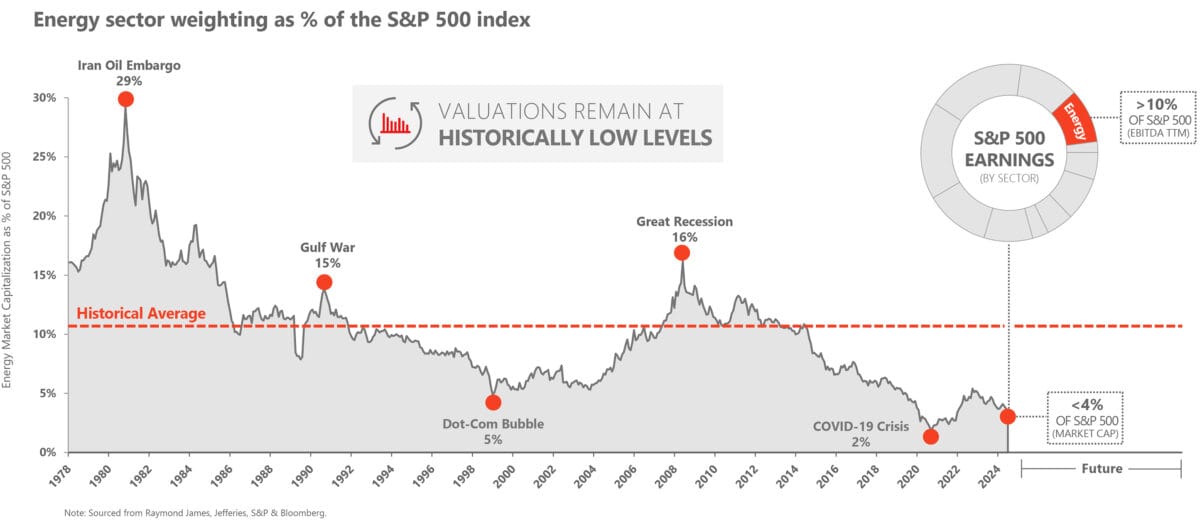
Source: Devon Energy

I am of the view that we are entering a phase where demand for energy is going to soar. Onshoring of manufacturing capability in the US continues at pace. The acceleration of the green revolution will, ironically, drive a surge in demand for energy, as the result of highly energy-intensive mining operations for metals.

But the biggest driver for energy will come from the tech companies themselves. Data centre growth to manage generative AI capabilities will see an explosion in energy demand like we have never witnessed before.

I particularly like BP and Shell because of their ultra-cheap valuations compared to their US peers. Neither is priced to reflect what I see as an oncoming tsunami in demand over the next decade and more.


Andrew Mackie has positions in Bp P.l.c. The Motley Fool UK has recommended Apple, Microsoft, and Nvidia. Views expressed on the companies mentioned in this article are those of the writer and therefore may differ from the official recommendations we make in our subscription services such as Share Advisor, Hidden Winners and Pro. Here at The Motley Fool we believe that considering a diverse range of insights makes us better investors.

More on Investing Articles

Investing Articles

Can the stock market continue its strong performance into 2026?

Will the stock market power ahead next year -- or could its recent strong run come crashing down? Christopher Ruane…

Read more »

Businessman hand stacking money coins with virtual percentage icons
Investing Articles

Here’s how someone could invest £20k in an ISA to target a 7% dividend yield in 2026

Is 7% a realistic target dividend yield for a Stocks and Shares ISA? Christopher Ruane reckons that it could be.…

Read more »

A quiet morning and an empty Victoria Street in Edinburgh's historic Old Town.
Investing Articles

How little is £1k invested in Greggs shares in January worth now?

Just how much value have Greggs shares lost this year -- and why has our writer been putting his money…

Read more »

Businessman using pen drawing line for increasing arrow from 2024 to 2025
Investing Articles

This cheap FTSE 100 stock outperformed Barclays, IAG, and Games Workshop shares in 2025 but no one’s talking about it

This FTSE stock has delivered fantastic gains in 2025, outperforming a lot of more popular shares. Yet going into 2026,…

Read more »

Close-up of British bank notes
Investing Articles

100 Lloyds shares cost £55 in January. Here’s what they’re worth now!

How well have Lloyds shares done in 2025? Very well is the answer, as our writer explains. But they still…

Read more »

Thoughtful man using his phone while riding on a train and looking through the window
Investing Articles

How much do you need in an ISA to target £2,000 a month of passive income

Our writer explores a passive income strategy that involves the most boring FTSE 100 share. But when it comes to…

Read more »

Investing Articles

£5,000 invested in a FTSE 250 index tracker at the start of 2025 is now worth…

Despite underperforming the FTSE 100, the FTSE 250 has been the place to find some of the UK’s top growth…

Read more »

Investing Articles

2 of the most compelling passive income strategies for 2026

Selling 'covered calls' could generate cash for investors in a stock market crash. But that’s not Stephen Wright’s top passive…

Read more »