
Share your opinion and earn yourself a free Motley Fool premium report!

We are looking for Fools to join a 75 minute online independent market research forum on 15th / 16th December.

To find out more and express your interest please click here

At 209%, the Warren Buffett Indicator says the stock market’s strongly overvalued. Is a crash coming?

An indicator named after world-famous investor Warren Buffett is rapidly increased this year. Here’s what it could mean for global markets.

| More on:

The content of this article was relevant at the time of publishing. Circumstances change continuously and caution should therefore be exercised when relying upon any content contained within this article.

One English pound placed on a graph to represent an economic down turn

Image source: Getty Images

You’re reading a free article with opinions that may differ from The Motley Fool’s Premium Investing Services. Become a Motley Fool member today to get instant access to our top analyst recommendations, in-depth research, investing resources, and more. Learn More.

Named after billionaire investor Warren Buffett, the ‘Buffett Indicator’ is a market valuation metric that divides the total market-cap of US stocks by the country’s GDP. Often viewed as one of the best single market valuation indicators, the metric traditionally flashes warning signs when it surpasses 100%.

Recently, it’s climbed to a staggering 209%. This figure is well above the historical average, indicating that stocks are highly overvalued relative to the economy. 
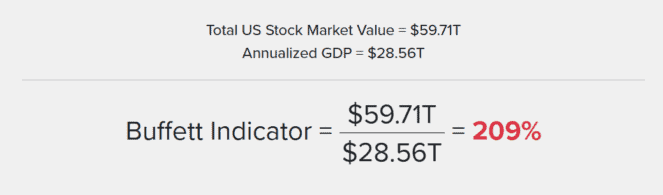
Screenshot from CurrentMarketValuation.com

The current level has spurred speculation that the stock market is entering bubble territory. When valuations are this high, it often signals future downturns as the gap between stock prices and economic fundamentals grows. 

The last time the Buffett Indicator reached such highs was in the lead up to the dot-com crash in 2000 and, more recently, before the pandemic-driven downturn in 2020.

Adding to this, Buffett’s Berkshire Hathaway fund has recently sold large portions of its portfolio. The company reportedly holds $325bn in cash — an unusually high amount even by its standards. This move suggests it may be preparing for a potential correction, as Buffett has famously advised against overvalued markets. 

The decision to sell rather than buy reflects his cautious approach, particularly given ongoing concerns about high interest rates and uncertain economic growth.

What to do in a market downturn

For individual investors, the temptation might be to follow Buffett’s lead by trimming overvalued stocks or reallocating to less risky assets. While a market crash is never certain, high valuations are a good time to evaluate a portfolio. 

Holding some cash or diversifying into defensive sectors could provide stability if a downturn hits in 2025. Paying attention to valuation signals and preparing for increased volatility is a prudent approach amid current market dynamics.

For UK investors, several defensive FTSE stocks have historically shown resilience during economic downturns. One of my favourites is data analytics firm RELX (LSE: REL).

As a global provider of information-based analytics, it has a strong foothold in legal, scientific and risk markets. It has a diversified revenue stream and a recurring subscription-based model, so it’s often seen as a stable, cash-generative company.

Over the past 30 years the share price has increased at an average rate of 7.36% a year.

Pros and cons

It may be defensive, but RELX still faces risks tied to economic cycles and regulatory changes. A slowdown in legal or financial services could impact its business segments. 

A recent focus on artificial intelligence (AI) and analytics has strengthened its competitive edge, enhancing its digital offer and data services. But competition is also intensifying as digital and AI-driven analytics become standard in the industry.

Recent stock performance has been positive but macroeconomic challenges, like inflation and interest rate hikes, could weigh on future growth.

Strong growth means it now has a relatively high valuation with a price-to-earnings (P/E) ratio of 36. This makes it susceptible to a pullback if growth slows. Still, its profit margin is good at around 20% and it has a high return on equity (ROE) of 56%, indicating efficient capital usage. 

Although it has a low yield of only 1.64%, dividends are reliable and reveal a commitment to shareholder returns. In volatile times, I think it is worth considering as a stock that could add stability to a portfolio.


Mark Hartley has positions in RELX. The Motley Fool UK has recommended RELX. Views expressed on the companies mentioned in this article are those of the writer and therefore may differ from the official recommendations we make in our subscription services such as Share Advisor, Hidden Winners and Pro. Here at The Motley Fool we believe that considering a diverse range of insights makes us better investors.

More on Investing Articles

Business man pointing at 'Sell' sign
Investing Articles

Is FTSE stock Trustpilot worth a look after a sharp 23% fall?

FTSE stock Trustpilot has tanked on the back of a short seller report. Is there an opportunity here? Edward Sheldon…

Read more »

Workers at Whiting refinery, US
Investing Articles

How many BP shares do I need for a £1,000-a-month passive income?

BP shares are now paying one of the highest FTSE 100 dividend yields. Are they they perfect ticket to a…

Read more »

Rolls-Royce's Pearl 10X engine series
Investing Articles

Can the Rolls-Royce share price do it again in 2026?

Can the Rolls-Royce share price do it again? The FTSE 100 company has been a star performer in recent years…

Read more »

Businessman hand flipping wooden block cube from 2024 to 2025 on coins
Investing Articles

After huge gains for S&P 500 tech stocks in 2025, here are 4 moves I’m making to protect my ISA and SIPP

Gains from S&P tech stocks have boosted Edward Sheldon’s retirement accounts this year. Here’s what he’s doing now to reduce…

Read more »

View of Lake District. English countryside with fields in the foreground and a lake and hills behind.
Investing Articles

With a 3.2% yield, has the FTSE 100 become a wasteland for passive income investors?

With dividend yields where they are at the moment, should passive income investors take a look at the bond market…

Read more »

Smart young brown businesswoman working from home on a laptop
Investing Articles

Should I add this dynamic FTSE 250 newcomer to my Stocks and Shares ISA?

At first sight, a UK bank that’s joining the FTSE 250 isn’t anything to get excited by. But beneath the…

Read more »

Investing Articles

£10,000 invested in BT shares 3 months ago is now worth

BT shares have been volatile lately and Harvey Jones is wondering whether now is a good time to buy the…

Read more »

Person holding magnifying glass over important document, reading the small print
Investing Articles

After a 66% fall, this under-the-radar growth stock looks like brilliant value to me

Undervalued growth stocks can be outstanding investments. And Stephen Wright thinks he has one in a company analysts seem to…

Read more »