
Share your opinion and earn yourself a free Motley Fool premium report!

We are looking for Fools to join a 75 minute online independent market research forum on 15th / 16th December.

To find out more and express your interest please click here

What on earth’s going on with the IAG share price?

The IAG share price has fallen 10% over the past week, so what exactly is happening? Dr James Fox spies an opportunity for investors.

| More on:

The content of this article was relevant at the time of publishing. Circumstances change continuously and caution should therefore be exercised when relying upon any content contained within this article.

Front view of aircraft in flight.

Image source: Getty Images

You’re reading a free article with opinions that may differ from The Motley Fool’s Premium Investing Services. Become a Motley Fool member today to get instant access to our top analyst recommendations, in-depth research, investing resources, and more. Learn More.

The IAG (LSE:IAG) share price has slumped 10% over the past five days, marking an end to the broad upward trajectory of the last six months. So what’s going on?

Airlines are sensitive

Airlines are particularly sensitive stocks when it comes to geopolitical events, wars, and oil price fluctuations. As we’ve seen with recent and ongoing conflicts, tensions and wars often lead to airspace closures, route disruptions, and decreased travel demand, directly affecting airline revenues.

Western airlines are still having to avoid Russian airspace, while Iran’s ballistic missile barrage on Israel caused more temporary disruptions. I was one of those sad people watching flightradar24 as airlines diverted and Iranian assets flew out of harm’s way on Tuesday (2 October) evening.

Meanwhile, apart from the dreadful human cost, wars tend to have a profound impact on oil prices, in turn, severely impacting airlines’ bottom lines. Fuel accounted for around 25% of IAG’s expenditure last year.

So what happen here?

Iran’s ballistic missile attack on Israel is bad for many reasons — most of them have nothing to do with investing. For one, this represented an arguably expected but tragic escalation of the ongoing conflict between Israel and Iran’s proxies.

But this is also a concern because Iran remains a notable oil producer — representing around 3% of global output — and exporter with over 1.7 million barrels a day leaving the country — much of it heading to Chinese refiners that don’t recognise US sanctions.

We can speculate as to how Israel might retaliate. However, US President Joe Biden said publicly on 3 October that Israeli strikes on Iranian oil facilities were being considered.

The result is oil spiked. At the time of writing, Brent Crude — a benchmark for oil — is up 8.9% over the week at $78 a barrel. Some analysts have even begun forecasting $100 a barrel by the end of the year.

Fuel hedging

It goes without saying that as oil becomes more expensive, so does jet fuel. And that would impact the bottom line of airlines like IAG.

However, European airlines practice hedging. This involves fixing a fuel price for a set period, which can help companies improve cost management.

IAG, the owner of British Airways and Iberia, has a strong hedging position, with just 24% of Q3 fuel — the current quarter — purchased at live or near-live prices.
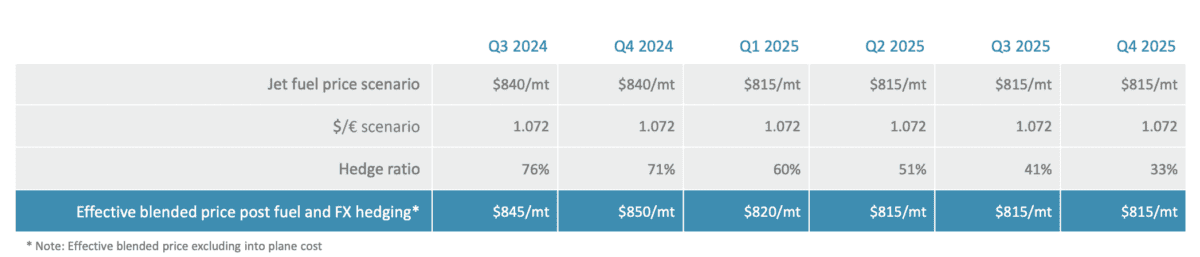
Source: IAG H1 Results

As we can see from the above, IAG’s hedged around 74% of fuel costs through to the end of the year. This should put it in a strong position to manage costs even if oil spikes.

However, looking further into 2025, the company’s more exposed to market prices. This means that while IAG has secured a level of price stability for its fuel costs in the immediate future, it faces greater uncertainty and potential risk from oil price fluctuations as we move into 2025.

My take

Investors are always looking for good entry points as stocks fall. And it’s possible the market’s overreacted to the escalation possibility, something we all fervently hope doesn’t happen.

There’s a lot to unpack here, including OPEC’s spare capacity, slowing oil demand, Iran’s ability to block key oil supply routes, and IAG’s valuation.

This could be an opportunity for investors, but there are risks attached.

James Fox has positions in International Consolidated Airlines Group. The Motley Fool UK has no position in any of the shares mentioned. Views expressed on the companies mentioned in this article are those of the writer and therefore may differ from the official recommendations we make in our subscription services such as Share Advisor, Hidden Winners and Pro. Here at The Motley Fool we believe that considering a diverse range of insights makes us better investors.

More on Investing Articles

Investing Articles

Can the stock market continue its strong performance into 2026?

Will the stock market power ahead next year -- or could its recent strong run come crashing down? Christopher Ruane…

Read more »

Businessman hand stacking money coins with virtual percentage icons
Investing Articles

Here’s how someone could invest £20k in an ISA to target a 7% dividend yield in 2026

Is 7% a realistic target dividend yield for a Stocks and Shares ISA? Christopher Ruane reckons that it could be.…

Read more »

A quiet morning and an empty Victoria Street in Edinburgh's historic Old Town.
Investing Articles

How little is £1k invested in Greggs shares in January worth now?

Just how much value have Greggs shares lost this year -- and why has our writer been putting his money…

Read more »

Businessman using pen drawing line for increasing arrow from 2024 to 2025
Investing Articles

This cheap FTSE 100 stock outperformed Barclays, IAG, and Games Workshop shares in 2025 but no one’s talking about it

This FTSE stock has delivered fantastic gains in 2025, outperforming a lot of more popular shares. Yet going into 2026,…

Read more »

Close-up of British bank notes
Investing Articles

100 Lloyds shares cost £55 in January. Here’s what they’re worth now!

How well have Lloyds shares done in 2025? Very well is the answer, as our writer explains. But they still…

Read more »

Thoughtful man using his phone while riding on a train and looking through the window
Investing Articles

How much do you need in an ISA to target £2,000 a month of passive income

Our writer explores a passive income strategy that involves the most boring FTSE 100 share. But when it comes to…

Read more »

Investing Articles

£5,000 invested in a FTSE 250 index tracker at the start of 2025 is now worth…

Despite underperforming the FTSE 100, the FTSE 250 has been the place to find some of the UK’s top growth…

Read more »

Investing Articles

2 of the most compelling passive income strategies for 2026

Selling 'covered calls' could generate cash for investors in a stock market crash. But that’s not Stephen Wright’s top passive…

Read more »