
Does owning National Grid shares for the dividend make sense for a risk-averse investor?

National Grid shares can seem attractive thanks to a positive yield and the economics of a monopoly power network. But this writer explains why he’s steering clear.

| More on:

The content of this article was relevant at the time of publishing. Circumstances change continuously and caution should therefore be exercised when relying upon any content contained within this article.

Two business people sitting at cafe working on new project using laptop. Young businesswoman taking notes and businessman working on laptop computer.

Image source: Getty Images

You’re reading a free article with opinions that may differ from The Motley Fool’s Premium Investing Services. Become a Motley Fool member today to get instant access to our top analyst recommendations, in-depth research, investing resources, and more. Learn More.

Different investors each have their own objectives and risk tolerance. Many, especially as they get older, like shares that are set to generate stable earnings over the long run and offer a beefy dividend. National Grid (LSE: NG) at first seems to fit that bill well. After all, a nationwide power grid is hard to replicate and benefits from long-term customer demand. National Grid shares yield 5.5% and have a solid history of growing the annual payout. Last year, the dividend per share grew 6%.
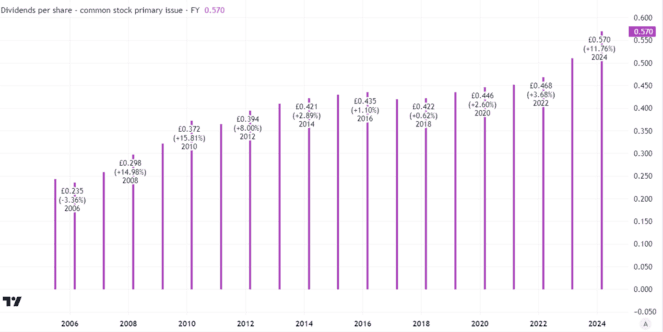
Created using TradingView

I understand the appeal of that dividend. National Grid aims to grow its dividend each year in line with a measure of inflation and has successfully achieved that over the past few years. That appeals to many investors – including me – as it helps to protect the real value of the payout.

The basis of success – and a challenge

However, maintaining dividend growth here is not as easy as it may first seem. National Grid’s strength is also a source of financial weakness, in my view.

If customer demand was not as strong and resilient as it is, it could become a cash cow, investing the bare minimum on infrastructure and increasing prices, generating large cash flows to fund the dividend.

But prices are regulated. Demand for power is set to remain high for the indefinite future, meaning National Grid needs to keep spending money just to keep the lights on (so people can keep their own lights on). Not only that, recent years have seen big shifts in where some power is generated and also where it is needed.

The upshot is that the company, like similar firms in other markets, is having to spend heavily to keep its network updated to meet current and likely needs. That has led to a long-term increase in borrowing, as this chart of National Grid’s net debt illustrates.
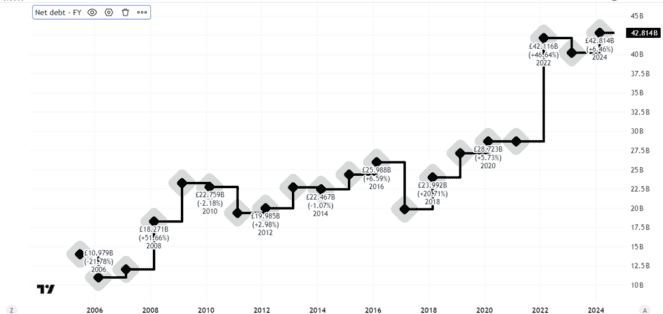
Created using TradingView

Where things might go from here

That threatens the ability of this dividend share to maintain let alone grow its dividend, in my view. The company raised around £7bn in a rights issue earlier this year, helping to bolster the balance sheet, which I see as positive for the dividend outlook.

But it came at the cost of diluting existing shareholders. I see a risk of more of the same in future if National Grid’s capex costs remain stubbornly high.

Given that, I think the risk profile of National Grid shares is higher than suits me.

I also have doubts about how long the firm’s chunky dividend can be sustained in the absence of more fundraising or changes to the business model. For now, as a risk-averse investor, I have no plans to buy.


C Ruane has no position in any of the shares mentioned. The Motley Fool UK has no position in any of the shares mentioned. Views expressed on the companies mentioned in this article are those of the writer and therefore may differ from the official recommendations we make in our subscription services such as Share Advisor, Hidden Winners and Pro. Here at The Motley Fool we believe that considering a diverse range of insights makes us better investors.

More on Investing Articles

Illustration of flames over a black background
Investing Articles

Recently released: December’s higher-risk, high-reward stock recommendation [PREMIUM PICKS]

Fire ideas will tend to be more adventurous and are designed for investors who can stomach a bit more volatility.

Read more »

Abstract 3d arrows with rocket
Growth Shares

Will the SpaceX IPO send this FTSE 100 stock into orbit?

How can British investors get exposure to SpaceX? Here is one FTSE 100 stock that might be perfect for those…

Read more »

Array of piggy banks in saturated colours on high colour contrast background
Investing Articles

Could drip-feeding £500 into the FTSE 250 help you retire comfortably?

Returns from FTSE 250 shares have rocketed to 10.6% over the last year. Is now the time to plough money…

Read more »

Passive and Active: text from letters of the wooden alphabet on a green chalk board
Investing Articles

How much does one need in an ISA for £2,056 monthly passive income?

The passive income potential of the Stocks and Shares ISA is higher than perhaps all other investments. Here's how the…

Read more »

Finger clicking a button marked 'Buy' on a keyboard
Investing Articles

The best time to buy stocks is when they’re cheap. Here’s 1 from my list

Buying discounted stocks can be a great way to build wealth and earn passive income. But investors need to be…

Read more »

Bus waiting in front of the London Stock Exchange on a sunny day.
Investing Articles

Martin Lewis just explained the stock market’s golden rule

Unlike cash, the stock market can quietly turn lump sums into serious wealth. So, what’s the secret sauce that makes…

Read more »

Close-up of British bank notes
Investing Articles

£5,000 invested in Greggs shares at the start of 2025 is now worth…

This year's been extremely grim for FTSE 250-listed Greggs -- but having slumped more than 40%, could its shares be…

Read more »

Investing Articles

Looking for shares to buy as precious metals surge? 3 things to remember!

Gold prices have been on a tear. So has silver. So why isn't this writer hunting for shares to buy…

Read more »