
How I’d invest £99 a week and aim to earn £90,000 of passive income every year

With as little as £99 a month, investors could generate a five-figure passive income. Dr James Fox explains the secret of potential success.

| More on:

The content of this article was relevant at the time of publishing. Circumstances change continuously and caution should therefore be exercised when relying upon any content contained within this article.

Two female adult friends walking through the city streets at Christmas. They are talking and smiling as they do some Christmas shopping.

Image source: Getty Images

You’re reading a free article with opinions that may differ from The Motley Fool’s Premium Investing Services. Become a Motley Fool member today to get instant access to our top analyst recommendations, in-depth research, investing resources, and more. Learn More.

Millions of Britons make plans for passive income. Buy-to-let’s undoubtedly popular — in 2023, 4.6m buy-to-let properties were being rented in the UK.

However, it’s not my preferred method of generating extra income. Mine’s investing in stocks and funds, allowing my annual returns to compound until my portfolio reaches a point at which it can generate a significant passive income.

Of course, there’s a caveat here. A varied portfolio doesn’t just mean different stocks, funds, and bonds, in my opinion. For me, a larger portfolios should include various asset classes. This may include a buy-to-let property. Alternative asset classes can include land, cars, and watches.

Let that £99 compound

For those of us new to investing, the way to start is by opening an account with a major brokerage platform like Hargreaves Lansdown, AJ Bell, or Interactive Investor. This allows me to invest my money into companies, funds, and even buy government debt. If I’m investing within a Stocks and Shares ISA, my returns are protected from tax.

Please note that tax treatment depends on the individual circumstances of each client and may be subject to change in future. The content in this article is provided for information purposes only. It is not intended to be, neither does it constitute, any form of tax advice. Readers are responsible for carrying out their own due diligence and for obtaining professional advice before making any investment decisions.

So how does £99 a month compound? Well, to start with I’d need to be making sensible investments that actually perform well. Many novice investors lose money because their investments aren’t built on sound analysis. As such, a sensible place to start could be index-tracking funds.

These are funds that track the performance of major indexes like the FTSE 100 or the S&P 500. Over the last 10 years, the S&P 500 has delivered average annual returns of 12.9%, including dividends, as of August.

While 12.9% would be a very strong return over the long run, the below chart shows how £99 a week could compound if it did achieve these very strong returns.
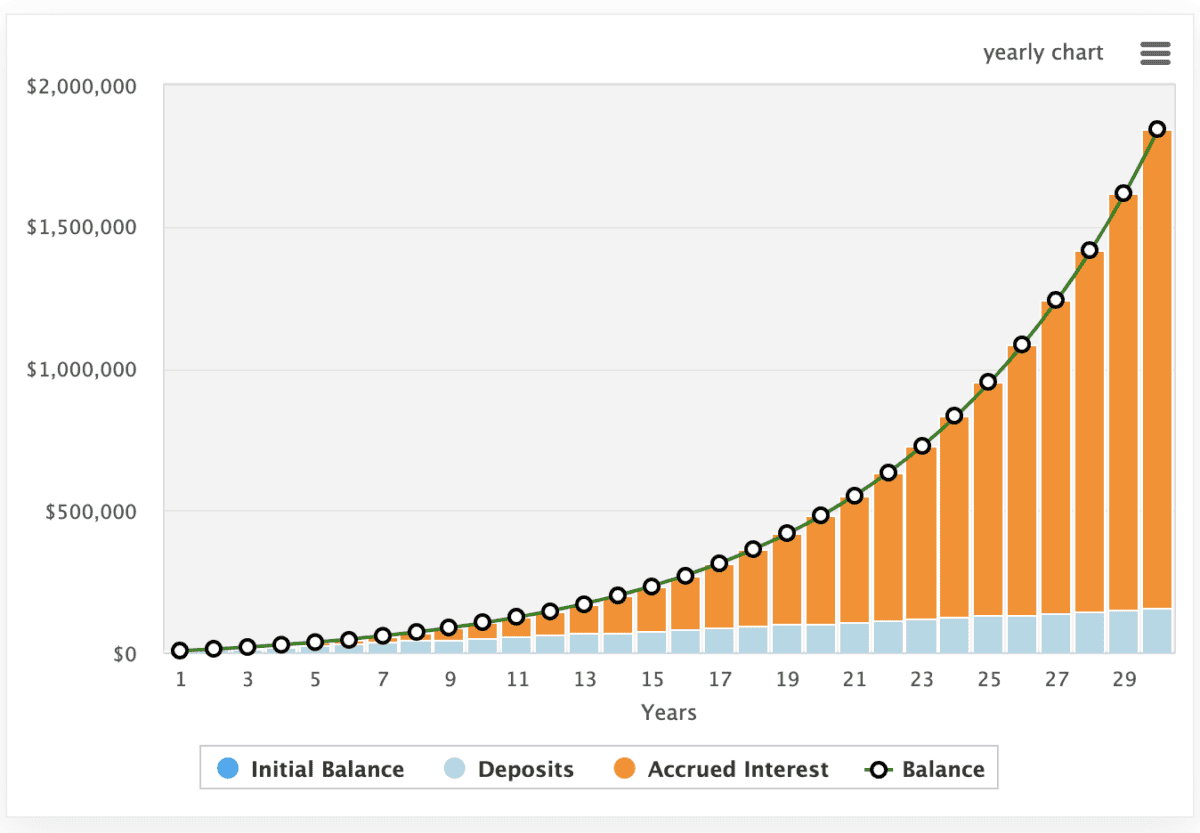
Created at the calculatorsite.com

After 30 years of investing £99 a week, my portfolio would be worth more than £1.8m, enough to generate at least £90,000 annually in passive income through dividend payments.

Where to put my money?

The Vanguard S&P 500 UCITS ETF GBP (LSE:VUSA) is one of the most popular exchange-traded funds (ETFs) for UK-based investors and is worth considering.

This ETF tracks the performance of the S&P 500 index, which comprises 500 of the largest US companies by market capitalisation

It employs a passive management approach, aiming to replicate the index by investing in all or substantially all of the stocks that make up the S&P 500, holding each stock in approximately the same proportion as its weighting in the index.

While this is broadly seen a relatively low-risk investment, the S&P 500 fluctuates with the US and global economy. A severe downturn in US economic fortunes would likely result in the value of the investment falling.

However, over the long run, the US economy and US-listed stocks have performed remarkably well. Investors bet against the US at their own peril.


James Fox has no positions in any of the shares mentioned. The Motley Fool UK has recommended Aj Bell Plc and Hargreaves Lansdown Plc. Views expressed on the companies mentioned in this article are those of the writer and therefore may differ from the official recommendations we make in our subscription services such as Share Advisor, Hidden Winners and Pro. Here at The Motley Fool we believe that considering a diverse range of insights makes us better investors.

More on Investing Articles

Investing Articles

Down 34% in 2025 — but could this be one of the UK’s top growth stocks for 2026?

With clarity over research funding on the horizon, could Judges Scientific be one of the UK’s best growth stocks to…

Read more »

piggy bank, searching with binoculars
Investing Articles

Can the rampant Barclays share price beat Lloyds in 2026?

Harvey Jones says the Barclays share price was neck and neck with Lloyds over the last year, and checks out…

Read more »

Investing Articles

Here’s how Rolls-Royce shares could hit £25 in 2026

If Rolls-Royce shares continue their recent performance, then £25 might be on the cards for 2026. Let's take a look…

Read more »

Departure & Arrival sign, representing selling and buying in a portfolio
Investing Articles

Prediction: in 2026 the red-hot Rolls-Royce share price could turn £10,000 into…

Harvey Jones can't believe how rapidlly the Rolls-Royce share price has climbed. Now he looks at the FTSE 100 growth…

Read more »

Businessman hand stacking up arrow on wooden block cubes
Investing Articles

Prediction: Tesco shares could soon climb another 17%

After a strong run for Tesco shares, analysts are optimistic for the start of 2026. Well, most of them are,…

Read more »

UK coloured flags waving above large crowd on a stadium sport match.
Investing Articles

Prediction: the Vodafone share price could soar 40% in 2026

Despite a great 2025, the Vodafone share price is still down 20% over five years. The latest predictions suggest more…

Read more »

Santa Clara offices of NVIDIA
Investing Articles

By January 2027, £1,000 invested in Nvidia shares could turn into…

What could £1,000 in Nvidia shares do by 2027? Our Foolish author explores three potential scenarios for the artificial intelligence…

Read more »

Investing Articles

How to target a stunning £1,000 weekly passive income for retirement, starting in 2026

It's a brand new year and Harvey Jones says this is the ideal time to accelerate plans to build a…

Read more »