
After avoiding a FTSE 100 exit, here’s what the charts say for the easyJet share price

Charlie Carman investigates where the easyJet share price could head next after the short-haul carrier escaped a demotion to the FTSE 250.

| More on:

The content of this article was relevant at the time of publishing. Circumstances change continuously and caution should therefore be exercised when relying upon any content contained within this article.

High flying easyJet women bring daughters to work to inspire next generation of women in STEM

Image source: easyJet plc

You’re reading a free article with opinions that may differ from The Motley Fool’s Premium Investing Services. Become a Motley Fool member today to get instant access to our top analyst recommendations, in-depth research, investing resources, and more. Learn More.

A boost in the easyJet (LSE:EZJ) share price over the past month has allowed the low-cost airline to cling on to its place in the FTSE 100 index. The company had been tipped for potential relegation from the UK’s leading benchmark in this week’s quarterly reshuffle.

As a shareholder, I’m pleased by this news. However, I’m also acutely conscious that easyJet shares are still down 62% from their pre-pandemic high.

Here’s what the charts say about the outlook for the Luton-headquartered business.

Valuation

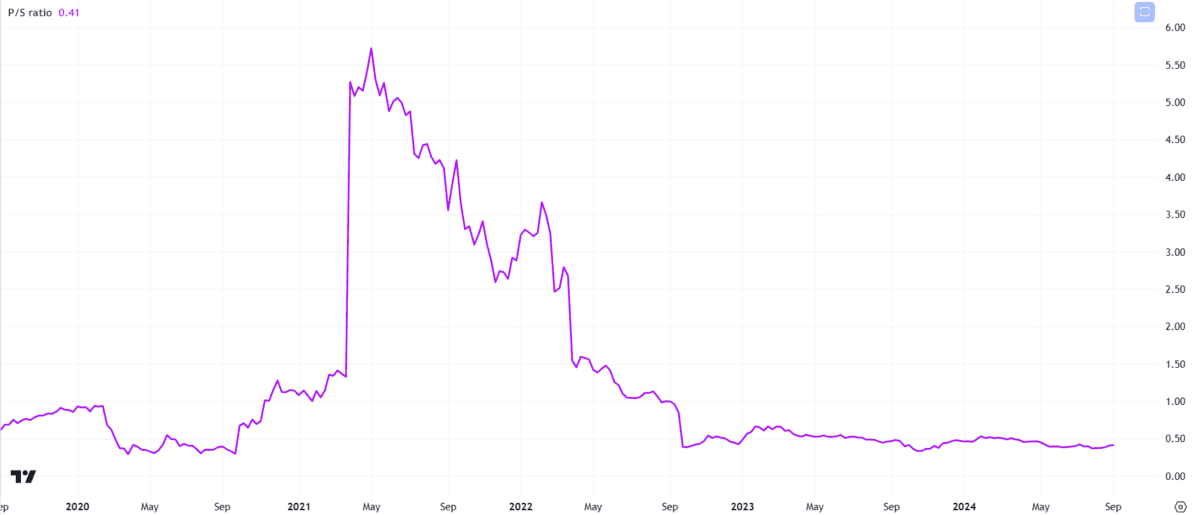
Using the price-to-sales (P/S) ratio as a valuation metric, easyJet shares have traded firmly back in cheaper territory for the past couple of years. Back in 2021, the stock looked pretty expensive as sales were decimated amid pandemic travel restrictions.

Currently, the stock has a P/S ratio of 0.41, which suggests it’s a potential bargain at today’s price of £4.82. Generally, any ratio below one is seen as a very attractive number.
Source: TradingView

However, it’s worth treating this figure with a degree of caution. Multiple airline stocks have had their valuations depressed for a while now as the market digests their future in a post-Covid world.

For instance, FTSE 250 competitor Wizz Air looks a bit cheaper on this metric with a P/S ratio of just 0.36 and easyJet’s FTSE 100 bedfellow IAG also has a lower 0.39 multiple. Accordingly, the stock’s valuation isn’t especially cheap when compared to the wider industry.

Debt

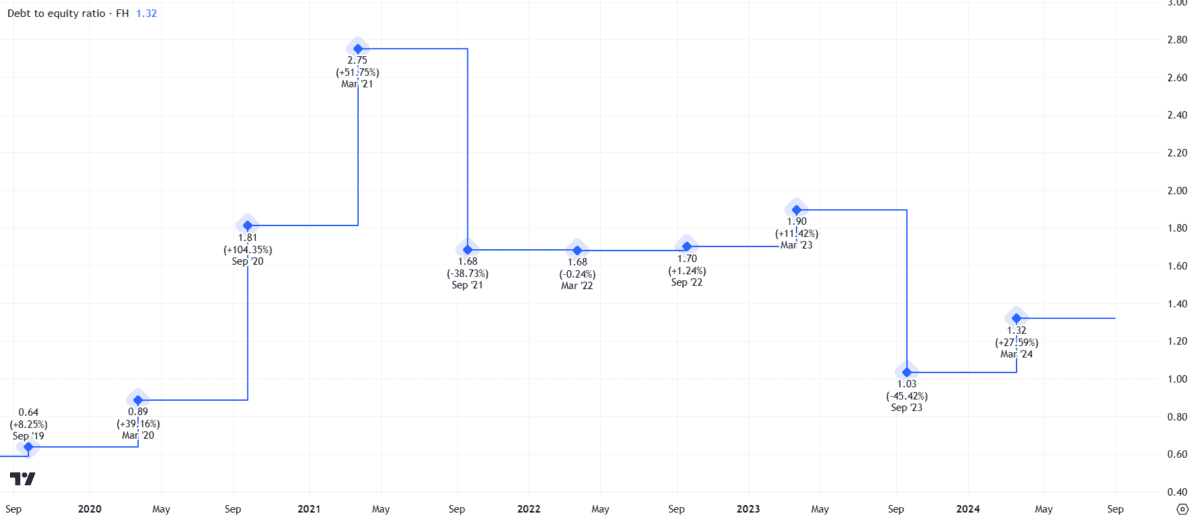
Overall, easyJet’s balance sheet appears to be in good shape. In the first half, the company moved into a net cash position of £146m, having ended FY23 with £485m in net debt on the books.
Source: TradingView

The debt-to-equity ratio of 1.32 suggests the business shouldn’t have too much difficulty in paying off its creditors. Considering the airline had to increase its liabilities considerably to stay afloat during the pandemic, I’m encouraged by the firm’s progress.

Dividends

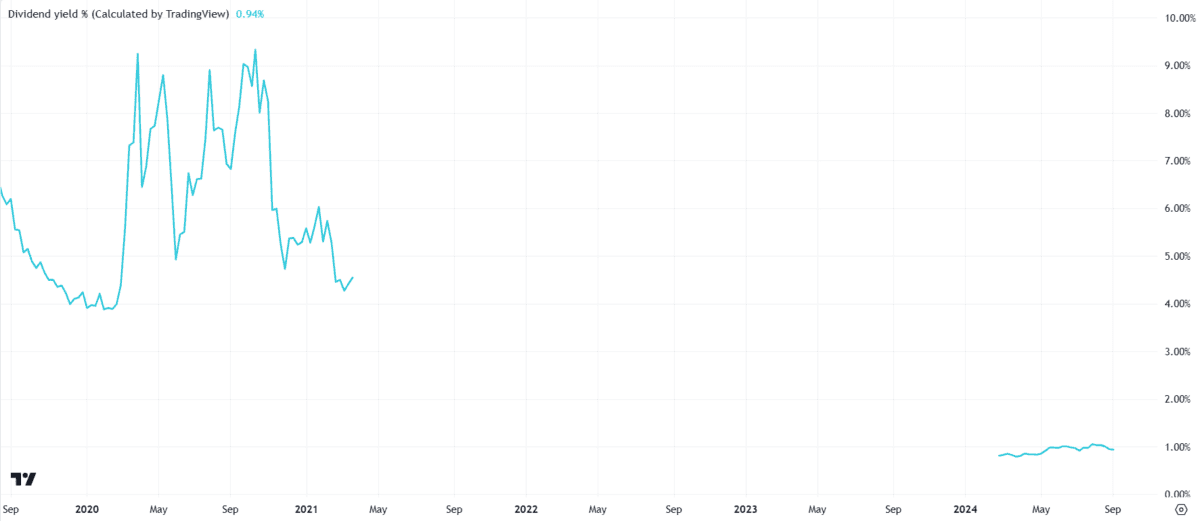
On the passive income front, it’s nice to see easyJet has resumed dividend payments. However, a yield below 1% means the stock is a shadow of its former self.

At some points in the past five years, easyJet shares were yielding above 9%. Unfortunately, I don’t see those glory days returning any time soon.
Source: TradingView

Nonetheless, Wizz Air doesn’t reward shareholders with dividends currently and IAG’s yield of 1.3% is only marginally better than easyJet’s.

Can the share price fly higher?

Overall, I’m optimistic about the prospects for further growth in the easyJet share price.

Granted, the stock faces risks. Margins are tight and expansion is difficult in a notoriously competitive industry. There’s also a risk of environmental taxes being levied on the company amid growing concern around climate change.

On the flip side, retaining a coveted FTSE 100 spot helps to maintain investor confidence. The airline’s post-Covid recovery remains intact and it has taken prudent steps to repair its balance sheet in recent years.

In addition, the package holidays division — launched in 2019 — has proved to be a huge success. It adds diversification to the business model and the board projects this arm will deliver £180m in pre-tax profit this year, which would represent an impressive 48% uplift.

I’ll continue to hold my easyJet shares for the long term.

Charlie Carman has positions in easyJet plc. The Motley Fool UK has no position in any of the shares mentioned. Views expressed on the companies mentioned in this article are those of the writer and therefore may differ from the official recommendations we make in our subscription services such as Share Advisor, Hidden Winners and Pro. Here at The Motley Fool we believe that considering a diverse range of insights makes us better investors.

More on Investing Articles

Older couple walking in park
Investing Articles

How much do I need in my ISA for a £1,000 monthly passive income?

Picking high-income stocks in an ISA can be a route to securing long-term passive income. And here's one with a…

Read more »

Smiling white woman holding iPhone with Airpods in ear
Investing Articles

Prediction: in 12 months the surging Aviva share price and dividend could turn £10,000 into…

Aviva's share price has beaten the broader FTSE 100 over the last year. But can the financial services giant keep…

Read more »

Portrait of elderly man wearing white denim shirt and glasses looking up with hand on chin. Thoughtful senior entrepreneur, studio shot against grey background.
Dividend Shares

I love FTSE 100 dividend shares, but do I buy this FTSE 250 loser?

Over the past year, the UK's FTSE 100 has thrashed the once-mighty US S&P 500 index. With value investing back…

Read more »

Investing Articles

How much do you need in an ISA to target a £2,000 monthly second income?

Harvey Jones crunches the numbers to see how much investors need in a Stocks and Shares ISA to generate a…

Read more »

Passive income text with pin graph chart on business table
Investing Articles

Should investors consider Legal & General shares for passive income?

As many investors are chasing their passive income dreams, our writer Ken Hall evaluates whether Legal & General could help…

Read more »

ISA coins
Investing Articles

How to transform an empty Stocks and Shares ISA into a £15,000 second income

Ben McPoland explains how a UK dividend portfolio can be built from the ground up inside a Stocks and Shares…

Read more »

Investing Articles

I asked ChatGPT if it’s better buy high-yielding UK stocks in an ISA or SIPP and it said…

Harvey Jones loves his SIPP, but he thinks a Stocks and Shares ISA is a pretty good way to invest…

Read more »

DIVIDEND YIELD text written on a notebook with chart
Investing Articles

How much do you need to invest in dividend shares to earn £1,500 a year in passive income?

As the stock market tries to get to grips with AI, could dividend shares offer investors a chance to earn…

Read more »