
How investing in a SIPP can build generational wealth

SIPPs are tax-efficient investment vehicles. So putting money into them can be a brilliant way to build wealth for future generations.

| More on:

The content of this article was relevant at the time of publishing. Circumstances change continuously and caution should therefore be exercised when relying upon any content contained within this article.

Black father holding daughter in a field of cows

Image source: Getty Images

You’re reading a free article with opinions that may differ from The Motley Fool’s Premium Investing Services. Become a Motley Fool member today to get instant access to our top analyst recommendations, in-depth research, investing resources, and more. Learn More.

Building generational wealth is a common financial goal today. This kind of wealth can provide long-term financial security for your loved ones, and set your family up for success for generations to come. If you’re interested in building wealth for future generations, you may want to consider investing within a SIPP (Self-invested Personal Pension). Here’s why.

A tax-efficient investment vehicle

From a wealth-building perspective, it’s hard to beat the SIPP as an investment vehicle, in my view.

For a start, contributions come with tax relief. Contribute £800 as a basic-rate taxpayer, and the government will add in another £200 for you, taking your total contribution to £1,000. That’s a risk-free 25% return (higher-rate and additional-rate taxpayers can claim even more tax relief).

Next, your money can grow free of Capital Gains Tax (CGT). This is a valuable perk, especially now that the annual CGT allowance is just £3,000.

Additionally, money in a SIPP can be passed onto future generations free of Inheritance Tax (IHT). That’s a huge plus for those looking to build generational wealth.

Please note that tax treatment depends on the individual circumstances of each client and may be subject to change in future. The content in this article is provided for information purposes only. It is not intended to be, neither does it constitute, any form of tax advice. Readers are responsible for carrying out their own due diligence and for obtaining professional advice before making any investment decisions.

Finally, SIPPs generally give investors access to a wide range of investments. That means it’s possible to generate high returns over the long term and compound gains.

Investing within a SIPP

One example of an investment that can be purchased within a SIPP is the L&G Global Equity UCITS ETF (LSE: LGGL).
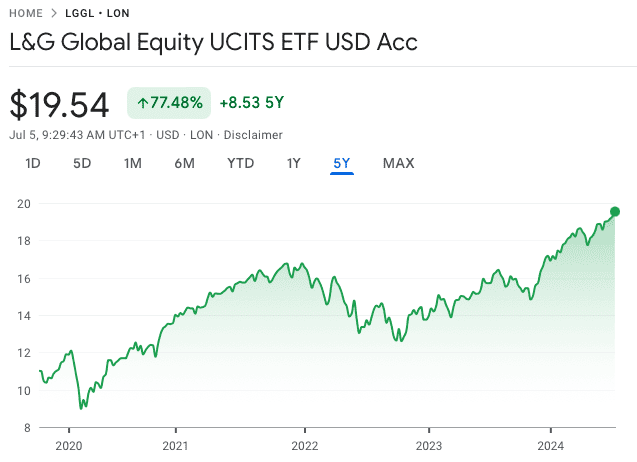
Source: Google Finance

This is an exchange-traded fund (ETF) from Legal & General that provides broad exposure to developed countries’ stock markets (over 1,400 stocks in total).

The beauty of this ETF is that it allows access to a range of top companies. Currently, its largest holdings include Apple, Microsoft, Nvidia, and Amazon.

Another big attraction is its low fee. The ongoing charge here is just 0.1%, which is very low.

Over the last five years, this ETF has returned a little over 12% a year. That’s an excellent return. Investing £100k in the product five years ago would now be worth over £175k.

Past performance is not an indicator of future performance though. If global stock markets (or the tech sector) were to experience a period of weakness, returns could be significantly lower.

Money for future generations

Let’s say an investor was able to generate a return of 9% a year on their capital over the long term. And they invested £8k a year into their SIPP (£10k after tax relief as a basic-rate taxpayer) for 35 years (ie between the ages 30-65). I calculate that in this scenario, a potential of around £2.2m could be built over the 35-year period within their SIPP. That’s a lot of money.

Now, that figure doesn’t factor in inflation. In other words, it’s not in today’s money.

However, realistically, it should be more than enough for retirement, meaning that there should be plenty of money left over for future generations to enjoy.


Ed Sheldon has positions in Amazon, Apple, Microsoft, and Nvidia. The Motley Fool UK has recommended Amazon, Apple, Microsoft, and Nvidia. John Mackey, former CEO of Whole Foods Market, an Amazon subsidiary, is a member of The Motley Fool’s board of directors. Views expressed on the companies mentioned in this article are those of the writer and therefore may differ from the official recommendations we make in our subscription services such as Share Advisor, Hidden Winners and Pro. Here at The Motley Fool we believe that considering a diverse range of insights makes us better investors.

More on Investing For Beginners

Night Takeoff Of The American Space Shuttle
Investing Articles

Prediction: 2 FTSE 100 losers I think could explode in 2026!

These FTSE 100 shares fell by 13% and 21% respectively in 2025. Can they rebound this year? Royston Wild explains…

Read more »

Young black woman walking in Central London for shopping
Investing Articles

2 top shares to consider stuffing in an ISA and holding until 2036!

Royston Wild reckons these FTSE 100 and FTSE 250 stocks could potentially turbocharge returns from a Stocks and Shares ISA.…

Read more »

US Tariffs street sign
Investing Articles

2 FTSE 100 shares to consider as tariff threats explode!

Are you looking for lifeboats as global trade wars intensify? Royston Wild thinks these FTSE 100 safe haven shares demand…

Read more »

Emma Raducanu for Vodafone billboard animation at Piccadilly Circus, London
Investing Articles

Up almost 50%! Is it too late to buy Vodafone shares?

Vodafone shares are back on the rise after years of decline, but can this rally continue into 2026? Zaven Boyrazian…

Read more »

Group of young friends toasting each other with beers in a pub
Investing Articles

At an 11-year low, are Diageo shares the ultimate comeback play?

Diageo shares are now trading at levels not seen since 2015, but with a new CEO at the helm, is…

Read more »

Thoughtful man using his phone while riding on a train and looking through the window
Investing Articles

How little is £5k invested in Greggs shares last year now worth?

Just how much money have Greggs shares lost investors in 2025? And could the stock secretly be getting ready for…

Read more »

Young woman working at modern office. Technical price graph and indicator, red and green candlestick chart and stock trading computer screen background.
Investing Articles

Prediction: in 2026, Rolls-Royce shares could turn £5,000 into…

Some experts expect even more explosive growth for Rolls-Royce shares in 2026! Here’s how much money investors could make if…

Read more »

UK coloured flags waving above large crowd on a stadium sport match.
Investing Articles

A once-in-a-decade opportunity to buy Lloyds shares?

After decades of underperformance, Lloyds shares have been surging, but with a key growth catalyst around the corner, this could…

Read more »