What will a general election mean for the UK stock market?

The Prime Minister must hold an election before 28 January 2025. Our writer considers what the consequences might be for the domestic stock market.

| More on:

The content of this article was relevant at the time of publishing. Circumstances change continuously and caution should therefore be exercised when relying upon any content contained within this article.

You’re reading a free article with opinions that may differ from The Motley Fool’s Premium Investing Services. Become a Motley Fool member today to get instant access to our top analyst recommendations, in-depth research, investing resources, and more. Learn More.

Portrait of pensive bearded senior looking on screen of laptop sitting at table with coffee cup.

Image source: Getty Images

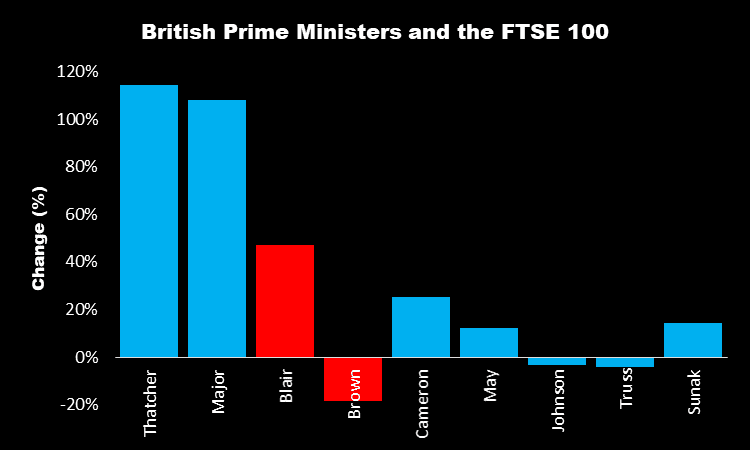
With a general election imminent, I’m wondering how a change of government might impact my portfolio. The chart below shows how the FTSE 100, used as a proxy for the wider UK stock market, has performed under our last nine Prime Ministers.

Encouragingly, only three of our leaders have presided over a fall. To be fair, Boris Johnson had a pandemic to deal with. And Gordon Brown was unfortunate to be in office when the global financial crisis hit. As for Liz Truss, well, what can I say?
Source: author’s calculations from data provided by MarketView

‘Events, dear boy, events’

But a British Prime Minister can do little to influence global events. This makes me think luck has been a big factor in determining how the market has performed under their tenures.

However, I think the chart illustrates a more important point. Generally speaking, those serving the longest saw the biggest increases in the FTSE 100. And that’s because successful investing requires taking a long-term view.

During the Footsie’s first 23 years, Margaret Thatcher, John Major and Tony Blair saw the index increase from 1,000 to 6,527. This tells me that longevity of service, rather than any specific policies, is probably the biggest reason behind the differences highlighted.

Lift-off

The index of the 100 largest listed companies was launched in January 1984.

Margaret Thatcher was in charge at the time and she was committed to the privatisation of a raft of state-owned industries. She told the 1985 Conservative Party conference: “Let us together set our sights on a Britain … where owning shares is as common as having a car”.

With one third of adults investing directly in the stock market, there’s a long way to go before that vision is fulfilled. But it’s undoubtedly true that we’re now closer to a share-owning democracy than when she first took office.

Ringing the changes

One of her early privatisations was that of BT (LSE:BT.A). In 1984, I remember my dad proudly telling me that he had bought shares in the company. I had no idea what this meant.

On flotation, the telecoms giant had a stock market valuation of £7.8bn. Today, it’s worth £10.2bn. But to have kept pace with inflation, its market cap should be over £30bn.

If BT were a PM, I think it would be more of a Gordon Brown than a Boris Johnson. It’s a steady — if unspectacular — performer. For the year ended 31 March 2024 (FY24), analysts are expecting earnings per share of 15.9p. Over the next two years, this is forecast to be 16p (FY25) and 16.1p (FY26).

However, despite a rise in earnings, the ‘experts’ are forecasting the dividend to fall slightly from an anticipated 7.7p in FY24, to 7.31p, by 2026. Even so, the stock’s still yielding an attractive 7%. Of course, dividends are never guaranteed.

With both main political parties adopting a near-identical approach to taxes and borrowing, if there’s a change of government, I suspect it’s going to have little impact.

Individual companies may be affected by the introduction of specific policies that affect their industries. For example, BT has been lobbying the Labour Party to encourage easier rollout of broadband to blocks of flats. But overall, it’s probably going to be business as usual for the UK stock market.

James Beard has no position in any of the shares mentioned. The Motley Fool UK has no position in any of the shares mentioned. Views expressed on the companies mentioned in this article are those of the writer and therefore may differ from the official recommendations we make in our subscription services such as Share Advisor, Hidden Winners and Pro. Here at The Motley Fool we believe that considering a diverse range of insights makes us better investors.

More on Investing Articles

Two business people sitting at cafe working on new project using laptop. Young businesswoman taking notes and businessman working on laptop computer.
Investing Articles

Are 76% off Vistry shares a once-in-a-decade opportunity?

Vistry shares are looking dirt-cheap on some metrics. Is this the kind of rare buying opportunity that only comes around…

Read more »

Road 2025 to 2032 new year direction concept
Investing Articles

Down 10% in a month with a near-7% yield — are Aviva shares the perfect ISA buy?

Harvey Jones says stock market volatility could give investors the opportunity to snap up Aviva shares at a reduced price…

Read more »

Man hanging in the balance over a log at seaside in Scotland
Investing Articles

£5,000 invested in Diageo shares 1 month ago is now worth…

Diageo shares have dipped below £14 recently, taking the one-year fall to 31%. So why has one leading broker turned…

Read more »

Close-up image depicting a woman in her 70s taking British bank notes from her colourful leather wallet.
Investing Articles

Elon Musk could give Scottish Mortgage shares a huge boost!

Dr James Fox explains why Scottish Mortgage shares could benefit massively as Elon Musk looks to take SpaceX public later…

Read more »

Investing Articles

As Rolls-Royce and Babcock rocket, has the BAE Systems share price finally run out of juice?

Harvey Jones is astonised at recent sluggish performance of the BAE Systems share price and wonders if there is better…

Read more »

Man hanging in the balance over a log at seaside in Scotland
Investing Articles

Down 31% and with a P/E of 8.8, is this FTSE 100 share too cheap to ignore?

Berkeley's share price has collapsed to its cheapest in roughly 10 years. Is the FTSE share now too cheap to…

Read more »

Investing Articles

10 dirt-cheap shares to consider after the correction

Investors keen to contribute to their ISA allowance before Sunday's deadline have a brilliant opportunity to buy cheap shares due…

Read more »

UK supporters with flag
Investing Articles

Why I think this super-cheap growth stock will lead the charge when the FTSE 100 recovers

Harvey Jones is seriously excited by this FTSE 100 growth stock but he also cautions that it can be very…

Read more »