
£20,000 in savings? I’d try to turn that into £29,685 of passive income each year

It’s amazing how much passive income can be generated by taking a long-term approach to investing. This is what I’d do with £20,000 in savings.

| More on:

The content of this article was relevant at the time of publishing. Circumstances change continuously and caution should therefore be exercised when relying upon any content contained within this article.

Passive income text with pin graph chart on business table

Image source: Getty Images

You’re reading a free article with opinions that may differ from The Motley Fool’s Premium Investing Services. Become a Motley Fool member today to get instant access to our top analyst recommendations, in-depth research, investing resources, and more. Learn More.

Passive income is earned by doing very little. But as appealing as it might sound to earn lots of it, there’s a bit of patience needed. Let me explain.

For the purposes of this exercise, I’m going to assume I have savings of £20,000 available to invest. This is the amount that can be invested each year in a Stocks and Shares ISA.

Diversification

As a risk-averse investor, I’d be uncomfortable concentrating all of my funds in a single stock. I know that if I bought the ‘correct’ one, I could make a lot of money. But with an estimated 60,000 listed companies in the world, there’s a good chance I’d choose unwisely.

One way of potentially overcoming the problem of picking winners is to buy shares in an investment trust. Although I’d hold a single investment, my risk’s spread across the many stocks the trust owns. My exposure isn’t then limited to one particular industry, index, or country.

What to buy?

With this in mind, I’d use my hypothetical £20,000 to buy shares in Allianz Technology Trust (LSE:ATT). Although not guaranteed, I believe technology stocks are likely to out-perform the wider market.

I like the fact that the trust isn’t just focused on artificial intelligence (AI). Although I believe AI’s going to revolutionise our lives, I think it’s a little too early to identify which particular aspect of the technology is going to be the most profitable.

As its name suggests, ATT has a wider remit and invests in all parts of the tech sector. Having said that, its biggest holding (9.9% of total assets at 29 February 2024) is Nvidia, whose semiconductors are used in many AI applications.

Its next four biggest stakes are in Microsoft (8.1%), Meta Platforms (6%), Apple (6%) and Broadcom (4.2%).

Another positive is that it invests only in quoted companies. Its more famous peer, Scottish Mortgage Investment Trust, owns some of the “world’s most exceptional growth companies”. But many of them aren’t listed, which means valuing them accurately can be difficult.

Historical performance

A summary of ATT’s performance, for the five years ended 29 February, is illustrated below.
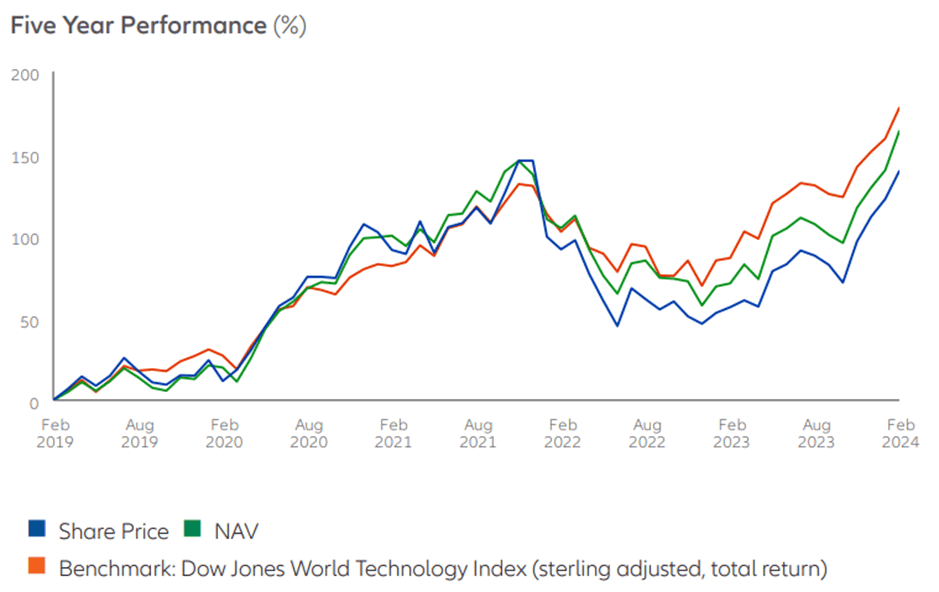
Source: Allianz Technology Trust, February 2024 Factsheet

Although it hasn’t performed as well as the Dow Jones World Technology Index, its cumulative five-year return of 139.4%’s impressive.

Also, the fund currently trades at a discount of approximately 10% to its net asset value, which implies the stock’s undervalued.

But tech stocks can be volatile. And when the dotcom bubble burst, we saw how quickly things can go spectacularly wrong.

However, for the purposes of this hypothetical exercise, I’m going to assume that the trust’s share price increases by 17.4% a year. This is equal to its compound annual growth rate during the five years ended 22 March.

Of course, there’s no guarantee history will be repeated. But if I could achieve this growth rate, after 20 years, my initial stake would be worth £494,757.

I could then sell up and buy some dividend stocks. Assuming an average yield of 6% — again, not guaranteed — I’d be able to generate an impressive income stream of £29,685 a year, with minimum effort.

That’s why I believe patience is the superpower of the wise.

Randi Zuckerberg, a former director of market development and spokeswoman for Facebook and sister to Meta Platforms CEO Mark Zuckerberg, is a member of The Motley Fool's board of directors. James Beard has no position in any of the shares mentioned. The Motley Fool UK has recommended Apple, Meta Platforms, Microsoft, and Nvidia. Views expressed on the companies mentioned in this article are those of the writer and therefore may differ from the official recommendations we make in our subscription services such as Share Advisor, Hidden Winners and Pro. Here at The Motley Fool we believe that considering a diverse range of insights makes us better investors.

More on Investing Articles

Female student sitting at the steps and using laptop
Investing Articles

How much do you need in an ISA to target £8,333 a month of passive income?

Our writer explores a potential route to earning double what is today considered a comfortable retirement and all tax-free inside…

Read more »

Three signposts pointing in different directions, with 'Buy' 'Sell' and 'Hold' on
Investing Articles

Could these 3 FTSE 100 shares soar in 2026?

Our writer identifies a trio of FTSE 100 shares he thinks might potentially have more petrol in the tank as…

Read more »

Pakistani multi generation family sitting around a table in a garden in Middlesbourgh, North East of England.
Dividend Shares

How much do you need in a FTSE 250 dividend portfolio to make £14.2k of annual income?

Jon Smith explains three main factors that go into building a strong FTSE 250 dividend portfolio to help income investors…

Read more »

Tesla building with tesla logo and two teslas in front
Investing Articles

275 times earnings! Am I the only person who thinks Tesla’s stock price is over-inflated?

Using conventional measures, James Beard reckons the Tesla stock price is expensive. Here, he considers why so many people appear…

Read more »

Investing Articles

Here’s what I think investors in Nvidia stock can look forward to in 2026

Nvidia stock has delivered solid returns for investors in 2025. But it could head even higher in 2026, driven by…

Read more »

Investing Articles

Here are my top US stocks to consider buying in 2026

The US remains the most popular market for investors looking for stocks to buy. In a crowded market, where does…

Read more »

Investing Articles

£20,000 in excess savings? Here’s how to try and turn that into a second income in 2026

Stephen Wright outlines an opportunity for investors with £20,000 in excess cash to target a £1,450 a year second income…

Read more »

DIVIDEND YIELD text written on a notebook with chart
Investing Articles

Is a 9% yield from one of the UK’s most reliable dividend shares too good to be true?

Taylor Wimpey’s recent dividend record has been outstanding, but investors thinking of buying shares need to take a careful look…

Read more »