
We have some exciting news to share! The Motley Fool UK has now become an independent, UK-owned company, led by our long-serving UK management team — Mark Rogers, Chris Nials and Heather Adlington. In practical terms, it’s the same team you know, now fully focused on serving our UK readers and members.

Just as importantly, our approach remains unchanged: long-term, jargon-free, and on your side. We’ll be introducing a new name and brand over the coming weeks — we're very excited to share it with you and embark on this new chapter together!

Investing just £100 per week in a SIPP could help make me a multimillionaire

Stock market investing is done over long periods of time, which makes a SIPP a perfect choice for the creation of retirement wealth.

The content of this article was relevant at the time of publishing. Circumstances change continuously and caution should therefore be exercised when relying upon any content contained within this article.

You’re reading a free article with opinions that may differ from The Motley Fool’s Premium Investing Services. Become a Motley Fool member today to get instant access to our top analyst recommendations, in-depth research, investing resources, and more. Learn More.

The words "what's your plan for retirement" written on chalkboard on pavement somewhere in London

Image source: Getty Images

Investing in the stock market has proven to be one of the most reliable ways to build wealth, provided it is done correctly. And a self-invested personal pension (SIPP) is an excellent vehicle to do this in the UK.

A SIPP is a pension ‘wrapper’ that allows me to save, invest and build up a pot of money for my retirement. My contributions qualify for tax relief, meaning I automatically get a government top-up on anything I pay in (currently up to £60,000 per year).

So if I contribute £800, I’d get an extra £200, bringing the total to £1,000.

If I pay tax at a higher rate, I can claim more through my tax return. But for the purposes of this article, I’m going to keep the figures simple.

Needless to say, these extra top-ups can make an enormous difference in the long run. Indeed, as we’ll see, it means I could eventually retire with a very substantial sum.

Please note that tax treatment depends on the individual circumstances of each client and may be subject to change in future. The content in this article is provided for information purposes only. It is not intended to be, neither does it constitute, any form of tax advice. Readers are responsible for carrying out their own due diligence and for obtaining professional advice before making any investment decisions.

Investing in growth and income shares

Historically, the stock market has returned an annualised 8-10%. That includes stocks from both the UK and US markets, which generally have different characteristics.

The FTSE 100, for example, is dominated by old economy companies like banks, miners and housebuilders. Meanwhile, the S&P 500 is top-heavy with innovative tech giants like Microsoft.

But both kind of stocks can have a role to play in a thriving SIPP portfolio. The old economy firms often have stable market positions and pay attractive dividends.

Conversely, some tech stocks offer much higher growth potential but not much in the way of dividends.

Choosing one style completely over the other risks an imbalanced portfolio. My own SIPP is probably 60/40 in favour of growth stocks right now, but that’s my own personal preference.

My risk tolerance and approach will probably change as I get closer to retirement.

The maths

As mentioned, stock returns have averaged 8-10% per year over the very long term. There is no guarantee that will continue in future, but I don’t think a 10% return is a totally unrealistic goal to aim for.

After all, Warren Buffett has averaged 19.8% per year. If I can do basically half as well as him, I’d still be able to build up a nice nest egg.

In this scenario, then, my £100 a week would become £125 (or £6,500 per year) with the government top-ups. Achieving an average 10% return over 30 years, I’d end up with a final pot of £1,069,211 (excluding any platform fees).

To be honest, I find it incredible that investing a mere £100 a week in a SIPP could end up as £1.07m.

It could be even higher

Now, so far we have assumed that I start from scratch. But what if I put in a lump sum before I started investing regularly? What difference would that make? Quite a lot, actually.

The average person in the UK has £17,365 in their savings, according to the Building Society Association.

So if I invested this money in my SIPP at the start, then my final sum would be £1.37m, assuming the same average returns and government tax relief. That’s a huge £300,000 or so difference.

What if I kept this going for 35 years instead of 30?
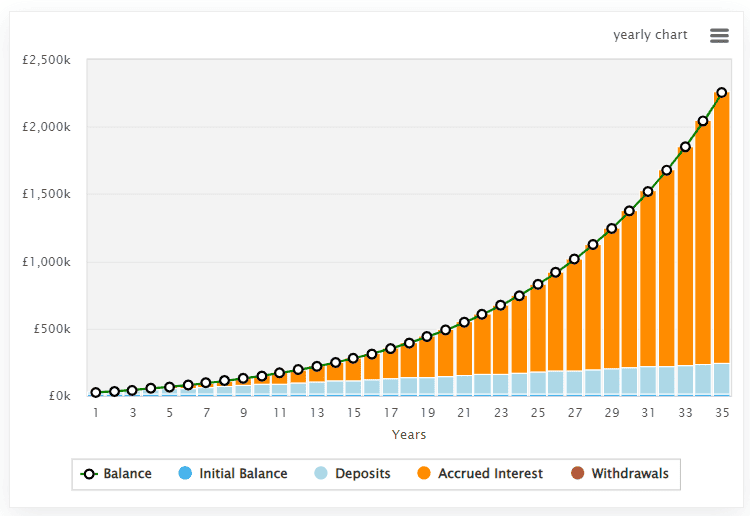
Created at thecalculatorsite.com

As the chart above shows, I’d end up with a whopping £2.25m instead of £1.37m. And if I could invest £200 a week rather than £100, then I’d be looking at a very comfortable retirement indeed.

The lessons, then, are clear. Fuelled by compounding, my returns can just explode higher the longer I keep investing.


Ben McPoland has no position in any of the shares mentioned. The Motley Fool UK has recommended Microsoft. Views expressed on the companies mentioned in this article are those of the writer and therefore may differ from the official recommendations we make in our subscription services such as Share Advisor, Hidden Winners and Pro. Here at The Motley Fool we believe that considering a diverse range of insights makes us better investors.

More on Investing Articles

Close-up of a woman holding modern polymer ten, twenty and fifty pound notes.
Investing Articles

Some pros and cons of buying dividend shares for passive income

Dividend shares can seem appealing, but they also carry risks. Christopher Ruane looks at what passive income potential -- and…

Read more »

Housing development near Dunstable, UK
Investing Articles

Down 73%, Vistry’s the worst-performing FTSE 250 share in my portfolio. Time to sell?

Mark Hartley outlines how UK housing market woes have driven down the price of one his core FTSE 250 holdings,…

Read more »

Aerial shot showing an aircraft shadow flying over an idyllic beach
Investing Articles

Just how cheap could IAG shares get this summer?

If the world runs out of jet fuel this summer then IAG shares could take a beating, says Harvey Jones.…

Read more »

Night Takeoff Of The American Space Shuttle
Investing Articles

Up 130% in 2026, can FTSE space stock Filtronic continue to soar?

Edward Sheldon thought that FTSE share Filtronic would do well in 2026. He wasn’t expecting it to shoot up 130%…

Read more »

British flag, Big Ben, Houses of Parliament and British flag composition
Investing Articles

Are investors still using an outdated playbook to value Lloyds shares?

Andrew Mackie looks beyond the standard rate-sensitive narrative around Lloyds shares to question whether we're missing a more resilient earnings…

Read more »

Hydrogen testing at DLR Cologne
Investing Articles

Is £15 the next stop for the Rolls-Royce share price?

Where will the Rolls-Royce share price go from here? Is a £15 price target for the next 12 months totally…

Read more »

Two female adult friends walking through the city streets at Christmas. They are talking and smiling as they do some Christmas shopping.
Investing Articles

How much is £7,620 saved in a Cash ISA a decade ago worth today?

Cash ISA savers have received an average of 4% over the last decade, but Harvey Jones says the average Stocks…

Read more »

Close-up as a woman counts out modern British banknotes.
Investing Articles

702 shares in this FTSE 100 stalwart earn a £100 a month second income

Unilever shares come with an unusually high dividend yield. Should investors looking for a second income grab the opportunity with…

Read more »