
We have some exciting news to share! The Motley Fool UK has now become an independent, UK-owned company, led by our long-serving UK management team — Mark Rogers, Chris Nials and Heather Adlington. In practical terms, it’s the same team you know, now fully focused on serving our UK readers and members.

Just as importantly, our approach remains unchanged: long-term, jargon-free, and on your side. We’ll be introducing a new name and brand over the coming weeks — we're very excited to share it with you and embark on this new chapter together!

Can the FTSE 100 hit 8,000 in January?

The FTSE 100 surged after central banks last week gave further suggestions that interest rates may soon start falling. Is 8,000 on the cards?

The content of this article was relevant at the time of publishing. Circumstances change continuously and caution should therefore be exercised when relying upon any content contained within this article.

You’re reading a free article with opinions that may differ from The Motley Fool’s Premium Investing Services. Become a Motley Fool member today to get instant access to our top analyst recommendations, in-depth research, investing resources, and more. Learn More.

Investor looking at stock graph on a tablet with their finger hovering over the Buy button

Image source: Getty Images

The FTSE 100 index reached its highest closing value of 8,012.53 points on February 16, 2023. This marked a significant milestone for the index that had been treading water for some time. The index is only up 12% over five years.

The index’s surge to 8,000 points was driven by a combination of factors. This included strong corporate earnings, a recovering global economy, and the outperformance of the resources sector, which is well-represented on it.

That bull run came to an end with the Silicon Valley Bank fiasco, and we’ve seen further downward pressure during the year.

A resurgence

The FTSE 100, along with other global indexes, surged last week as central banks hinted at an end to an aggressive fiscal tightening programmes aimed at countering inflation. This reduced the uncertainty surrounding interest rate hikes, which had weighed on market sentiment.

More generally, concerns about a potential economic downturn have subsided, with positive economic data and improving corporate earnings boosting investor confidence.

The Purchasing Managers’ Index (PMI) for the UK and other major economies showed strong growth in the manufacturing and services sectors, while corporate earnings reports generally exceeded expectations.

Interest rates and stocks

The relationship between interest rates and stocks, particularly their attractiveness to investors, is rooted in the opportunity cost of capital.

When interest rates are low, returns from fixed-income investments like bonds are less attractive. As a result, investors may turn to stocks seeking higher potential returns.

Conversely, when interest rates rise, the appeal of fixed-income investments increases, potentially making stocks less attractive.

However, the relationship is nuanced, considering various economic factors.

More broadly, in a low-interest-rate environment, stocks may be favoured for their growth potential, while in a high-interest-rate environment, income-generating assets like bonds might gain preference.

So, with interest rates expected to fall, capital should move away from debt and cash, towards stocks.

And the faster interest rates fall, the more quickly we can expect to see this transition from debt to stocks.

A healthy forecast

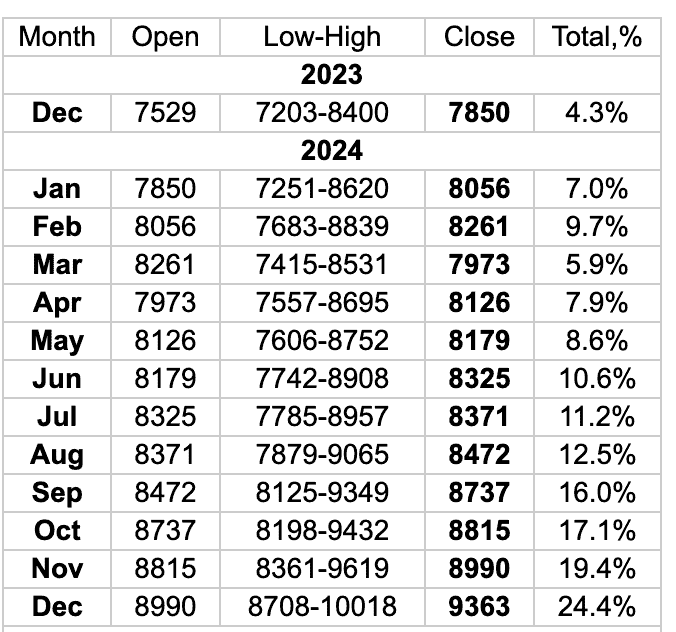
Forecasts change all the time. However, one I often keep an eye on is from the Economy Forecast Agency. Its prediction isn’t always correct, but from time to time, it’s been very accurate.

Following the recent dovish narratives from the US Federal Reserve and changing sentiment within the Bank of England, the forecast has recently been upgraded. And it looks pretty good.
Source: Economy Forecast Agency

As we can see, the agency expects to see the index close above 8,000, at 8,261 in January, representing a healthy 7% premium on the current position. That’s great.

It also suggests that UK stocks will go from strength to strength during the year. The index could close at 9,363 in December 2024. That’s 24.4% above where we are now.

Maybe we can assume that this improving forecast is related to falling interest rates. If so, a January rise to 8,000 might not happen, but a 2024 rise to that level just might.


James Fox has no position in any of the shares mentioned. The Motley Fool UK has no position in any of the shares mentioned. Views expressed on the companies mentioned in this article are those of the writer and therefore may differ from the official recommendations we make in our subscription services such as Share Advisor, Hidden Winners and Pro. Here at The Motley Fool we believe that considering a diverse range of insights makes us better investors.

More on Investing Articles

Close-up of a woman holding modern polymer ten, twenty and fifty pound notes.
Investing Articles

Some pros and cons of buying dividend shares for passive income

Dividend shares can seem appealing, but they also carry risks. Christopher Ruane looks at what passive income potential -- and…

Read more »

Housing development near Dunstable, UK
Investing Articles

Down 73%, Vistry’s the worst-performing FTSE 250 share in my portfolio. Time to sell?

Mark Hartley outlines how UK housing market woes have driven down the price of one his core FTSE 250 holdings,…

Read more »

Aerial shot showing an aircraft shadow flying over an idyllic beach
Investing Articles

Just how cheap could IAG shares get this summer?

If the world runs out of jet fuel this summer then IAG shares could take a beating, says Harvey Jones.…

Read more »

Night Takeoff Of The American Space Shuttle
Investing Articles

Up 130% in 2026, can FTSE space stock Filtronic continue to soar?

Edward Sheldon thought that FTSE share Filtronic would do well in 2026. He wasn’t expecting it to shoot up 130%…

Read more »

British flag, Big Ben, Houses of Parliament and British flag composition
Investing Articles

Are investors still using an outdated playbook to value Lloyds shares?

Andrew Mackie looks beyond the standard rate-sensitive narrative around Lloyds shares to question whether we're missing a more resilient earnings…

Read more »

Hydrogen testing at DLR Cologne
Investing Articles

Is £15 the next stop for the Rolls-Royce share price?

Where will the Rolls-Royce share price go from here? Is a £15 price target for the next 12 months totally…

Read more »

Two female adult friends walking through the city streets at Christmas. They are talking and smiling as they do some Christmas shopping.
Investing Articles

How much is £7,620 saved in a Cash ISA a decade ago worth today?

Cash ISA savers have received an average of 4% over the last decade, but Harvey Jones says the average Stocks…

Read more »

Close-up as a woman counts out modern British banknotes.
Investing Articles

702 shares in this FTSE 100 stalwart earn a £100 a month second income

Unilever shares come with an unusually high dividend yield. Should investors looking for a second income grab the opportunity with…

Read more »