
£2,000 in savings? Here’s how I’d aim to turn that into an £8,738 second income

Many of us invest for a second income. However, if we don’t have a substantial pot of money, we’re going to need to build wealth to make that happen.

The content of this article was relevant at the time of publishing. Circumstances change continuously and caution should therefore be exercised when relying upon any content contained within this article.

Young mixed-race woman jumping for joy in a park with confetti falling around her

Image source: Getty Images

You’re reading a free article with opinions that may differ from The Motley Fool’s Premium Investing Services. Become a Motley Fool member today to get instant access to our top analyst recommendations, in-depth research, investing resources, and more. Learn More.

There are plenty of ways to earn a second income. But only a few are truly passive. For me, it’s all about investing — putting money aside, investing it wisely, building wealth, and eventually drawing out the cash.

However, if I have £2,000 in savings, I need to be realistic. I’m not going to be generating life-changing passive income overnight. Instead, I must recognise that it’s going to take time, and maybe more money.

Building wealth

Phoenix Group is among the best paying dividend stocks on the FTSE 100. However, even if I put all of my £2,000 in there, I’d still only be generating £210 a year. Plus, it’s not overly wise to have all my money invested in one stock.

Instead, I need to build wealth over time, and then I can look to take a second income when the portfolio has reached my targets. But that can be easier said than done.

My strategy

If I were to put my £2,000 in an active savers account, it’d grow at a meagre rate — perhaps somewhere between 1.5% and 3% this year.

This is where investing comes in. A novice investor could look to make 6%-10% annually if they make wise investment decisions.

In theory, this means my money would be growing much faster than if it were in a savings account. This is particularly important when we consider compound returns — as explained below.

But I should also recognise that my investments will grow faster if I make regular contributions. Even if it’s as little as £50 a month. This will give my portfolio extra fuel for growth.

Compounding

In simple terms, compound returns is the concept of earning interest on interest, which leads to exponential growth over time.

The magic lies in the compounding process, where the money I earn from my investments starts generating its own returns when I reinvest it, creating a cycle of growth.

This effect is especially powerful over long periods, as the gains from each period contribute to an ever-expanding base.

Compound returns are a key principle in investing, emphasising the importance of starting early, making regular contributions, and reinvesting profits to maximise wealth accumulation over time.

The below chart highlights the impact of compound returns on portfolio growth, when starting with £2,000, contributing £50 a month, and achieving an annualised return of 8%. The timeframe is 35 years.
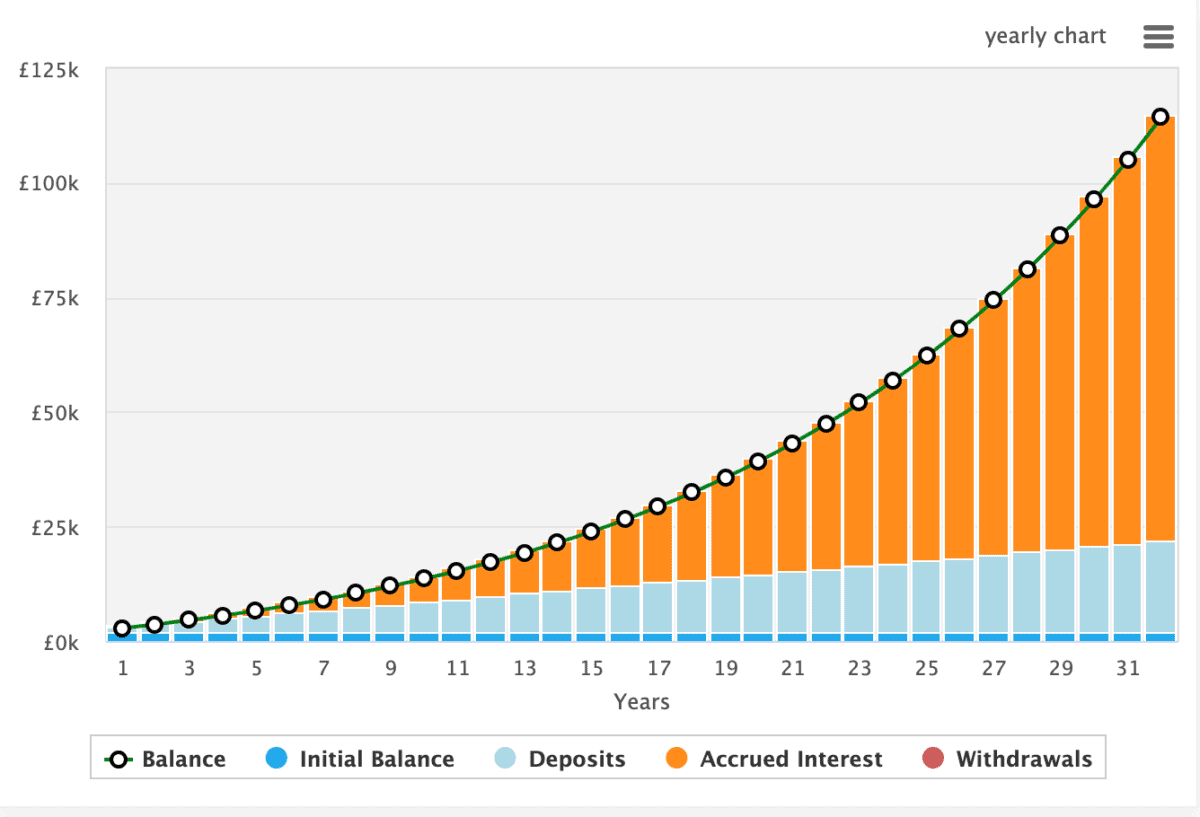
Created at thecalculatorsite.com

After 35 years, the portfolio would be worth £114k. That’s enough to generate £8,738 every year — a substantial improvement on the original £210 figure.

Investing wisely

These days, there’s a host of democratising platforms that can help us make wise investment decisions. And that’s important, because many novice investors lose money. The thing is, if I lose 50% on an investment, I’ve got to achieve 100% to get back to where I started.


James Fox has positions in Phoenix Group Holdings. The Motley Fool UK has no position in any of the shares mentioned. Views expressed on the companies mentioned in this article are those of the writer and therefore may differ from the official recommendations we make in our subscription services such as Share Advisor, Hidden Winners and Pro. Here at The Motley Fool we believe that considering a diverse range of insights makes us better investors.

More on Investing Articles

Female student sitting at the steps and using laptop
Investing Articles

How much do you need in an ISA to target £8,333 a month of passive income?

Our writer explores a potential route to earning double what is today considered a comfortable retirement and all tax-free inside…

Read more »

Three signposts pointing in different directions, with 'Buy' 'Sell' and 'Hold' on
Investing Articles

Could these 3 FTSE 100 shares soar in 2026?

Our writer identifies a trio of FTSE 100 shares he thinks might potentially have more petrol in the tank as…

Read more »

Pakistani multi generation family sitting around a table in a garden in Middlesbourgh, North East of England.
Dividend Shares

How much do you need in a FTSE 250 dividend portfolio to make £14.2k of annual income?

Jon Smith explains three main factors that go into building a strong FTSE 250 dividend portfolio to help income investors…

Read more »

Tesla building with tesla logo and two teslas in front
Investing Articles

275 times earnings! Am I the only person who thinks Tesla’s stock price is over-inflated?

Using conventional measures, James Beard reckons the Tesla stock price is expensive. Here, he considers why so many people appear…

Read more »

Investing Articles

Here’s what I think investors in Nvidia stock can look forward to in 2026

Nvidia stock has delivered solid returns for investors in 2025. But it could head even higher in 2026, driven by…

Read more »

Investing Articles

Here are my top US stocks to consider buying in 2026

The US remains the most popular market for investors looking for stocks to buy. In a crowded market, where does…

Read more »

Investing Articles

£20,000 in excess savings? Here’s how to try and turn that into a second income in 2026

Stephen Wright outlines an opportunity for investors with £20,000 in excess cash to target a £1,450 a year second income…

Read more »

DIVIDEND YIELD text written on a notebook with chart
Investing Articles

Is a 9% yield from one of the UK’s most reliable dividend shares too good to be true?

Taylor Wimpey’s recent dividend record has been outstanding, but investors thinking of buying shares need to take a careful look…

Read more »