
If I invest £10,000 in a FTSE 100 Index ETF, how much passive income would I receive?

Ben McPoland looks at how much passive income investors could expect to receive from a £10k investment in the UK’s blue-chip index.

| More on:

The content of this article was relevant at the time of publishing. Circumstances change continuously and caution should therefore be exercised when relying upon any content contained within this article.

View of Tower Bridge in Autumn

Image source: Getty Images

You’re reading a free article with opinions that may differ from The Motley Fool’s Premium Investing Services. Become a Motley Fool member today to get instant access to our top analyst recommendations, in-depth research, investing resources, and more. Learn More.

Investing in an index tracker that pay dividends is an easy way to generate a steady passive income. There is always the potential for decent capital growth as well.

One of the most popular of these trackers in the UK is the Vanguard FTSE 100 Index Unit Trust (LSE: VUKE). This ETF can be bought and sold just like any other regular stock.

But how much could it pay me in dividends if I invested £10,000 in it today?

What’s in it?

First, before looking at the potential income, here are the top 10 holdings, as at 30 April.

% of fund
AstraZeneca 8.5%
Shell8.4%
HSBC Holdings 5.7%
Unilever5.5%
BP4.6%
Diageo3.9%
British American Tobacco 3.2%
Glencore 2.9%
GSK2.8%
Rio Tinto 2.7%

One of the things I immediately like about this list is its diversity. There are well-established miners, giants in energy and pharmaceuticals, and diversified consumer staples companies here.

Yes, one possible criticism is that it doesn’t provide much technology exposure — but then tech stocks aren’t known for paying generous dividends.

This ETF currently yields 3.84%. That means I’d expect £384 annually from a £10,000 investment.

While no dividends are ever totally guaranteed, the payment here is sourced from all the Footsie’s dividend-paying stocks. In theory, that should make the income safer, particularly as most of the constituent companies sell products and services right across the globe.

Less appealing

Now, obviously central banks have been aggressively increasing base interest rates to try and tame stubbornly high inflation. As a result, investors can find higher yields elsewhere today.

For example, the UK 10-year gilt (a fixed-interest bond issued by the Treasury) is currently yielding 4.26%. So a 3.8% cash yield doesn’t sound particularly impressive in comparison.

So why should I bother?

Well, investing in a FTSE 100 tracker could also generate additional returns through share price appreciation. However, this isn’t guaranteed, as we can see by the fund’s poor -2.75% five-year return (excluding dividends).

Different paths

I think there are two alternative strategies investors could pursue here.

The first is buying a FTSE 100 tracker than reinvests the dividend payments back into the fund rather than paying them out. This tends to generate far superior returns, as can be seen below.
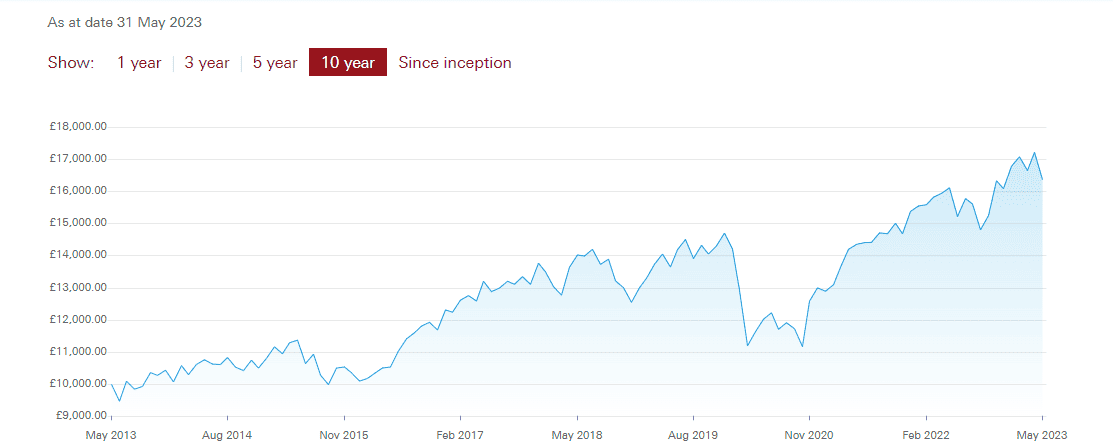
Source: Vanguard

A £10,000 investment made a decade ago would now be worth over £16,000 as a result of reinvested dividends.

Of course, the drawback here would be the sacrifice of passive income today for potentially greater returns in the future.

Therefore, a second strategy could be to target those individual FTSE 100 dividend stocks that pay far higher yields than the average. And currently there are a good few of these in the Footsie.

One is investment management firm M&G, which currently yields a massive 9.6%. Meanwhile, British American Tobacco and Lloyds are yielding 8.6% and 5.3%, respectively. And insurance groups Phoenix and Legal & General both have cash yields above 8%.

So, if I spread my £10,000 between ultra-high-yield stocks such as these, then my portfolio could be generating passive income far above what I could achieve through bonds or index trackers.


HSBC Holdings is an advertising partner of The Ascent, a Motley Fool company. Ben McPoland has positions in Diageo Plc, Glencore Plc, and Legal & General Group Plc. The Motley Fool UK has recommended British American Tobacco P.l.c., Diageo Plc, GSK, HSBC Holdings, Lloyds Banking Group Plc, M&g Plc, and Unilever Plc. Views expressed on the companies mentioned in this article are those of the writer and therefore may differ from the official recommendations we make in our subscription services such as Share Advisor, Hidden Winners and Pro. Here at The Motley Fool we believe that considering a diverse range of insights makes us better investors.

More on Investing Articles

Female student sitting at the steps and using laptop
Investing Articles

How much do you need in an ISA to target £8,333 a month of passive income?

Our writer explores a potential route to earning double what is today considered a comfortable retirement and all tax-free inside…

Read more »

Three signposts pointing in different directions, with 'Buy' 'Sell' and 'Hold' on
Investing Articles

Could these 3 FTSE 100 shares soar in 2026?

Our writer identifies a trio of FTSE 100 shares he thinks might potentially have more petrol in the tank as…

Read more »

Pakistani multi generation family sitting around a table in a garden in Middlesbourgh, North East of England.
Dividend Shares

How much do you need in a FTSE 250 dividend portfolio to make £14.2k of annual income?

Jon Smith explains three main factors that go into building a strong FTSE 250 dividend portfolio to help income investors…

Read more »

Tesla building with tesla logo and two teslas in front
Investing Articles

275 times earnings! Am I the only person who thinks Tesla’s stock price is over-inflated?

Using conventional measures, James Beard reckons the Tesla stock price is expensive. Here, he considers why so many people appear…

Read more »

Investing Articles

Here’s what I think investors in Nvidia stock can look forward to in 2026

Nvidia stock has delivered solid returns for investors in 2025. But it could head even higher in 2026, driven by…

Read more »

Investing Articles

Here are my top US stocks to consider buying in 2026

The US remains the most popular market for investors looking for stocks to buy. In a crowded market, where does…

Read more »

Investing Articles

£20,000 in excess savings? Here’s how to try and turn that into a second income in 2026

Stephen Wright outlines an opportunity for investors with £20,000 in excess cash to target a £1,450 a year second income…

Read more »

DIVIDEND YIELD text written on a notebook with chart
Investing Articles

Is a 9% yield from one of the UK’s most reliable dividend shares too good to be true?

Taylor Wimpey’s recent dividend record has been outstanding, but investors thinking of buying shares need to take a careful look…

Read more »