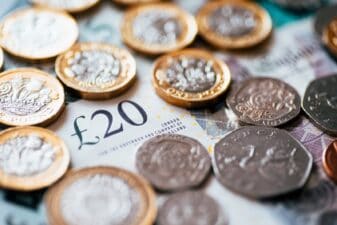
In recent weeks, I’ve been looking at the rare beasts of the FTSE 100 whose shares can be bought for less than £1.
So far, I’ve discussed Rolls-Royce and Lloyds, and identified what I think are credible reasons why both companies could deliver high investment returns.
Today, I’m turning the spotlight on the third blue-chip name that currently trades as a penny stock. The ITV (LSE: ITV) share price is 75p, as I’m writing. Are there reasons to believe it could have similar upside potential to Lloyds and Rolls-Royce?
Big fundraisings
Lloyds and Rolls-Royce are penny stocks today, because they’ve been through the same class of corporate event. Both have faced crises in which they had to issue masses of new shares to raise funds.
In the case of Lloyds, this was during the great financial crisis and recession of 2008-09. In the case of Rolls-Royce, it was in 2020 during the Covid-19 pandemic.
Lloyds went into the financial crisis with 6bn shares in issue and came out of it with more than 60bn. Rolls-Royce had less than 2bn shares in issue before its 2020 fundraising and more than 8bn after.
In theory, if the number of shares in issue increases by a factor of ‘X’, the value of each individual share should decrease by the same factor. In this way, the value of the whole company, before and after the event, remains the same.
It’s been different at ITV
ITV was formed by the merger of Granada and Carlton Communications. The enlarged group’s shares started trading at 141p on 2 February 2004 and its market capitalisation of £5.8bn made it a FTSE 100 stock.
Unlike Lloyds and Rolls-Royce, there’s been no huge change in ITV’s number of shares in issue (around 4bn) over the years. Its current market capitalisation is £3.2bn. As such, the market is pricing ITV today as a significantly less valuable business than in 2004.
Clearly, the upside would be substantial, if the market were to return to valuing the shares at the 141p level of 2004 — let alone their peak of double that in 2015.
Are there reasons why market sentiment for the stock could improve? Or have there been fundamental changes to the company’s prospects that make it an inherently less valuable business today?
Yo-yo stock
ITV’s business is highly sensitive to the state of the broader economy. About half its revenue comes from advertising, and customers tend to cut their marketing budgets when there’s an economic downturn.
The company has yo-yoed in and out of the FTSE 100 through economic cycles. It was relegated to the second-tier FTSE 250 in 2008, before returning to the top index in 2011. And it was relegated again in 2020, only to be promoted back last year.
Not all about economic cycles
However, if ITV had released its latest annual results a day earlier than it did, it would once again have dropped out of the FTSE 100. Its shares crashed 28% on the results, but the quarterly FTSE index review was done the day before.
Ironically, the company reported record advertising revenue in the results. The market response showed that sentiment for the stock isn’t all about economic cycles.
As well as being a hostage to those cycles, ITV faces challenges from a structurally changing industry and intense competition for viewers. The negative reaction to the results was very much a reflection of investor concerns about these challenges.
Hey big spender
ITV detailed the next phase of its ‘More Than TV’ strategy in the results. The market baulked at the amount of investment that management feels it needs to make over the next five years to keep the company and its content competitive and relevant in the global entertainment market.
Berenberg analyst Sarah Simon summed up the market’s concerns about the company’s prospects. “They’re spending more because they’re losing eyeballs,” she told the Financial Times. “You’ve got Netflix, Amazon, Peacock, Discovery+, Facebook Watch, YouTube — there’s just so much [competition].”
Cheap valuation
At the current share price of 75p, the market is valuing ITV at less than six times forecast 2022 earnings, with a prospective dividend yield of over 6%. I think this valuation may be a little too cheap.
Having said that, I can’t see investors moving to rate the stock as a very high-value business, given its sensitivity to economic cycles, and the level of investment now needed to compete in the global entertainment market. On this basis, I don’t see as much upside potential here as at Lloyds and Rolls-Royce.