Does buying dips in the FTSE 100 beat regular investing?

It has been said that time in the market beats trying to time the market, but is it true?

The content of this article was relevant at the time of publishing. Circumstances change continuously and caution should therefore be exercised when relying upon any content contained within this article.

You’re reading a free article with opinions that may differ from The Motley Fool’s Premium Investing Services. Become a Motley Fool member today to get instant access to our top analyst recommendations, in-depth research, investing resources, and more. Learn More.

The FTSE 100 dropped over 3% yesterday. Today it is down by another percentage point. In times like these, the question of whether buying dips in the market beats regular investing often gets asked. The answer may appear obvious. After all, buying dips means buying cheap. Regular investing could mean buying just before a dip or when the market is expensive. Should investors not aim to buy low and sell high?

A strategy of buying low and selling high makes intuitive sense, especially when we look at the performance of the FTSE 100 index.
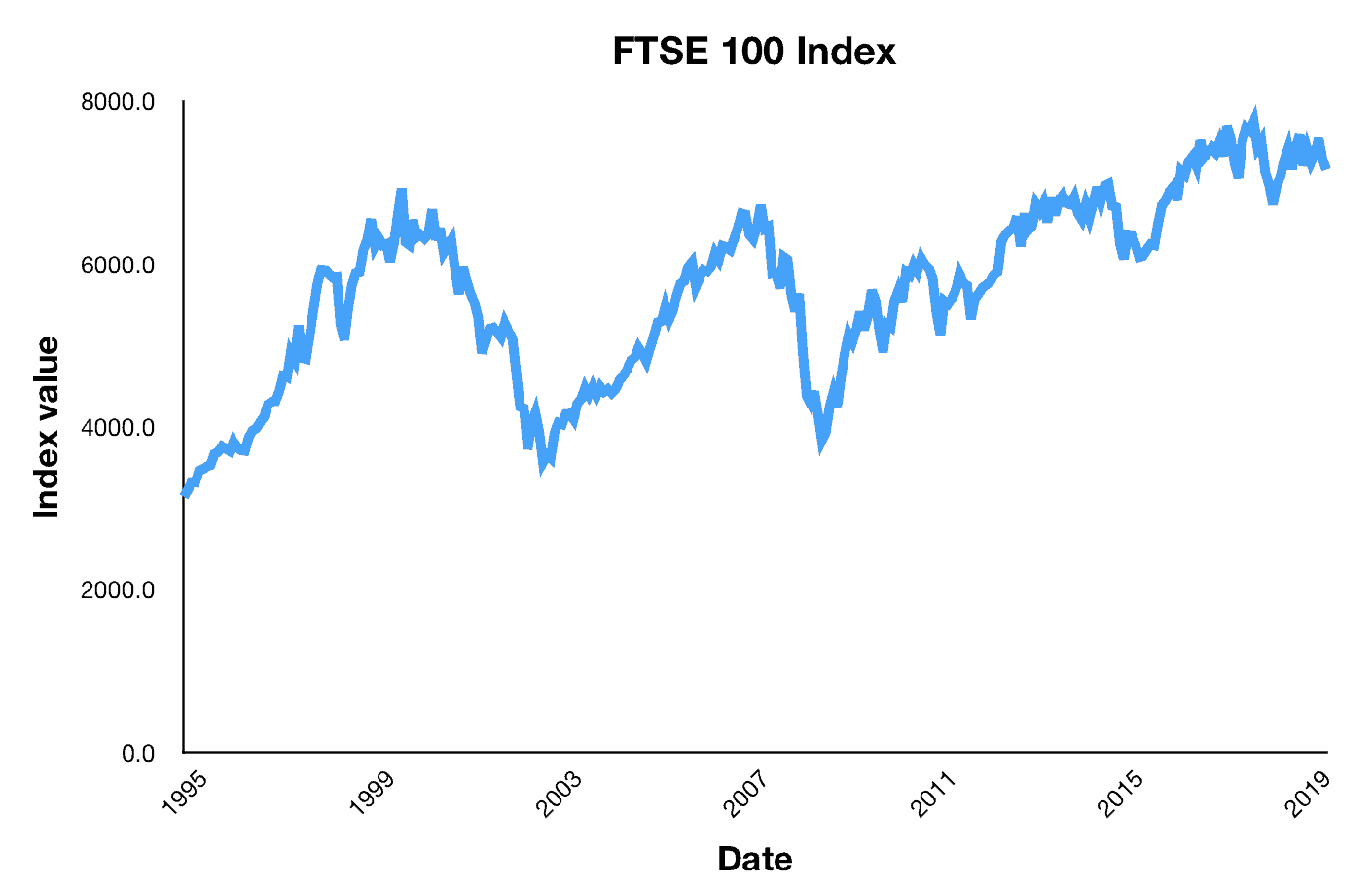
But the chart above shows the price of the index only. It does not account for the dividends that are paid by the companies in the index. The average annual dividend yield on the FTSE 100 from June 1993 to November 2018 was 3.47% or about 0.28% per month.

An investor in the FTSE 100 will receive these dividends if they buy all 100 stocks themselves or a fund that tracks the index. If dividends are being reinvested then the performance of the investment will not look like the chart above.

Dipping in

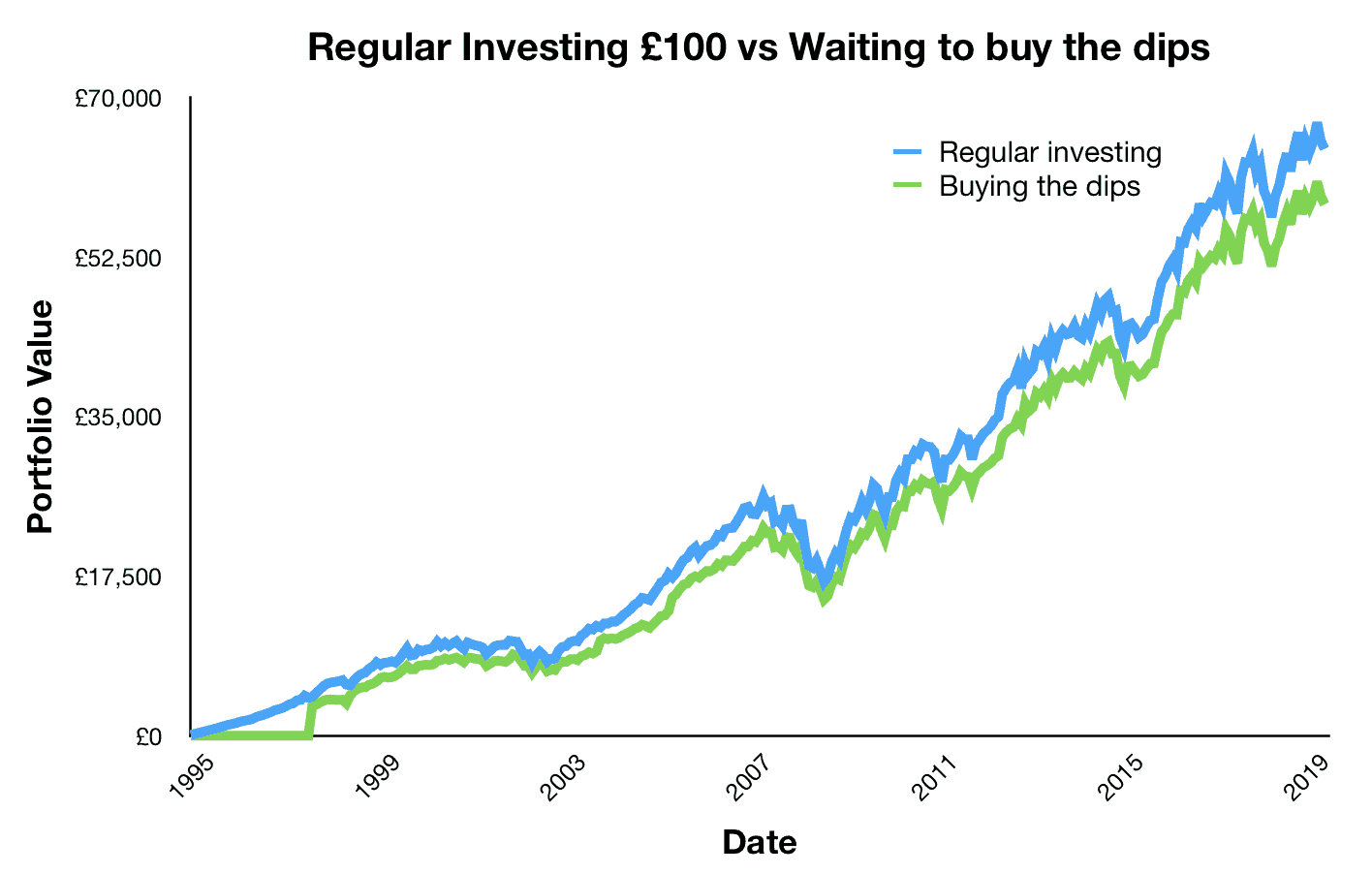
Let’s compare the two strategies. First, we will invest £100 every month in the FTSE 100 starting in March 1995 and finishing in January 2020. Second, we will look at a strategy of investing after the price of the FTSE 100 has fallen at least 5% in a month. To keep the total invested amounts similar, in the second strategy, £100 is either invested or banked until the index has fallen by 5%.

In total of £29,800 gets invested buying the dips and £30,000 in regular investments over the 25 or so years. How about the performance of the two strategies? Well, the regular investor ends up with £64,359 compared to £58,270 for the dip buyer. 
Along for the ride

Of the two strategies, regular investing comes out on top. The message is clear, don’t wait to buy the dip, just keep investing. The more time you are in the market, the more your money grows, assuming dividends are being paid and reinvested. The more you try to time the market, the less time your money has to grow.

I used data for the entire FTSE 100 for this exercise. There are some stocks that have higher dividend yields than the 3.47% average, so a diversified portfolio of those could have done even better.

Also bear in mind that this experiment was carried out with 25 years of monthly returns. The longer your investment time horizon, the more likely you are to do well. Looking back over the FTSE 100 price chart should make this point clear. If you only had two or three years to invest and you started around 1999 or 2007 you would have done badly. Long-term investing is the key to success.


Views expressed on the companies mentioned in this article are those of the writer and therefore may differ from the official recommendations we make in our subscription services such as Share Advisor, Hidden Winners and Pro. Here at The Motley Fool we believe that considering a diverse range of insights makes us better investors.

More on Investing Articles

Investing Articles

Here’s how many British American Tobacco shares it takes to earn a £1,000 monthly second income

Is an AI-resistant business with a 5.38% dividend yield a good choice for investors looking for a second income in…

Read more »

Black woman using smartphone at home, watching stock charts.
Investing Articles

1,001 Barclays shares bought 12 months ago are now worth…

Barclays shares have delivered excellent returns over the last year. But can the FTSE 100 bank keep outperforming? Royston Wild…

Read more »

Two business people sitting at cafe working on new project using laptop. Young businesswoman taking notes and businessman working on laptop computer.
Investing Articles

Get started on the stock market: 3 ‘safe’ shares for beginner UK investors to consider

Kicking off an investment portfolio on the stock market may seem like a scary prospect. Mark Hartley details a few…

Read more »

Black woman using smartphone at home, watching stock charts.
Investing Articles

2 spectacular growth stocks to consider buying in March

Investors ignore the risks with growth stocks when things are going well. But when this changes, fixating on the dangers…

Read more »

UK financial background: share prices and stock graph overlaid on an image of the Union Jack
Investing Articles

Why is the FTSE 100 suddenly beating the S&P 500?

The UK's blue-chip index has been on fire over the past couple of years, helping it catch up to the…

Read more »

Artillery rocket system aimed to the sky and soldiers at sunset.
Investing Articles

This non-oil FTSE stock’s risen 4.6% in 3 days. What’s going on?

Against the backdrop of trouble in the Middle East, James Beard investigates why this FTSE 100 stock’s doing so well.…

Read more »

Three signposts pointing in different directions, with 'Buy' 'Sell' and 'Hold' on
Investing Articles

Has a 2026 stock market crash just come a whole lot closer?

If we're in for a stock market crash, what's the best way for us to prepare, and what kinds of…

Read more »

Silhouette of a bull standing on top of a landscape with the sun setting behind it
Investing Articles

Up 79% in a year, this FTSE 250 stock still gets a resounding Strong Buy from analysts

This under-the-radar growth stock in the FTSE 250 has been on fire over the past 12 months. Why are City…

Read more »