Here’s how much you need to save for retirement by 40, 50 and 60

Working out how money to have saved for retirement by certain ages is not straightforward, explains Edward Sheldon.

The content of this article was relevant at the time of publishing. Circumstances change continuously and caution should therefore be exercised when relying upon any content contained within this article.

You’re reading a free article with opinions that may differ from The Motley Fool’s Premium Investing Services. Become a Motley Fool member today to get instant access to our top analyst recommendations, in-depth research, investing resources, and more. Learn More.

Calculating how much money you need for retirement is not straightforward. And neither is calculating how much money you should have saved up for retirement by certain ages.

This is because there are many variables that need to be considered. For example, first there are basic retirement variables that you can control, such as the age you plan to retire, and the kind of lifestyle you plan to live in retirement. But then there’s a whole stack of variables that you can’t control, such as your life expectancy, the returns your investments are likely to generate over time, and inflation rates. So, overall, working out how much money you should have saved for retirement by ages 40, 50 or 60 is rather complicated.

Savings model

That said, analysts at US investment manager Fidelity have recently put together a basic retirement savings model that provides some insight into how much money people should have saved for retirement by certain ages.

The model – which aims to help people plan for retirement effectively – is based on certain key assumptions, such as a retirement age of 67 and a retirement lifestyle that is similar to the individual’s pre-retirement lifestyle. It also assumes that individuals are willing to invest at least 50% of their savings in the stock market over the long run. Here are some key numbers that Fidelity came up with.

How much to save by 40, 50, 60

According to Fidelity, individuals should aim to have three times their salary saved by 40, six times their salary saved by 50, and eight times their salary saved by 60. The final goal should be to have around 10 times your salary saved by 67 when you retire, as shown in the chart below.
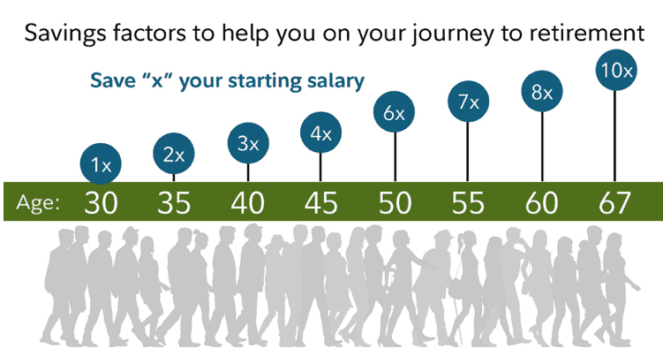
Source: Fidelity.com 

For instance, if you are 40, earning £40,000, and plan to retire at 67, Fidelity believes you should have around £120,000 saved for retirement. Similarly, if you are 60, earning £50,000, and plan to retire at 67, the investment manager believes you should have around £400,000 saved.

Falling behind

Of course, these numbers are just a guide as to how much money people should have saved for retirement by certain ages. Fidelity advises that if you’re behind in your retirement savings plan, don’t panic, as there are ways to catch up. The key, as always, is to take action.

Action plan

Two things that you can do to boost your savings to where they should be, include saving more regularly and then investing your savings into a diversified investment mix of shares, bonds and cash savings to ensure that they are working for you and generating a healthy return that is in excess of inflation over time. Retirement planning doesn’t need to be complicated, but it is something that people should spend a few minutes on every now and then. If you can get your savings working for you now, you’ll give yourself a good chance of living your dream retirement further down the track.


More on Investing Articles

Friends at the bay near the village of Diabaig on the side of Loch Torridon in Wester Ross, Scotland. They are taking a break from their bike ride to relax and chat. They are laughing together.
Investing Articles

2 UK stocks to consider buying as Mounjaro and Wegovy take off

Weight-loss drugs like Mounjaro are surging in popularity, making the following pair interesting stocks to think about buying today.

Read more »

British union jack flag and Parliament house at city of Westminster in the background
Investing Articles

As the FTSE 100 drops back below 10,000, how long can share prices keep falling?

FTSE 100 share prices are falling, but is it time to consider buying shares in the one industry that’s still…

Read more »

piggy bank, searching with binoculars
Investing Articles

As the stock market closes in on a correction, where are the buying opportunities?

Volatile share prices can bring huge buying opportunities. But which shares offer value with the stock market closer to correction…

Read more »

Middle-aged white man wearing glasses, staring into space over the top of his laptop in a coffee shop
Investing Articles

Will Lloyds shares return to £1 in 2026?

Only a few weeks ago Lloyds' shares were well above £1. Now however, they’re trading near 90p. Can they regain…

Read more »

Hand flipping wooden cubes for change wording" Panic" to " Calm".
Investing Articles

This could be the start of a stock market crash. Here’s what I’m doing…

Investors think geopolitical tension's the most likely cause of a stock market crash right now. If they’re right, it might…

Read more »

Satellite on planet background
Investing Articles

Here’s why I think this FTSE 250 high-tech defence gem ‘should’ be trading over £7 now, not under £5

A little‑known FTSE 250 defence innovator is riding a global spending super-cycle and its valuation gap suggests investors may be…

Read more »

Union Jack flag triangular bunting hanging in a street
Investing Articles

Buy cheap FTSE shares, says Barclays

Analysts at Barclays have upgraded their rating of FTSE shares and reckon the UK stock market could carry on powering…

Read more »

Artillery rocket system aimed to the sky and soldiers at sunset.
Investing Articles

With oil & gas prices rising, are there only 2 FTSE 100 stocks to consider buying now?

Most stocks on the FTSE 100 are suffering due to rising energy prices. James Beard explores how investors can navigate…

Read more »