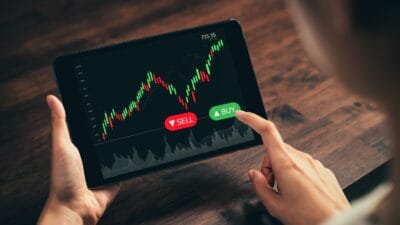
Does it scare you when you see headlines like “A billion pounds knocked off the FTSE” or “Shares slide in FTSE rout“? And what about when you look at a stock market chart and see something like the Himalayas, with gains and losses that look like pure gambling?
It’s only natural if it does, and it’s the kind of thing that keeps many people away from investing in shares altogether, instead sticking to “safer” cash savings accounts that earn a measly 1% or 2% per year. And it’s understandable that you might feel more confident with a smooth stock market chart, edging gradually up every year, and with no sharp dips for your cash to fall into.
But if you’re looking for a home for long-term savings — money that you won’t want to touch for a couple of decades or so — then you could be making a very big mistake. That’s because over the long term, the ups and downs of the market actually help to boost your profits.
Regular investments
Let’s suppose you have £100 a month to save and you think about putting it into a FTSE 100 tracker — that’s a low-cost fund that closely replicates the performance of the index. And let’s imagine a year in which the FTSE ends the year at exactly the same level as it started. Which would make you feel better — a smooth ride at the same level all year with no ups and downs, or violent 20% swings either way month by month?
Well, the smooth ride would leave you with exactly the same at the end of the year as you had invested (minus charges, which can be as low as 0.25% per year for a tracker fund).
But if you get hit with the extreme roller-coaster ride, on a month when the FTSE 100 is 20% up you’ll buy fewer shares with your £100, and on months when it’s down you’ll be able to buy more. Now, you might think I’m going to tell you the two will even out and you’ll be no worse off, but it’s actually better than that.
An extra boost
Thanks to a thing called pound cost averaging, the extra shares you can buy on cheaper months actually slightly outweigh the shortfall on more expensive months, and by the end of the year you will have invested £1,200… but it will be worth £1,250! That might not sound much, but it’s an extra 4.2%, which alone is way better than you’ll get from cash savings.
Of course, the FTSE won’t gyrate as wildly as that, but I chose such big swings to emphasize that you really should not be afraid of short term spikes and dips in the market. Over the long term they tend to even out anyway and investing in shares has soundly beaten cash savings for a century and more. But on top of that, my extreme example shows that short-term volatility actually adds a little boost to the profits made by regular investors.
Take the profits
So next time you hear someone sucking their teeth and shaking their head over a “FTSE collapse” headline, you shouldn’t feel down in the dumps. No, if you’re in it for the long term, you should be smiling and thinking to yourself “Now I can buy shares in great companies even cheaper“.