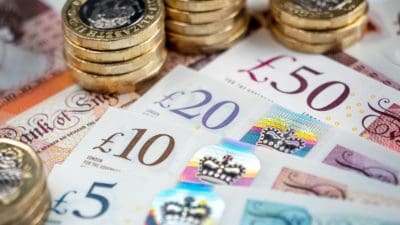
Cash and stock markets are ancient rivals. For years, cash was the one they called king. It was safe, it was solid, it put a defensive moat around your money. Cash allowed you to sleep at night.
Stocks and shares were the upstart challenger. Canny investors have always known that stock markets will make them a far more princely sum in the longer run, but they were too risky for many.
But now, the battle is over. An outright winner has been declared. Cash has lost its crown.
Stocks and shares hold the field.
Savers Are On The Chopping Block
If cash is king, it is Louis XVI, beheaded in the French Revolution in 1793. Or Charles I, who lost his head in 1649.
Cash lost its throne in March 2009, when the Bank of England slashed base rates to 0.5%. There has been no sign of a reprieve since then.
Today, the average savings account pays 0.62%, according to Moneyfacts, although by shopping around, you can find easy access account paying around 1.5%.
But that is still below the rate of inflation at 1.7%, as measured by the consumer prices index.
This means that in real terms, money in the bank can only wither and die.
Blue-Chips To The Rescue
Why put up with 0.62%, when you can invest in blue-chip FTSE 100 stocks and get eight or nine times the return from the dividend payment alone?
Right now, pharmaceutical giant GlaxoSmithKline pays a dividend equivalent to a return of 4.9% a year. National Grid, Centrica, Tesco and J Sainsbury all yield just over 5%.
Energy company SSE yields 5.7%.
These aren’t high-risk stock tips, but familiar, established names. As are BP, HSBC, Imperial Tobacco and Royal Dutch Shell, all of which yield more than 4.5%.
If you prefer to spread the risk by investing in a tracker fund, the FTSE 100 currently offers an average yield of 3.66%. That is six times greater than the average savings account.
A Right Royal Return
Companies pay dividends in order to reward shareholders for holding their stock. Once the dividend has been paid, quarterly or twice-yearly, it is yours to keep, whatever happens.
Any capital growth when the company’s share price rises is paid on top of that.
Over the years, this royal combination of dividend income and share price growth puts cash to the sword.
Cash Lost Its Crown Years Ago
If you had saved £10,000 in the average high-street cash savings account 10 years ago, you would now have £11,070, according to figures from Fidelity.
You would have made just £1,070.
But if you had invested your £10,000 in the FTSE All-Share instead, you would have more than doubled your money to £22,010.
That’s a profit of £10,940.
Yes, stock markets are more risky. But you can reduce the danger by spreading your cash between different companies, or buying an index tracker to do the job for you at minimal cost.
And you should only invest money you don’t expect to need for at least five or 10 years, to give you time to overcome any short-term correction.
Stock markets have always beaten cash in the longer run. At today’s low interest rates, there can only be one verdict.
Choosing shares over cash is a no-brainer. Stock markets rule.