It has certainly been a wild March for the FTSE 100 index. Recently, it tanked by more than 10%, reaching a low of 9,677 on Monday morning (23 March). For context, it was close to 11,000 in late February.
However, since Monday’s low, the index has started recovering. As I type (25 March), it’s up to 10,077.
So, is the FTSE 100 back on track? Let’s discuss.
What’s the latest?
Obviously the event that triggered all the stock market uncertainty is the Iran war. Or, more specifically, the lack of shipping going through the Strait of Hormuz.
The longer this goes on, the worse inflation will be due to disrupted oil, gas, and fertiliser supplies. The current energy crisis is perhaps the worst in decades.
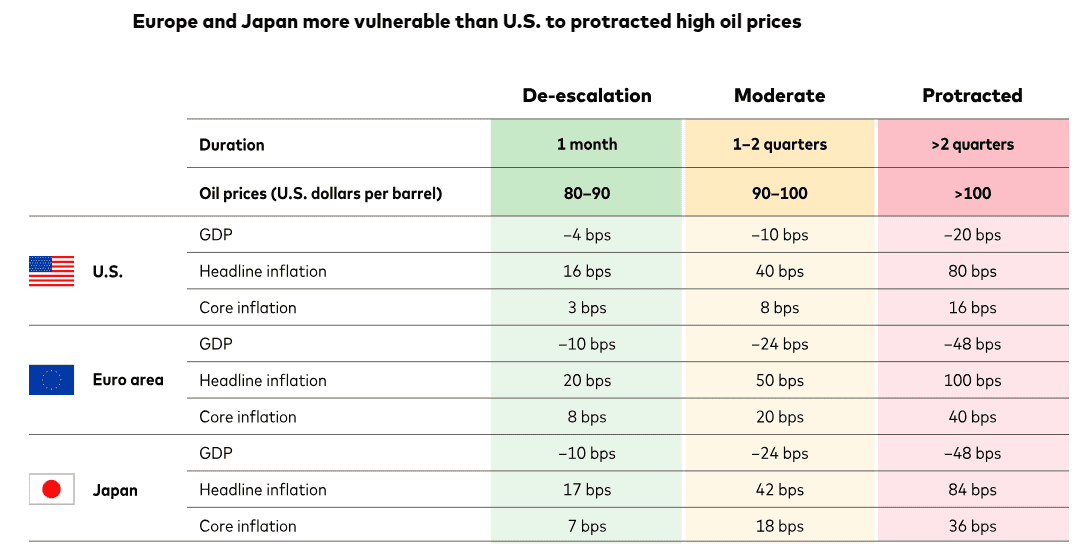
Research from Vanguard earlier this month shows the economic damage that could be caused by a protracted conflict. Europe (including the UK) and Japan are particularly vulnerable to high oil prices.
As we’re all aware, things change hour by hour with President Trump’s policies. The latest is that Iran has — unsurprisingly — rejected a 15-point plan from Washington to end the conflict.
The Footsie is cheap
Needless to say then, it’s too early to tell whether the FTSE 100 is back on track. We don’t yet know the inflationary damage to the UK economy or whether the US and Iran are even talking to one another.
Either way, interest rates are likely going up in 2026. So investors probably aren’t going to be in the mood for higher-risk assets.
But that might benefit the FTSE 100 to some degree, as it’s cheap and many constituents pay generous dividends (the index yield has climbed to 3.2%).
Some might be perfectly satisfied to buy cheap FTSE 100 blue chips, collect any dividends, and wait for a potential snapback rally later this year. If so, investors could consider something like the Vanguard FTSE 100 UCITS ETF.
Perspective helps
When unpredictable events like this develop, I think it helps to keep some perspective as a long-term investor.
For example, look at this chart below from Scottish American Investment Company (LSE:SAIN), or ‘SAINTS’. It shows how the FTSE 250 investment trust has pumped out inflation-busting dividends for many decades.
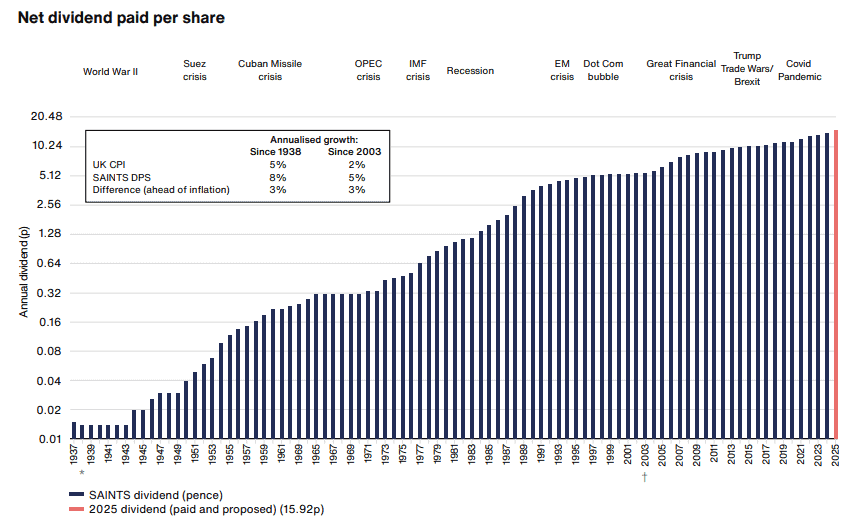
There were multiple oil crises, recessions, and stock market crashes over this period. And some very scary geopolitical events. Yet most of the stocks SAINTS invested in proved resilient enough to pay rising dividends.
And the stock market went up and to the right over time.
But is SAINTS worth considering today? I reckon it might be for investors looking for a steady dividend-paying trust that aims to grow income above inflation. Yielding 3.25%, it has increased the payout for 52 consecutive years.
Top holdings include Taiwan Semiconductor Manufacturing, Apple, Microsoft, and Procter & Gamble.
That said, performance has been disappointing lately, with SAINTS’ ‘quality’ investing style out of favour. Last year, the share price returned just 6.8% versus the FTSE All‑World Index‘s total return of 14.7%.
If performance doesn’t pick up, more investors could dump the shares, widening the current 8.2% discount to net asset value.
On balance, however, I think the potential rewards outweigh the risks. Last year, shareholders enjoyed a 7% increase in the dividend, twice the rate of inflation.