
Finding ways to grow passive income is always appealing. But the market dips we’ve seen recently don’t come around often. As FTSE 100 share prices fall, dividend yields on many blue-chip stocks are quietly rising.
That creates a rare window. Investors buying today aren’t just picking up shares at lower prices — they could be locking in higher income streams for decades to come.
So how much difference could acting now make to the income a portfolio generates in the future?
How small return differences drive passive income
Small changes in annual returns during the contribution phase can have a big impact on future passive income. Over time, even a small gap in performance compounds into something far more meaningful.
The chart below highlights this clearly. By contributing £10,000 each year for 20 years, two different return scenarios — 7% and 9% — lead to very different outcomes.
At first, the gap might look small, but over two decades, the difference compounds dramatically, shaping how much passive income a portfolio can generate in retirement.
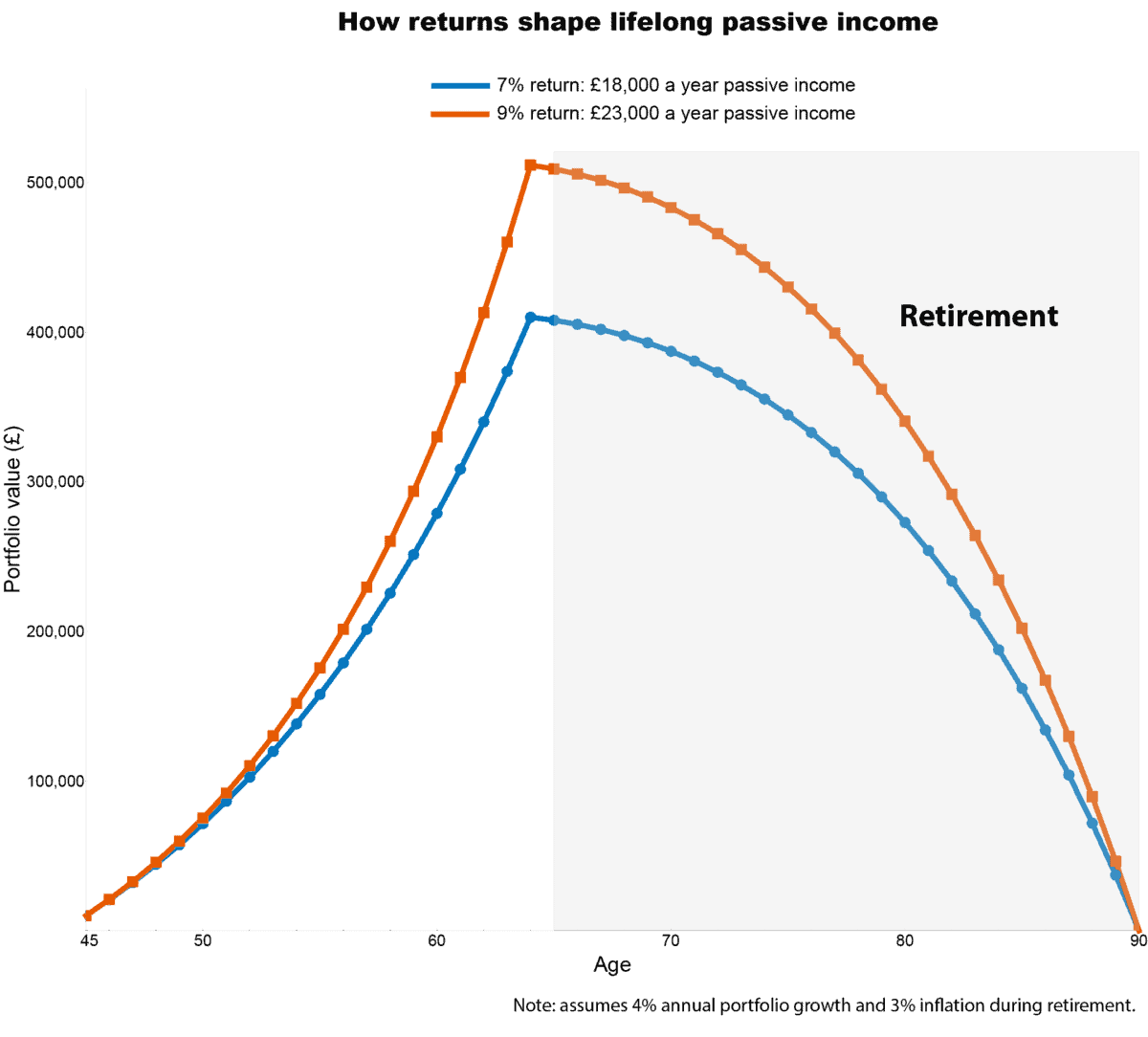
Chart generated by author
After years of compounding, that 2% gap leads to a £100,000 difference in the final portfolio value. Over a 25-year drawdown it could mean roughly £5,000 more in inflation-adjusted passive income each year.
While many FTSE 100 stocks are offering attractive yields, I’ve also been looking further down the market for opportunities.
Dividends and growth
Aberdeen (LSE: ABDN) may not make headlines every day, but its forward momentum is catching my attention. The stock has fallen 13% in the recent sell-off, lifting the dividend yield up to 7.5%. Its growth prospects, however, really stand out.
The company enters 2026 with outflows from its Adviser business at less than half of last year’s levels. Meanwhile, interactive investor continues to gain traction. Its flat pricing and platform innovations are resonating with investors. A recent high-profile outage at Hargreaves Lansdown could hand interactive investor extra market share — a reminder of how crucial trust is in this industry.
Shifting asset allocation
Structural market trends also play in Aberdeen’s favour. Volatility, elevated inflation, and a global shift away from US tech are creating opportunities for its Investments division. Emerging markets, alternative assets, and undervalued regions — areas where the asset manager has deep expertise — could drive growth over the coming years.
To illustrate these shifting trends, Aberdeen’s Gold ETF started with just $10m in 2009 and now manages over $7bn.
Outflows remain a key risk. Aberdeen is targeting a return to net inflows by 2027, but if funds continue to underperform global benchmarks, it may struggle to attract new independent financial advisers to its platform. This could limit future growth and keep pressure on the share price.
Long-term thinking
When markets wobble and the future feels uncertain, savvy investors with a long-term mindset act.
Structural growth drivers remain in place across the investment landscape. The responsibility for funding retirement is increasingly falling on individuals, while the advice gap continues to widen.
Intergenerational wealth from baby boomers will see tens of trillions of pounds transferred over the next 20 years.
These forces are creating opportunities for innovative companies with strong brands that can deliver financial solutions in a complex world.
For long-term investors, this isn’t just about growth — it’s about locking in a steady passive income for decades. And Aberdeen is far from the only opportunity I’m watching.