
I asked ChatGPT how to build £1,000 a month in passive income using an ISA – here’s what it suggested

I asked ChatGPT how to grow passive income in an ISA – then ran the numbers myself to see what really works for the long term.

| More on:

The content of this article was relevant at the time of publishing. Circumstances change continuously and caution should therefore be exercised when relying upon any content contained within this article.

You’re reading a free article with opinions that may differ from The Motley Fool’s Premium Investing Services. Become a Motley Fool member today to get instant access to our top analyst recommendations, in-depth research, investing resources, and more. Learn More.

Friends at the bay near the village of Diabaig on the side of Loch Torridon in Wester Ross, Scotland. They are taking a break from their bike ride to relax and chat. They are laughing together.

Image source: Getty Images

Building a £1,000-a-month passive income (£12,000 a year) from an Individual Savings Account (ISA) isn’t straightforward. When I asked ChatGPT for a plan, it flagged the reality: achieving this requires either very high capital or high-return investments, because Cash ISAs alone won’t get you there.

That left me wondering: could a Stocks and Shares ISA bridge the gap and help reach this goal?

Please note that tax treatment depends on the individual circumstances of each client and may be subject to change in future. The content in this article is provided for information purposes only. It is not intended to be, neither does it constitute, any form of tax advice. Readers are responsible for carrying out their own due diligence and for obtaining professional advice before making any investment decisions.

Size of the pot

ChatGPT quickly calculated the pot I’d need to hit my passive income target – and that’s where it went a bit off the rails!

It suggested that with a Cash ISA at 4% growth, I’d need a £300,000 pot. A Stocks and Shares ISA generating 6% yearly returns could reduce that to £200,000.

The confusion came with the difference between total contributions needed and the pot required to safely sustain £1,000 a month. That’s a subtle but crucial distinction for anyone planning income from an ISA.

Crunching the numbers

First, don’t forget inflation. Over time, it quietly erodes purchasing power. Assuming 2% inflation over a 20-year investing horizon, that £1,000 monthly target effectively rises to £1,486.

Using the classic 4% withdrawal rule, the final pot would need to be £445,800.

The chart below models £10,000 a year contributions into an ISA over 20 years. It shows that even with a 4% Cash ISA return, the target remains out of reach. But with annual investment returns of 8%-9%, achieving the goal becomes realistic.
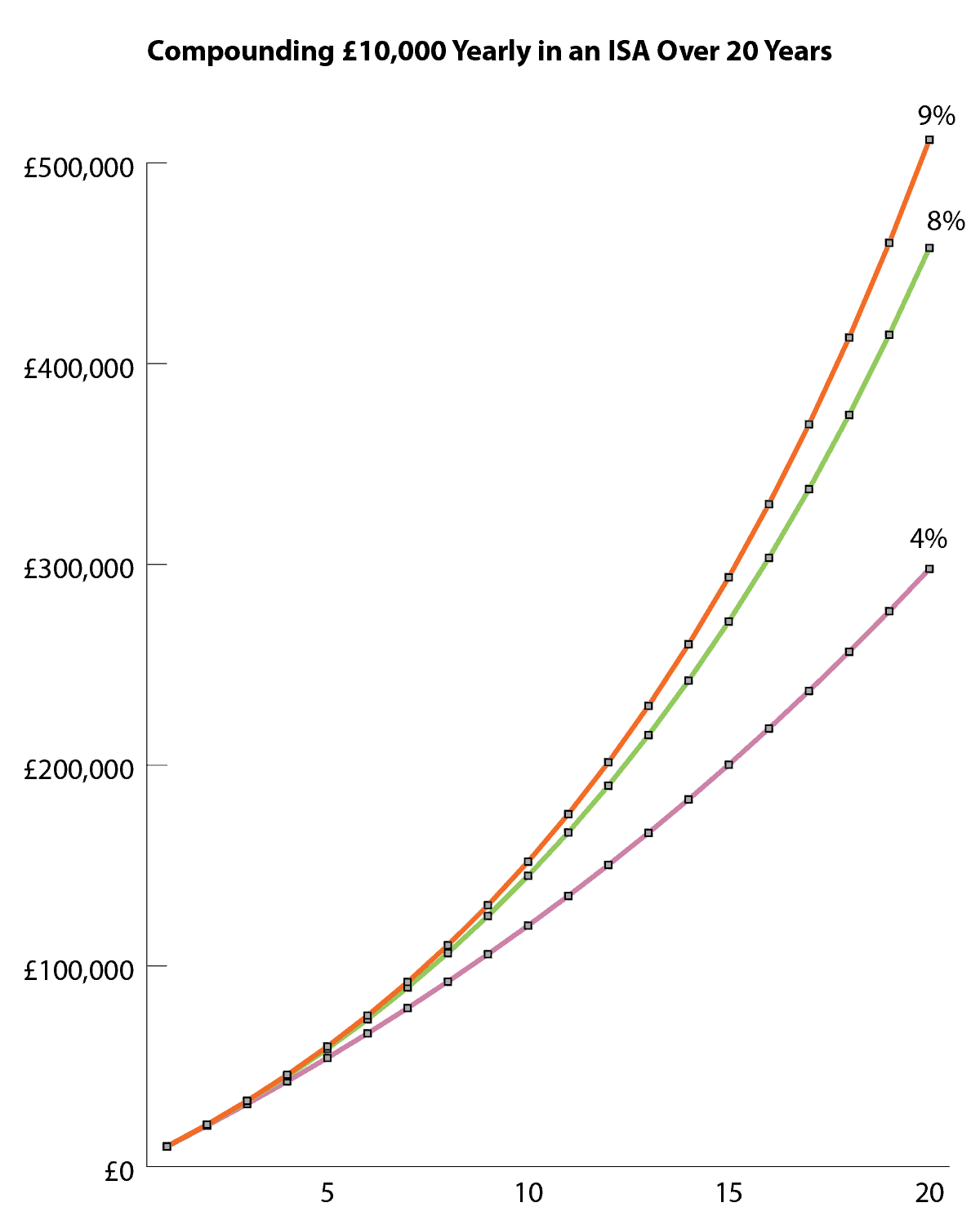
Chart shows compounding an ISA pot over 20 years

Chart generated by author

Constructing a portfolio

Investing isn’t about hitting the target every year – it’s about hitting it on average. Markets deliver good years and bad ones, and that’s unavoidable.

A set-and-forget ETF, like the iShares UK Dividend UCITS ETF, can do a lot of the heavy lifting. It’s had a strong year, combining low double-digit capital growth with a 4.9% dividend yield.

But over the long term, a major bear market can seriously delay recovery – sometimes beyond your investing timeframe. That’s why I don’t rely on one approach. I blend passive investing with active stock picking, targeting high-yield shares for income and a small number of high-conviction growth stocks for long-term outperformance.

A high-yield income stock

Phoenix Group (LSE: PHNX) yields 7.6%, one of the highest dividends in the FTSE 100. Many investors worry about its sustainability because headline IFRS earnings can look weak. For example, last year it generated negative earnings per share.

For insurers, I pay far less attention to those accounting numbers. Profits are distorted by long-term assets backing pensions and life policies.

Instead, I focus on operating capital generation, which strips out the noise. On that measure, the insurer’s cash generation has been strong and, in my view, comfortably supports the dividend.

However, the company relies on stable market conditions and tight cost control to keep funding the dividend. A prolonged market downturn or regulatory change could put pressure on both. Remember, no dividend is ever guaranteed.

Bottom line

For me, building passive income inside an ISA is about patience and balance. I focus on owning high-quality businesses, spreading risk across sectors, and reinvesting income to let compounding do the heavy lifting. Over time, combining reliable dividends with selective growth gives my ISA the best chance to work harder for me.


Andrew Mackie has no position in any of the shares mentioned. The Motley Fool UK has no position in any of the shares mentioned. Views expressed on the companies mentioned in this article are those of the writer and therefore may differ from the official recommendations we make in our subscription services such as Share Advisor, Hidden Winners and Pro. Here at The Motley Fool we believe that considering a diverse range of insights makes us better investors.

More on Investing Articles

Lady wearing a head scarf looks over pages on company financials
Investing Articles

Is April a good time to start buying shares?

Wondering whether now's a good time to start buying shares to build wealth? History suggests it is, says Edward Sheldon.

Read more »

A senior group of friends enjoying rowing on the River Derwent
Investing Articles

How much passive income could a Stocks and Shares ISA pump out every year?

Regular investing inside a Stocks and Shares ISA could lead to the equivalent of £141 a week in tax-free passive…

Read more »

Fans of Warren Buffett taking his photo
Investing Articles

With the FTSE 100 down 5%+ investors should remember this legendary quote from Warren Buffett

Warren Buffett is widely regarded as the greatest investor of all time. And he says that the best time to…

Read more »

Inflation in newspapers
Investing Articles

1 FTSE 100 stock that could benefit from higher inflation

For most companies, inflation is a risk. But for one FTSE 100 firm, higher input costs could be an opportunity…

Read more »

Man hanging in the balance over a log at seaside in Scotland
Investing Articles

The 2026 stock market sell-off could be a rare opportunity to build wealth in an ISA

The recent stock market sell-off has led to some shares falling 20% or more. This could be a great opportunity…

Read more »

Thoughtful man using his phone while riding on a train and looking through the window
Investing Articles

It’s down another 13%! Analysts were dead wrong about the Greggs share price

The Greggs share price continues to fall and analysts have been revising their share price targets down further. Dr James…

Read more »

Burst your bubble thumbtack and balloon background
Investing Articles

Is the stock market about to reach breaking point?

Private credit has a problem with the emergence of artificial intelligence. And it could be set to create issues across…

Read more »

BUY AND HOLD spelled in letters on top of a pile of books. Alongside is a piggy bank in glasses. Buy and hold is a popular long term stock and shares strategy.
Investing Articles

A once-in-a-decade chance to buy this S&P 500 stock?

As investors focus on oil prices and the conflict in Iran, Stephen Wright's looking at potential opportunities in the S&P…

Read more »