
Building a passive income portfolio in the UK doesn’t just require a bucketload of patience and dedication (although they help). Equally as important is a portfolio made of the right FTSE 100 shares.
But what are the ‘right’ shares?
Well, in all honesty, there’s no definitive list of correct shares for such an endeavour. And the fact that the goal posts are constantly changing doesn’t help. Fluctuating interest rates, political instability and foreign tariffs all play a part in where share prices go daily.
That’s why the ideal shares are those that keep a steady head even when times get tough. If your investment outlook is 10 to 20 years (and it should be), then you need shares that will survive the journey.
With that in mind, I’ve identified two dividend shares on the FTSE 100 that have a super-reliable history. Whether preparing for retirement or saving up for a house, I think both are well worth considering.
Unilever
Despite a typically moderate yield, Unilever (LSE: ULVR) is popular for passive income because of its exceptional dividend track record. Spanning nearly a century, it’s paid dividends consistently since 1929, with almost 20 years of uninterrupted growth before Covid.
That alone is impressive — but the real attraction is its resilience to market downturns. Even during the most severe economic downturns (the Great Depression, World War II, the 2008 Financial Crisis, and Covid), Unilever maintained its dividend payments.
The reason for this is the company’s recession-resistant business model. Selling essential goods like food, personal care, and household products means its revenues flow regardless of economic conditions.
It’s worth noting, there’s a risk of unexpected currency fluctuations affecting dividend payments, as Unilever reports in both sterling and euros. Furthermore, its global diversification means returns are at risk from political instability, currency crises and economic volatility.
Still, history has shown it’s one of the most stable of FTSE 100 dividend stocks.
Severn Trent
When thinking of a good utility stock for income, many people turn to National Grid. But while the nation’s core energy grid operator is a great option, Severn Trent (LSE: SVT) actually has a better dividend track record.
What’s more, it’s also performed slightly better over the past 20 years.
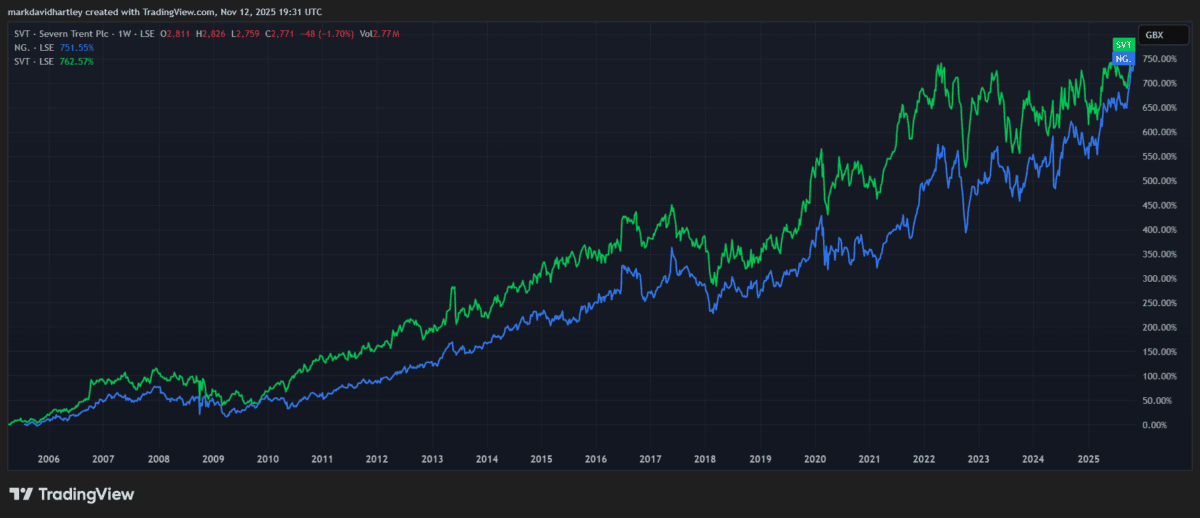
Similar to National Grid, Severn Trent is a regulated utility company serving approximately 4.7m households and businesses across the Midlands and Wales. As a regulated monopoly, the company benefits from predictable, inflation-linked revenue streams with minimal competition.
While nowhere near Unilever’s record, in its 20-year-long history, it’s done surprisingly well. Despite two minor dividend reductions in the past 20 years, overall, dividends have grown at an average rate of 3.53% per year. For example, the company increased dividends from 81p in 2016 to £1.19 in 2024 — approximately 47% growth over eight years.
Another bonus of regulation adds provisions for inflation indexation, ensuring dividend payments keep pace with rising costs. And the essential need for water means revenue remains stable regardless of economic conditions.
But there is one elephant in the room that can’t be ignored: £8.65bn in debt. At that level, even a regulated business is at risk of defaulting — or at least cutting dividends.
Still, with a long-term view, I expect debt will come under control and the company will continue delivering stable income to shareholders.