£5,000 invested in BAE shares 6 years ago is now worth…

Mark Hartley takes a look at the factors that drove a 440% rise in BAE shares since its pandemic lows and whether the spectacular gains can continue.

| More on:

The content of this article was relevant at the time of publishing. Circumstances change continuously and caution should therefore be exercised when relying upon any content contained within this article.

You’re reading a free article with opinions that may differ from The Motley Fool’s Premium Investing Services. Become a Motley Fool member today to get instant access to our top analyst recommendations, in-depth research, investing resources, and more. Learn More.

Artillery rocket system aimed to the sky and soldiers at sunset.

Image source: Getty Images

BAE (LSE:BA) shares have rocketed an incredible 440% since November 2020, making the defence giant one of the FTSE 100’s most remarkable recovery stories. After the pandemic struck, the stock sank to just 341p in late October 2020, as global markets panicked and investors fled anything cyclical.

Fast forward six years, and the shares now trade above 1,800p — near all-time highs.
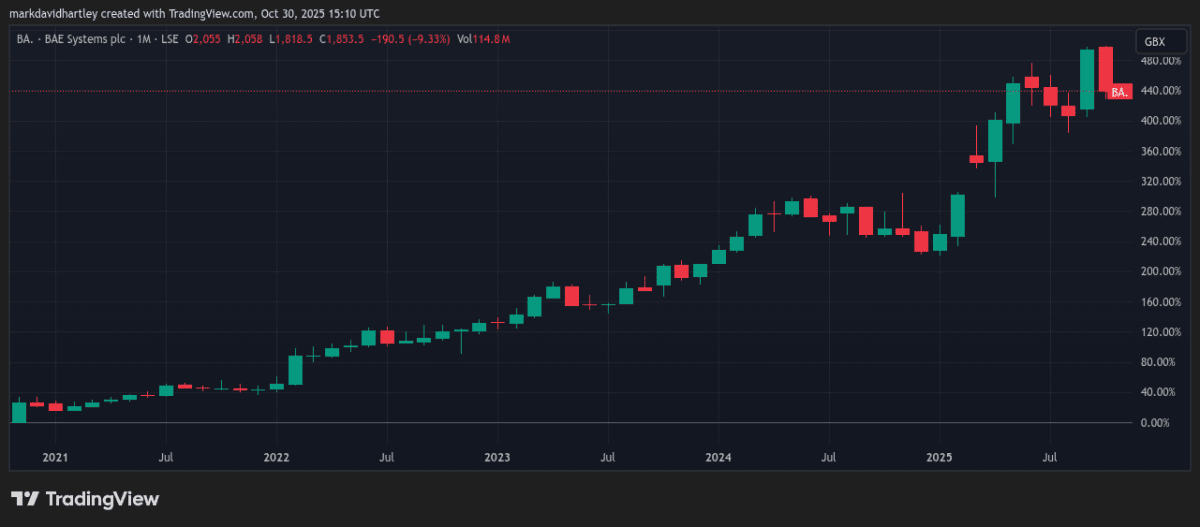
BAE share price 6 years
Created on TradingView.com

An investor bold enough to put £5,000 into BAE shares at their low point would be sitting on roughly £27,000 today, including dividends. That’s the kind of long-term performance many dream of.

But the question now is whether the gains are all gone, or does the stock still deserve a place on an investor’s radar? Let’s take a closer look.

Record-breaking contracts

BAE’s been a clear beneficiary of rising defence budgets across Europe following the war in Ukraine. The company recently confirmed record order books and has raised its full-year guidance twice, citing strong demand for combat systems, submarines and munitions.

Just weeks ago, the group secured a £4.6bn UK-brokered contract to deliver 20 Eurofighter Typhoon jets to Türkiye. That’s one of the biggest export deals for British aerospace in years, supporting thousands of domestic jobs and ensuring steady cash inflows for years to come.

Meanwhile, Norway’s chosen BAE’s Type 26 frigate design for its next-generation naval fleet – another significant export and production win. It’s the same platform adopted by the UK, Australia and Canada, helping BAE establish itself as a cornerstone of allied naval capability.

For investors, these contracts suggest long-term visibility of earnings, and I think that’s something worth weighing up when assessing the company’s valuation today.

A reputational risk

However, it’s not all plain sailing. The company recently faced an uncomfortable story in the press after ending support for its Advanced Turbo-Prop (ATP) aircraft, which has grounded planes used to deliver food aid across Africa. Kenyan operator EnComm claims BAE misled it over the aircraft’s future and is now pursuing legal action.

While the dispute may not have material financial consequences, the reputational damage could prove more significant. For a company increasingly judged on its environmental, social and governance (ESG) standards, this kind of controversy adds a risk factor investors should think about carefully.

Solid financial footing

Financially, BAE remains in excellent health. The group generates strong cash flow from long-term government contracts and has continued to raise its dividend, currently yielding around 2.6%. Guidance has been upgraded twice this year thanks to resilient demand for its electronic systems and submarine programmes.

In an unpredictable global economy, I think it’s still a company with a promising future – one with reliable earnings, solid growth prospects and a shareholder-friendly dividend policy.

Final thoughts

There’s little doubt that BAE has strong commercial momentum, but reputational and legal risks mean investors should weigh up how sustainable this growth truly is. As scrutiny intensifies over the human consequences of defence contracts, the company’s toughest battles may not be fought in the skies – but in the court of public opinion.

Still, demand for its expertise is only rising, so in my view, it remains one of the FTSE 100’s top defensive stocks to consider for long-term growth and income.

Mark Hartley has positions in BAE Systems. The Motley Fool UK has recommended BAE Systems. Views expressed on the companies mentioned in this article are those of the writer and therefore may differ from the official recommendations we make in our subscription services such as Share Advisor, Hidden Winners and Pro. Here at The Motley Fool we believe that considering a diverse range of insights makes us better investors.

More on Investing Articles

Close-up of children holding a planet at the beach
Investing Articles

The stock market is changing fundamentally — and most investors haven’t noticed

Andrew Mackie argues the FTSE 100 is being misread — beneath the volatility, investors are rotating into cash-generating businesses, not…

Read more »

British flag, Big Ben, Houses of Parliament and British flag composition
Investing Articles

FTSE 100 shares: the ‘old economy’ trade the market may be misreading

Andrew Mackie argues recent FTSE 100 volatility is masking a deeper shift, as investors rotate into cash-generative 'old economy' winners.

Read more »

A pastel colored growing graph with rising rocket.
Investing Articles

Down 19% to under £1, here’s why Lloyds shares look a bargain to me anywhere up to £1.80

Lloyds' shares are down a lot in a short time, but the price doesn’t reflect how well the business is…

Read more »

Hydrogen testing at DLR Cologne
Investing Articles

£20,000 invested in Rolls-Royce shares 3 years ago is now worth…

Rolls‑Royce shares are down after a huge surge from 2023, but the numbers suggest this rare dip could be a…

Read more »

ISA Individual Savings Account
Investing Articles

How big must an ISA be to aim for a £25,000+ a year second income?

Ahead of the 5 April ISA deadline, I double-checked I had fully utilised my tax-free allowance by topping up my…

Read more »

Portrait of pensive bearded senior looking on screen of laptop sitting at table with coffee cup.
Investing For Beginners

Why the Marks & Spencer share price fell 12% in March

Jon Smith points out why the Marks & Spencer share price underperformed last month, and explains why the outlook is…

Read more »

DIVIDEND YIELD text written on a notebook with chart
Investing Articles

How many Greggs shares does someone need to earn a £1,000 monthly passive income?

When share prices fall, dividend yields go up. And in that situation, investors looking for passive income can find unusually…

Read more »

Thoughtful man using his phone while riding on a train and looking through the window
Investing Articles

Aviva shares are still up strongly — so why has the yield jumped back above 6%?

Andrew Mackie looks beyond the cyclical noise in Aviva shares to show a capital-light transformation and re-rating story the market…

Read more »