
Phoenix share price may be flat, but its 8.3% yield could build a strong second income

The Phoenix share price has gone nowhere in five years, but its market-beating dividend yield could still deliver solid passive income over time.

| More on:
Rear view image depicting a senior man in his 70s sitting on a bench leading down to the iconic Seven Sisters cliffs on the coastline of East Sussex, UK. The man is wearing casual clothing - blue denim jeans, a red checked shirt, navy blue gilet. The man is having a rest from hiking and his hiking pole is leaning up against the bench.

Image source: Getty Images

When investing, your capital is at risk. The value of your investments can go down as well as up and you may get back less than you put in.

Read More

The content of this article is provided for information purposes only and is not intended to be, nor does it constitute, any form of personal advice. Investments in a currency other than sterling are exposed to currency exchange risk. Currency exchange rates are constantly changing, which may affect the value of the investment in sterling terms. You could lose money in sterling even if the stock price rises in the currency of origin. Stocks listed on overseas exchanges may be subject to additional dealing and exchange rate charges, and may have other tax implications, and may not provide the same, or any, regulatory protection as in the UK.

You’re reading a free article with opinions that may differ from The Motley Fool’s Premium Investing Services. Become a Motley Fool member today to get instant access to our top analyst recommendations, in-depth research, investing resources, and more. Learn More.

Despite limited share price progress in recent years, the Phoenix (LSE: PHNX) share price continues to reward patient investors through reliable dividends. With one of the highest yields in the FTSE 100 and a solid record of payout growth, the insurer still offers appeal for those focused on building steady passive income over time.

Steady accumulator

Over the last 10 years, the insurer’s dividends per share (DPS) have grown at a compound annual growth rate of around 3.2%.

For income chasers, I believe it’s important to use historical DPS growth as a guide when modelling future returns. A 3% annual increase in the cash cost of the dividend looks a realistic assumption.

The following chart shows how a £5,000 investment could grow over the next 15 years, assuming a flat share price.
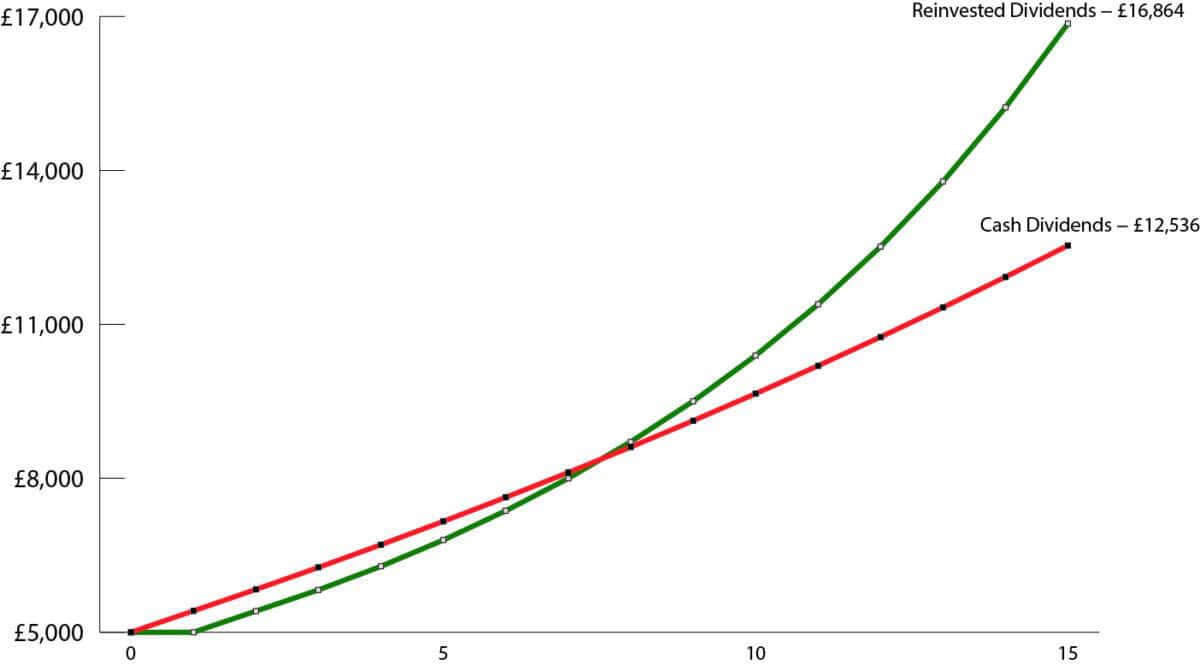
Chart generated by author

The key takeaway is that compounding is an investor’s best friend. Reinvesting dividends to buy additional income-generating units creates an exponentially growing curve, far more powerful than the linear growth achieved by withdrawing cash each year.

Dividend sustainability

It is all well and good building a future income model, but I also need confidence that profits will keep growing to sustain those payouts.

Phoenix operates with a clear capital allocation framework, with dividend increases linked to three factors.

First, and most importantly, is operating capital generation (OCG). At H1 2025, OCG stood at £705m, of which only £274m was paid out in dividends. That leaves the business with plenty of headroom to reinvest for growth.

Second is the solvency coverage ratio, currently 175%, placing it in the upper half of its operating range. Such a high figure reflects a robust balance sheet capable of absorbing financial shocks.

Finally, distributable reserves are extremely healthy at £5.5bn, up 20% year on year.

Accounting quirk

The insurer’s H1 results highlighted that shareholders’ equity, based on statutory accounting principles (IFRS), fell 37% to £768m. However, on an adjusted basis it came in at £3.5bn, a substantial discrepancy.

The company explained the decline as an “accounting mismatch” between IFRS and its preferred Solvency II framework. Under IFRS, long-term investment contracts such as annuities are valued using fixed economic assumptions, while Solvency II re-values them each period to reflect market conditions. Consequently, this can lead to vastly different valuation metrics for individual financial assets.

It may just be an accounting quirk, but if IFRS shareholders’ equity fails to recover over time, investors may begin to question the long-term sustainability of the dividend.

Bottom line

For now, Phoenix remains one of the FTSE 100’s most reliable income plays. The share price may be static, but the dividend is well-covered, supported by strong capital generation and solid reserves.

For patient investors seeking predictable cash flow and gradual compounding, the stock is worthy of consideration, even if capital growth remains elusive.



Should you invest, the value of your investment may rise or fall and your capital is at risk. Before investing, your individual circumstances should be assessed. Consider taking independent financial advice.

Andrew Mackie has no position in any of the shares mentioned. The Motley Fool UK has no position in any of the shares mentioned. Views expressed on the companies mentioned in this article are those of the writer and therefore may differ from the official recommendations we make in our subscription services such as Share Advisor, Hidden Winners and Pro. Here at The Motley Fool we believe that considering a diverse range of insights makes us better investors.

More on Investing Articles

Close-up of British bank notes
Investing Articles

Down 23%, this passive income stock offers a 10.4% dividend yield!

This FTSE 250 share offers a double-digit dividend yield. And City analysts expect shareholder payouts to keep rising to 2030.

Read more »

Road 2025 to 2032 new year direction concept
Investing Articles

£20,000 in BP shares can net investors a £1,232 second income…

BP shares have been bumpy lately but there's a terrific dividend income stream on offer and Harvey Jones says it…

Read more »

Front view of aircraft in flight.
Investing Articles

Rolls-Royce shares just got an Outperform rating

A 10% dip in Rolls-Royce shares since September hasn't deterred one analyst team from giving the FTSE 100 stock a…

Read more »

Night Takeoff Of The American Space Shuttle
Investing Articles

3 FTSE 250 shares to target a 14.8% annual return

Discover which FTSE 250 growth shares have torn higher over the last decade -- and why Royston Wild thinks they…

Read more »

Middle aged businesswoman using laptop while working from home
Investing Articles

I asked ChatGPT to design a 5% yielding passive income ISA from 5 FTSE 250 shares and it said…

Harvey Jones asked artificial intelligence to create a passive income stream from a balanced portfolio from medium-sized UK companies. The…

Read more »

Snowing on Jubilee Gardens in London at dusk
Investing Articles

Will the stock market crash before Christmas?

Christmas is fast approaching. Could the uncertainty in the markets lead to a stock market crash before presents get opened?

Read more »

Portsmouth, England, June 2018, Portsmouth port in the late evening
Investing Articles

What will happen to the UK stock market in 2026? Here’s what experts think

UK stocks have had one of the best years of the century, but can that momentum continue into 2026? Our…

Read more »

Illustration of flames over a black background
Investing Articles

Why are investors on this trading platform piling in to an AI-threatened US stock?

James Beard tries to work out why this US stock’s attracting a lot of interest even though it could be…

Read more »