
No savings at 50? Consider ETFs to target a £572k retirement fund

Discover how exchange-traded funds (ETFs) can be used to generate significant wealth — and a top index tracker I think investors should consider.

| More on:

The content of this article was relevant at the time of publishing. Circumstances change continuously and caution should therefore be exercised when relying upon any content contained within this article.

Hand is turning a dice and changes the direction of an arrow symbolizing that the value of an ETF (Exchange Traded Fund) is going up (or vice versa)

Image source: Getty Images

You’re reading a free article with opinions that may differ from The Motley Fool’s Premium Investing Services. Become a Motley Fool member today to get instant access to our top analyst recommendations, in-depth research, investing resources, and more. Learn More.

Exchange-traded funds (ETFs) are a rapidly-growing asset class among global investors. With eligibility for tax-efficient products like Individual Savings Accounts (ISAs) and Self-Invested Personal Pensions (SIPPs), they can be a value addition to a long-term portfolio.

These funds offer a low-cost way for investors to diversify their holdings. And they provide exposure to a wide range of markets and themes. This means they can be tailored to each individual’s specific financial goals, risk appetite and investing style.

Yet while gaining in popularity, a report by the Investment Association (IA) shows that ETF investors “tend to be younger, higher-income and male, with a quarter living in London“.

Indeed, roughly 41% of fund investors are aged between 18-34. That compares with just 17% for those aged 55 and above. The IA believes “a lack of awareness and understanding… is the single biggest barrier preventing many retail investors from considering ETFs“.

Targeting high returns

This is striking, in my opinion, given the huge versatility of these products and the potential they have to generate mammoth returns.

Take a simple tracker fund like the iShares S&P 500 ETF (LSE:CSPX), which mimics the performance of the US index of blue-chip shares. This spreads investors’ capital across hundreds of different companies spanning regions, industries and sub-sectors.

It’s delivered an average annual return of 14.4% over the last five years. And with a total expense ratio of 0.07%, it’s achieved this at extremely low cost to investors.

Past performance isn’t a guarantee of future returns. And in this case, investor profits could disappoint if the recent rotation from US equities into European shares continues.

But on balance I expect S&P funds like this to continue outperforming, thanks in large part to their large weighting of high-performing tech shares like Nvidia, Microsoft and Apple. It’s why I own an S&P 500 fund in my own portfolio.
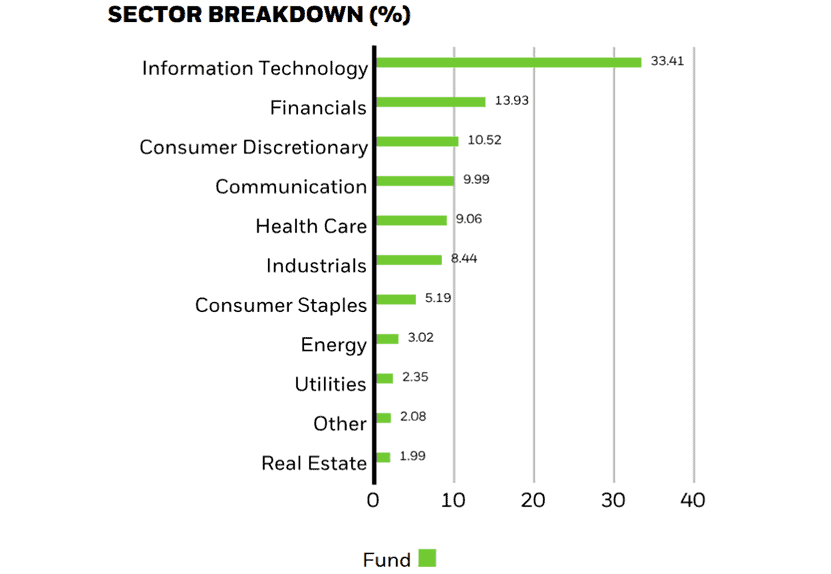
Sector make-up of the iShares S&P 500 ETF
Source: iShares

Achieving a £572k retirement fund

This fund’s performance suggests even someone starting their investing journey late on can make a decent pile of cash for retirement.

Let’s say a 50-year-old invests £500 a month until they reach their State Pension age of 68 (between 2044 and 2046). Based on that S&P 500 fund’s past returns, they’d have a healthy £572,092 nest egg by retirement.

As I said though, there’s a vast range of thematic, sector and index funds that investors can choose from today in anticipation of high returns. The L&G Cyber Security ETF, another fund I hold, has delivered an average annual return of 9% since 2020.

I’ve also bought the Xtrackers MSCI World Momentum ETF for my portfolio, which holds “large and mid-cap companies from global developed markets with high momentum scores“. This fund’s provided an average yearly return of 12.8% during the last half a decade.

Regardless of an investor’s goals and experience, I think funds like this are worth serious consideration for building retirement wealth.


Royston Wild has positions in Legal & General Ucits ETF Plc - L&g Cyber Security Ucits ETF and Xtrackers (ie) Public - Xtrackers Msci World Momentum Ucits ETF. The Motley Fool UK has recommended Apple, Microsoft, and Nvidia. Views expressed on the companies mentioned in this article are those of the writer and therefore may differ from the official recommendations we make in our subscription services such as Share Advisor, Hidden Winners and Pro. Here at The Motley Fool we believe that considering a diverse range of insights makes us better investors.

More on Investing Articles

Hand of person putting wood cube block with word VALUE on wooden table
Investing Articles

UK shares look cheap — but the market might be about to take notice

UK shares have traded at a persistent discount to their US counterparts. This can create huge opportunities, but investors need…

Read more »

Investing Articles

This FTSE 100 growth machine is showing positive signs for a 2026 recovery

FTSE 100 distributor Bunzl is already the second-largest holding in Stephen Wright’s Stocks and Shares ISA. What should his next…

Read more »

Investing Articles

I asked ChatGPT for the best FTSE 100 stocks to buy for passive income in 2026 and it said…

Paul Summers wanted to learn which dividend stocks an AI bot thinks might be worth buying for 2026. Its response…

Read more »

ISA Individual Savings Account
Investing Articles

Stop missing out! A Stocks and Shares ISA could help you retire early

Investors who don't use a Stocks and Shares ISA get all the risks that come with investing but with less…

Read more »

Investing Articles

Will Greggs shares crash again in 2026?

After a horrible 2025, Paul Summers takes a look at whether Greggs shares could sink even further in price next…

Read more »

Investing Articles

This quantum computing growth stock could skyrocket 113%, says 1 broker

One team of analysts on Wall Street have put a $100 price target on this high-growth tech stock. Should I…

Read more »

Black father and two young daughters dancing at home
Investing Articles

Here’s how you can invest £5,000 in UK stocks to earn a second income

Zaven Boyrazian explains how investing £5,000 in UK stocks could potentially unlock a second income of up to £1,100 in…

Read more »

Investing Articles

My top 2 disruptive growth stocks to consider buying in 2026

Looking for stocks to buy? Find out why our writer likes this pair of explosive growth shares that have sold…

Read more »