
With an 8% yield, is the second-largest FTSE 250 stock worth considering?

Our writer considers the value of the second-largest stock on the FTSE 250 with a £4bn market cap and a dividend yield of 8%.

| More on:

The content of this article was relevant at the time of publishing. Circumstances change continuously and caution should therefore be exercised when relying upon any content contained within this article.

Petrochemical engineer working at night with digital tablet inside oil and gas refinery plant

Image source: Getty Images

You’re reading a free article with opinions that may differ from The Motley Fool’s Premium Investing Services. Become a Motley Fool member today to get instant access to our top analyst recommendations, in-depth research, investing resources, and more. Learn More.

Harbour Energy (LSE: HBR) is a FTSE 250 oil and gas company based in London. With a £4bn market cap, it’s not only the second-largest on the index but also currently larger than the 10 smallest on the FTSE 100. Consequently, it main rejoin the main index in the next reshuffle.

It got demoted from the FTSE 100 in late 2022 after its market cap collapsed below £3bn. However, it catapulted back above £4bn again in early September last year after finalising the acquisition of the upstream assets of German oil and gas producer Wintershall Dea.

The acquisition represents a significant expansion for the company, pushing production up to 475,000 barrels of oil equivalent per day (boepd). According to a press release, it’s now “one of the world’s largest and most geographically diverse independent oil and gas companies.”

Assessing viability

Harbour certainly seems to be enthusiastically expanding its business but oil and gas is a tough industry. Prospecting for new wells can be expensive and at times, can yield no returns. Many independent companies experience long periods of losses and mounting debt with no guarantee of a recovery.

When assessing oil and gas companies, it’s important to consider how many years of reserves they hold. The potential value of an as-yet untapped reserve depends on its commercial viability.

Successful explorations amount to assets on the balance sheet and then slowly decrease as they are depleted. As incoming cash is used to fund new explorations, the company can quickly fall back into a low valuation.

Thus, accurately assessing the investment viability of an oil and gas company can prove difficult. This is often made most evident by a wildly fluctuating price-to-earnings (P/E) ratio.

Value and dividends
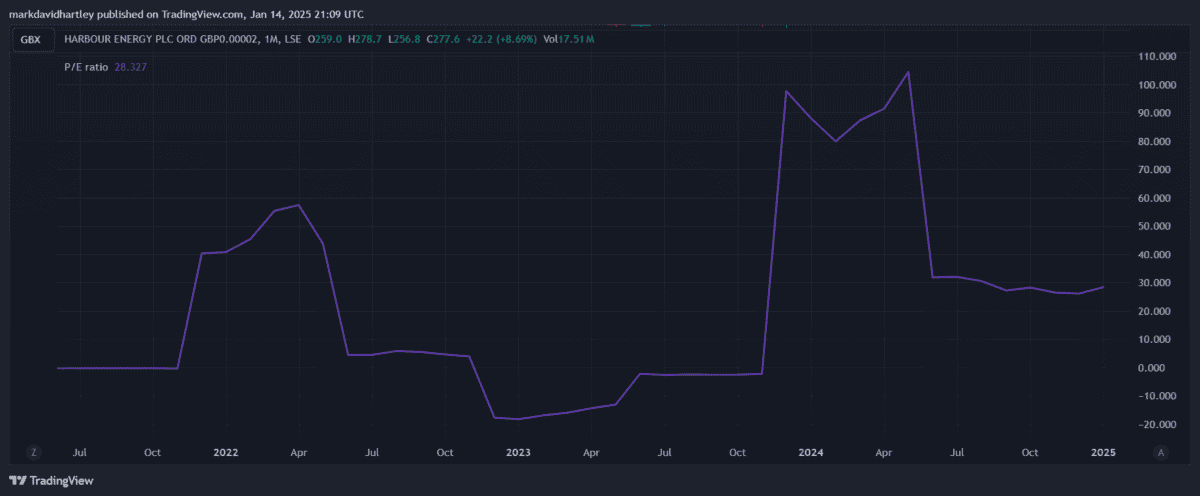
Harbour Energy P/E ratio
TradingView.com

In the graph above, we can see how Harbour’s trailing P/E ratio has moved in a range between -18 and +105 over the past few years.

Currently, it’s positive and sits around 28, which looks expensive for investors considering it now. But the recent boost in production means earnings are forecast to improve significantly, so it has a forward P/E ratio of only 10.

That means the current share price of 277p could be very cheap, prompting analysts to forecast an average 12-month price target of 370p — a 33% increase!

An extra 8% in dividends on top of that would be the cherry on top. But with almost no track record of payments, it’s impossible to say whether its dividends are reliable.

With no steady or consistent cash flow, energy companies can be unreliable when it comes to dividends. Last year, for instance, Diversified Energy Company slashed its dividend and the yield fell from 15% to 7.2%.

Subsequently, I wouldn’t factor in the dividend when assessing the long-term value of Harbour.

Further advancements

But in December 2024, Harbour enjoyed further good news. In cooperation with partner Ithaca Energy, it discovered hydrocarbons in the Jocelyn South prospect in the North Sea. Of course, while the discovery is promising, the commercial viability of it still needs to be evaluated. As ever, there’s a risk it could cost a lot and amount to little.

While Harbour’s developments seem promising, I don’t plan to buy it today. However, it may be worth considering for risk-tolerant investors keen on emerging energy stocks.


Mark Hartley has no position in any of the shares mentioned. The Motley Fool UK has no position in any of the shares mentioned. Views expressed on the companies mentioned in this article are those of the writer and therefore may differ from the official recommendations we make in our subscription services such as Share Advisor, Hidden Winners and Pro. Here at The Motley Fool we believe that considering a diverse range of insights makes us better investors.

More on Investing Articles

Illustration of flames over a black background
Investing Articles

Recently released: December’s higher-risk, high-reward stock recommendation [PREMIUM PICKS]

Fire ideas will tend to be more adventurous and are designed for investors who can stomach a bit more volatility.

Read more »

Abstract 3d arrows with rocket
Growth Shares

Will the SpaceX IPO send this FTSE 100 stock into orbit?

How can British investors get exposure to SpaceX? Here is one FTSE 100 stock that might be perfect for those…

Read more »

Array of piggy banks in saturated colours on high colour contrast background
Investing Articles

Could drip-feeding £500 into the FTSE 250 help you retire comfortably?

Returns from FTSE 250 shares have rocketed to 10.6% over the last year. Is now the time to plough money…

Read more »

Passive and Active: text from letters of the wooden alphabet on a green chalk board
Investing Articles

How much does one need in an ISA for £2,056 monthly passive income?

The passive income potential of the Stocks and Shares ISA is higher than perhaps all other investments. Here's how the…

Read more »

Finger clicking a button marked 'Buy' on a keyboard
Investing Articles

The best time to buy stocks is when they’re cheap. Here’s 1 from my list

Buying discounted stocks can be a great way to build wealth and earn passive income. But investors need to be…

Read more »

Bus waiting in front of the London Stock Exchange on a sunny day.
Investing Articles

Martin Lewis just explained the stock market’s golden rule

Unlike cash, the stock market can quietly turn lump sums into serious wealth. So, what’s the secret sauce that makes…

Read more »

Close-up of British bank notes
Investing Articles

£5,000 invested in Greggs shares at the start of 2025 is now worth…

This year's been extremely grim for FTSE 250-listed Greggs -- but having slumped more than 40%, could its shares be…

Read more »

Investing Articles

Looking for shares to buy as precious metals surge? 3 things to remember!

Gold prices have been on a tear. So has silver. So why isn't this writer hunting for shares to buy…

Read more »