
Share your opinion and earn yourself a free Motley Fool premium report!

We are looking for Fools to join a 75 minute online independent market research forum on 15th / 16th December.

To find out more and express your interest please click here

With a P/E ratio of 3.4, is the cheapest stock on the FTSE 100 index a bit of a bargain?

After applying a popular valuation technique to all the stocks on the FTSE 100 index, our writer’s found the cheapest. But should he buy it?

| More on:

The content of this article was relevant at the time of publishing. Circumstances change continuously and caution should therefore be exercised when relying upon any content contained within this article.

This way, That way, The other way - pointing in different directions

Image source: Getty Images

You’re reading a free article with opinions that may differ from The Motley Fool’s Premium Investing Services. Become a Motley Fool member today to get instant access to our top analyst recommendations, in-depth research, investing resources, and more. Learn More.

I believe the stock on the FTSE 100 index that’s presently offering the best value (at least in statistical terms) is Pershing Square Holdings (LSE:PSH). That’s because it has the lowest historical price-to-earnings ratio (P/E) of all 100 companies.

With a current (13 September) market cap of £6.52bn — and net income for the year ended 31 December 2023 (FY23) of $2.54bn (£1.93bn) — it has a P/E ratio of 3.4.

That’s very low (the average for the index as a whole is four times higher) and suggests the stock could be in bargain territory.

Or is it?

Crunching the numbers

The first thing to note is that Pershing Square is not a trading company, it’s an investment trust. Therefore, its P/E ratio is not particularly meaningful.

For investment trusts, a better measure of value for money is to compare its market cap with the net asset value (NAV) of the companies in which it’s invested. At 31 August 2024, its NAV was £50.98. At the moment, its shares are changing hands for around £35.60, meaning they trade at a 30% discount.

This is a big differential. For comparison, the Scottish Mortgage Investment Trust discount is 12%.

Again, Pershing Square looks cheap to me.

What’s more, the return on its investments has beaten the wider market since it was formed in 2004. During this period, it’s achieved annualised growth of 15.7%. This compares to a 10.1% return from the S&P500.
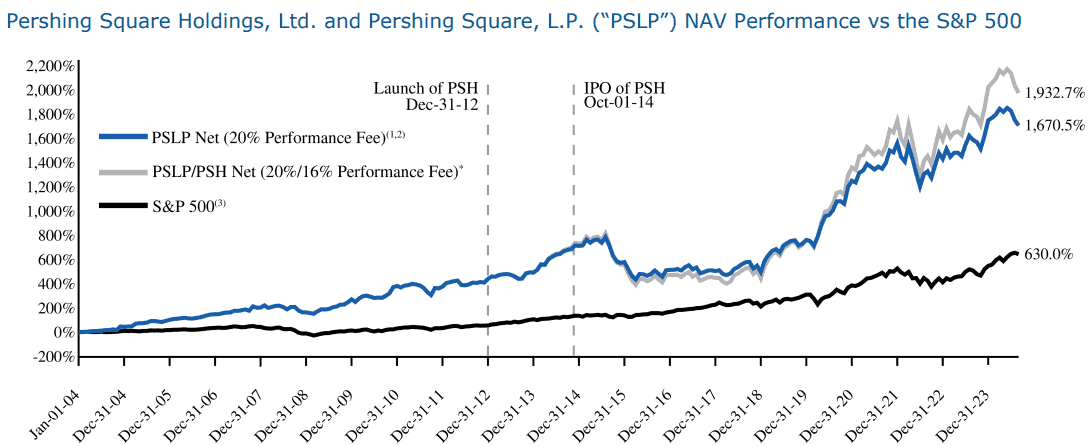
Source: company reports

This performance has helped contribute to a 124% increase in the trust’s share price, since September 2019.

What’s not to like?

All this sounds very positive.

Who wouldn’t want to buy into a something that’s selling for significantly less than the value of its investments, and has a long track record of delivering growth?

Well, I do have some concerns.

First, its portfolio is concentrated in a small number of stocks.

It typically invests in eight to 12 North American companies. Current holdings include Universal Music Group, Hilton, Restaurant Brands International and Alphabet.

The principal reason for investing in a trust is to spread the risk across multiple companies through just one shareholding. This advantage is diminished with such a small number of positions.

I’m also wary that the trust is 100% exposed to North America. There’s increased speculation that a recession is coming there, which would severely impact, for example, the leisure companies that Pershing Square has in its portfolio.

Also, its investment manager charges an annual fee of 1.46%.  I’m sure it will argue this is justified given its performance. But I feel this is expensive — Scottish Mortgage’s manager charges 0.3%.

What should I do?

However, taking these concerns into account, now could be a good time to invest.

The significant discount to its NAV is attractive. I’d have to pay approximately 30% more if I wanted to invest in the same companies that Pershing Square has in its portfolio.

Of course, we all know that shares can go down. But there’s presently quite a big buffer which gives some downside protection.

That’s why it’s going on my watch list for when I next have some spare cash.

Suzanne Frey, an executive at Alphabet, is a member of The Motley Fool’s board of directors. James Beard has no position in any of the shares mentioned. The Motley Fool UK has recommended Alphabet. Views expressed on the companies mentioned in this article are those of the writer and therefore may differ from the official recommendations we make in our subscription services such as Share Advisor, Hidden Winners and Pro. Here at The Motley Fool we believe that considering a diverse range of insights makes us better investors.

More on Investing Articles

Young woman holding up three fingers
Investing Articles

Want to start investing in 2026? 3 things to get ready now!

Before someone is ready to start investing in the stock market, our writer reckons it could well be worth them…

Read more »

Investing Articles

Can the stock market continue its strong performance into 2026?

Will the stock market power ahead next year -- or could its recent strong run come crashing down? Christopher Ruane…

Read more »

Businessman hand stacking money coins with virtual percentage icons
Investing Articles

Here’s how someone could invest £20k in an ISA to target a 7% dividend yield in 2026

Is 7% a realistic target dividend yield for a Stocks and Shares ISA? Christopher Ruane reckons that it could be.…

Read more »

A quiet morning and an empty Victoria Street in Edinburgh's historic Old Town.
Investing Articles

How little is £1k invested in Greggs shares in January worth now?

Just how much value have Greggs shares lost this year -- and why has our writer been putting his money…

Read more »

Businessman using pen drawing line for increasing arrow from 2024 to 2025
Investing Articles

This cheap FTSE 100 stock outperformed Barclays, IAG, and Games Workshop shares in 2025 but no one’s talking about it

This FTSE stock has delivered fantastic gains in 2025, outperforming a lot of more popular shares. Yet going into 2026,…

Read more »

Close-up of British bank notes
Investing Articles

100 Lloyds shares cost £55 in January. Here’s what they’re worth now!

How well have Lloyds shares done in 2025? Very well is the answer, as our writer explains. But they still…

Read more »

Thoughtful man using his phone while riding on a train and looking through the window
Investing Articles

How much do you need in an ISA to target £2,000 a month of passive income

Our writer explores a passive income strategy that involves the most boring FTSE 100 share. But when it comes to…

Read more »

Investing Articles

£5,000 invested in a FTSE 250 index tracker at the start of 2025 is now worth…

Despite underperforming the FTSE 100, the FTSE 250 has been the place to find some of the UK’s top growth…

Read more »