
The Aviva dividend yield is 7%. I think it could reach 8% — or even 9%!

Our writer already likes the look of the 7% Aviva dividend yield. Could the prospect of a higher prospective yield tempt him to invest?

| More on:

The content of this article was relevant at the time of publishing. Circumstances change continuously and caution should therefore be exercised when relying upon any content contained within this article.

You’re reading a free article with opinions that may differ from The Motley Fool’s Premium Investing Services. Become a Motley Fool member today to get instant access to our top analyst recommendations, in-depth research, investing resources, and more. Learn More.

Aviva logo on glass meeting room door

Image source: Aviva plc

Looking at the annual shareholder payout from insurer Aviva (LSE: AV), I like what I see. At the moment the Aviva dividend yield is 7%.

I think it could go higher from here. So, should I invest?

Promising dividend outlook

Let me start by explaining why I am upbeat about what might happen to the payout. After all, it is just a few years since we saw an Aviva dividend cut (a reminder that no payout is ever guaranteed to last).
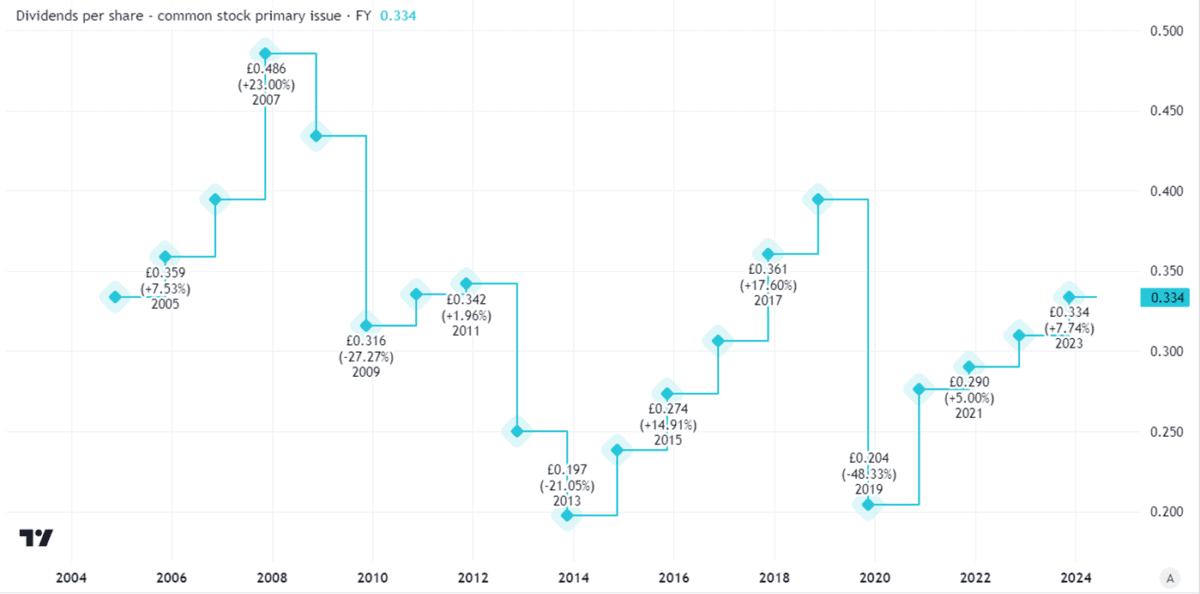
Created using TradingView

There are a couple of ways one might look at this as far as I am concerned.

One is to say that insurance is a cyclical business – rates go up and underwriters do well, then at some point they fall again across the industry and profits shrink.

Another analysis is that Aviva has historically been a ragbag of different businesses, but under current management has become more focussed and has now put its dividend on a more sustainable footing than used to be the case.

Which of these is more true (as both may be valid), only time will tell. But I think there is a lot to like about the business outlook for the insurer, from its large customer base, strong position in the UK market, and brand to its proven underwriting capabilities.

The dividend grew by 7.7% last year. The yield is already 7%. So if the dividend growth rate can continue at its current level, the prospective yield a couple of years from now will be 8% and within five years, the FTSE 100 share will be yielding a juicy 9%.

Balancing risks and rewards

Current management of the company strikes me as competent and realistic. So, for the Aviva dividend to keep growing at a strong clip, the business performance will need to support it.

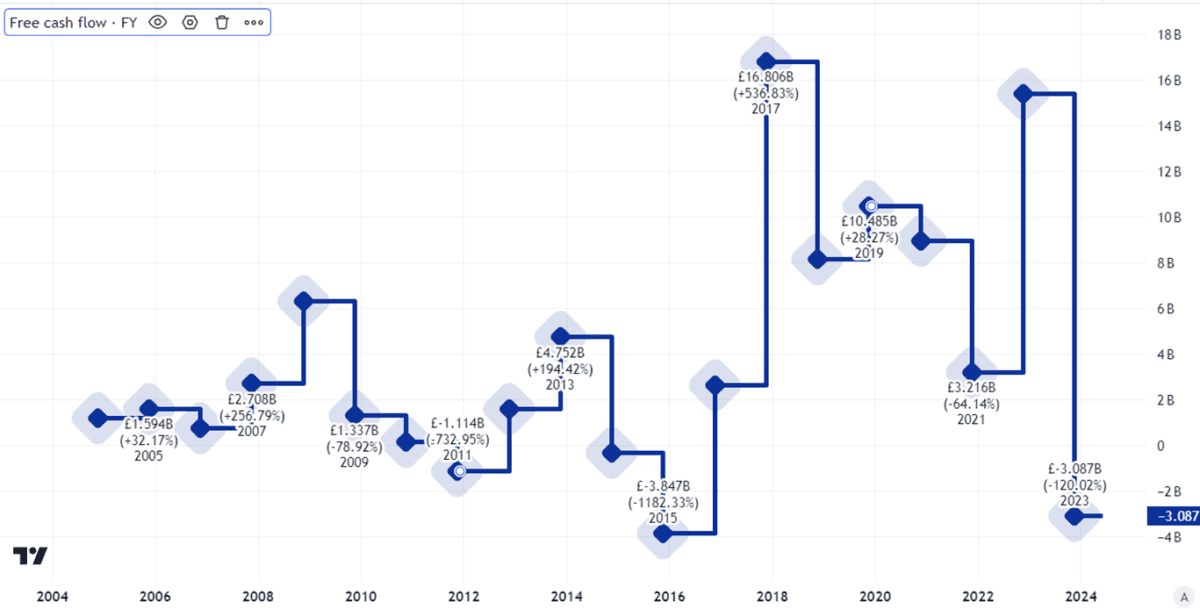
Often when looking at the sustainability of a dividend, I look at a firm’s free cash flow.

Can that help here, though? Look at the chart.
Created using TradingView

Like a lot of financial services firms (especially insurers), free cash flow does not help me as much as it could. It reflects monies coming in and out that do not necessarily illustrate the underlying health of the company.

So I pay more attention to how much surplus capital Aviva generates, as it can use that to help fund its dividend.

Here, I think things look promising. In its full-year results for last year, the company announced a share buyback. It also announced the cash cost of its dividend is set to keep growing by mid-single digits each year. That could be, for example, 5% — but as the buyback reduces the number of shares, that could mean a higher per share growth in the payout.

If I had spare cash to invest, the potential of a growing Aviva dividend would make me want to add this income share to my portfolio.


C Ruane has no position in any of the shares mentioned. The Motley Fool UK has no position in any of the shares mentioned. Views expressed on the companies mentioned in this article are those of the writer and therefore may differ from the official recommendations we make in our subscription services such as Share Advisor, Hidden Winners and Pro. Here at The Motley Fool we believe that considering a diverse range of insights makes us better investors.

More on Investing Articles

UK financial background: share prices and stock graph overlaid on an image of the Union Jack
Investing Articles

2 top growth stocks to consider for an ISA in April

The UK market is home to some fantastic under-the-radar growth stocks trading at very reasonable valuations. Here are two of…

Read more »

Warren Buffett at a Berkshire Hathaway AGM
Investing Articles

Could thinking like Warren Buffett help create a market-beating ISA?

Christopher Ruane zooms in on some aspects of Warren Buffett's investing approach he thinks could help an ambitious ISA investor…

Read more »

British pound data
Investing Articles

£10,000 invested in a FTSE 100 index tracker at the start of March is now worth…

Anyone who invested money in a FTSE 100 index tracker at the start of the month may wish to look…

Read more »

Chalkboard representation of risk versus reward on a pair of scales
Investing Articles

Should investors consider Rolls-Royce shares as war rocks global markets?

Investors who thought Rolls-Royce shares had grown too expensive might have second thoughts as Iran turmoil rattles the FTSE 100,…

Read more »

Young black woman walking in Central London for shopping
Investing Articles

Some lucky ISA investors could pick up £2,000 for free in the next month. Here’s how

The UK government is handing out free money to some ISA investors to help them save for retirement. Here’s a…

Read more »

DIVIDEND YIELD text written on a notebook with chart
Investing Articles

Is this the best time to buy dividend shares since Covid-19?

A volatile stock market gives investors a chance to buy shares with unusually high dividend yields. Stephen Wright highlights one…

Read more »

UK financial background: share prices and stock graph overlaid on an image of the Union Jack
Investing Articles

Are we staring at a once-in-a-decade chance to buy this beaten-down UK growth stock?

Investors couldn't get enough of this FTSE 100 growth stock, but the last 10 years have been pretty frustrating. Could…

Read more »

Person holding magnifying glass over important document, reading the small print
Investing Articles

What I look for when searching for shares to buy

There’s a lot that goes into finding shares to buy. Ultimately though, it comes down to two things: numbers that…

Read more »