
Share your opinion and earn yourself a free Motley Fool premium report!

We are looking for Fools to join a 75 minute online independent market research forum on 15th / 16th December.

To find out more and express your interest please click here

Already 7%, could the Aviva dividend yield go higher?

Our writer considers Aviva’s dividend prospects. It has an inconsistent track record — but what do the chances look like from here?

| More on:

The content of this article was relevant at the time of publishing. Circumstances change continuously and caution should therefore be exercised when relying upon any content contained within this article.

Aviva logo on glass meeting room door

Image source: Aviva plc

You’re reading a free article with opinions that may differ from The Motley Fool’s Premium Investing Services. Become a Motley Fool member today to get instant access to our top analyst recommendations, in-depth research, investing resources, and more. Learn More.

One of the attractions of buying shares in a proven FTSE 100 business can be the income potential from dividends. Insurer Aviva (LSE: AV) is an example. The Aviva dividend yield is currently 7%.

Could it go higher from here – and ought I to buy this share for my ISA?

Uneven dividend history

At first glance, the dividend story here looks strong. Ordinary shareholder payouts have grown annually for the past few years.  Last year, for example, the dividend increased by 7%.

But as a long-term investor, I consider more than just the most recent data when I can. Looking back over the past decade and more, we can see that the dividend has been cut more than once.
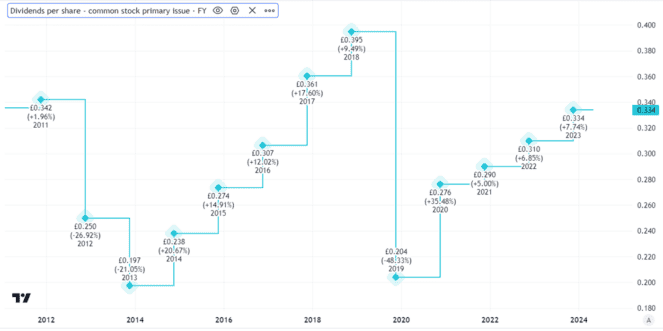
Created using TradingView

Dividends are never guaranteed at any company. The chart demonstrates what this has meant in practice. Aviva dividend growth has been healthy more than once before, only for the payout to be cut at some later point.

Reshaped company with strong prospects

Still, just because that has happened before does not necessarily mean it will again.

Over recent years, Aviva has changed the shape of its business significantly. It sold multiple ops, distributing some of the proceeds in the form of a special dividend (not represented in the chart above).

That has allowed it to focus its energy on key markets, such as the UK. It has a number of competitive advantages, including a large customer base, strong brands including Norwich Union and deep experience in underwriting.

So far, however, the results may not be obvious from the company’s profit performance. Basic earnings per share improved last year but that followed a run of declining performance.
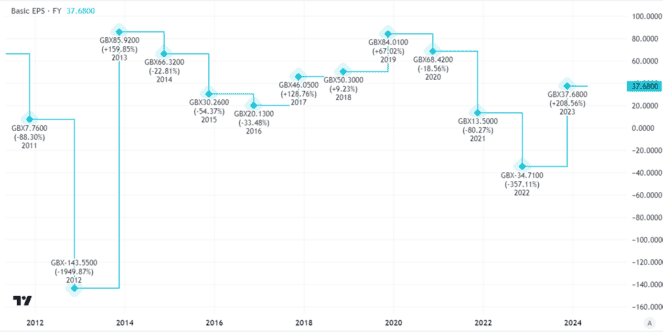
Created using TradingView

Earnings are an accounting measure, so do not always provide the most useful info when it comes to valuing financial services firms. They can move around a lot due to changes in the value of assets a firm holds on its books, something that may bear little relation to cash flows.

When it comes to Aviva’s dividend, cash flows matter because ultimately a dividend is a means for a company to distribute surplus cash.

Here again, the company’s performance has moved around a lot.
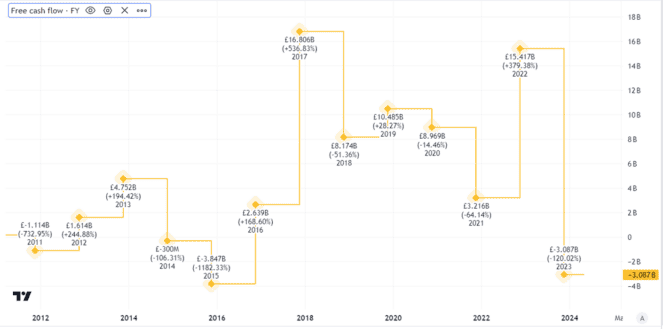
Created using TradingView

What gives me confidence though, is that Aviva has demonstrated that it can generate significant excess cash even though the amount may move around from one year to the next.

One measure of that is what is known as ‘Solvency II operating own funds generation’. Last year that came in at £1.7bn, 12% higher than the prior year.

Future prospects look good

If Aviva can continue to generate surplus cash at a high level — which I think it likely can — then I expect the dividend to grow from here. The company says it expects to grow the cash cost of the dividend, which if the share count remains the same means the per share payout should go up. The prospective Aviva dividend yield would be higher than 7% in that case.

There are risks along the way. Poor underwriting choices could unexpectedly hurt profits, as happened at rival Direct Line last year. Its increased focus on the UK market also ties Aviva more closely to the UK economy: a recession could make policyholders more price-sensitive, hurting renewal rates.

But the income prospects attract me. If I had spare cash to invest, I would be happy to buy Aviva shares.


C Ruane has no position in any of the shares mentioned. The Motley Fool UK has no position in any of the shares mentioned. Views expressed on the companies mentioned in this article are those of the writer and therefore may differ from the official recommendations we make in our subscription services such as Share Advisor, Hidden Winners and Pro. Here at The Motley Fool we believe that considering a diverse range of insights makes us better investors.

More on Investing Articles

Young woman holding up three fingers
Investing Articles

Want to start investing in 2026? 3 things to get ready now!

Before someone is ready to start investing in the stock market, our writer reckons it could well be worth them…

Read more »

Investing Articles

Can the stock market continue its strong performance into 2026?

Will the stock market power ahead next year -- or could its recent strong run come crashing down? Christopher Ruane…

Read more »

Businessman hand stacking money coins with virtual percentage icons
Investing Articles

Here’s how someone could invest £20k in an ISA to target a 7% dividend yield in 2026

Is 7% a realistic target dividend yield for a Stocks and Shares ISA? Christopher Ruane reckons that it could be.…

Read more »

A quiet morning and an empty Victoria Street in Edinburgh's historic Old Town.
Investing Articles

How little is £1k invested in Greggs shares in January worth now?

Just how much value have Greggs shares lost this year -- and why has our writer been putting his money…

Read more »

Businessman using pen drawing line for increasing arrow from 2024 to 2025
Investing Articles

This cheap FTSE 100 stock outperformed Barclays, IAG, and Games Workshop shares in 2025 but no one’s talking about it

This FTSE stock has delivered fantastic gains in 2025, outperforming a lot of more popular shares. Yet going into 2026,…

Read more »

Close-up of British bank notes
Investing Articles

100 Lloyds shares cost £55 in January. Here’s what they’re worth now!

How well have Lloyds shares done in 2025? Very well is the answer, as our writer explains. But they still…

Read more »

Thoughtful man using his phone while riding on a train and looking through the window
Investing Articles

How much do you need in an ISA to target £2,000 a month of passive income

Our writer explores a passive income strategy that involves the most boring FTSE 100 share. But when it comes to…

Read more »

Investing Articles

£5,000 invested in a FTSE 250 index tracker at the start of 2025 is now worth…

Despite underperforming the FTSE 100, the FTSE 250 has been the place to find some of the UK’s top growth…

Read more »