
With no savings in 2024, I’d use Warren Buffett’s golden rules to build wealth

Building wealth with no existing savings may feel like an impossible task, but it’s not. Dr James Fox explains how Warren Buffett can guide us.

The content of this article was relevant at the time of publishing. Circumstances change continuously and caution should therefore be exercised when relying upon any content contained within this article.

Young black colleagues high-fiving each other at work

Image source: Getty Images

You’re reading a free article with opinions that may differ from The Motley Fool’s Premium Investing Services. Become a Motley Fool member today to get instant access to our top analyst recommendations, in-depth research, investing resources, and more. Learn More.

Warren Buffett stands out as one of history’s most accomplished investors, having built a net worth in excess of $120bn.

Since 1970, he has led Berkshire Hathaway, an American multinational conglomerate holding company, that now boasts a valuation of $777bn.

And thankfully, Buffett has share many nuggets of wisdom with investors over the years. So what are his golden rules and how can they help me turn an empty portfolio into a thriving one?

Start saving

If I’m going to start investing, I’m going to need to begin putting some money aside. It doesn’t matter that I may not have any savings, but I can put some of my salary aside to fuel my financial goals. Some investing platforms could allow me to do this with just £50 a month, or less.

Don’t lose money

Buffett’s “don’t lose money” mantra highlights the disproportionate impact of losses on investment goals.

If I invest poorly and lose 50%, I need a 100% gain to recover. That’s a very important lesson to remember and it should shape my investment decision process.

This emphasis on capital preservation stems from the asymmetric nature of gains and losses.

Buffett’s strategy prioritises safeguarding capital to minimise the challenging task of recovering from substantial declines.

The margin of safety

Buffett’s investment strategy involves a margin-of-safety approach. This means finding a significant gap between the market’s valuation of a company and my own valuation, providing a cushion against market fluctuations.

In order to find my own margin of safety, I should undertake research into a company’s intrinsic value, evaluating its fundamentals and potential risks.

Finding value

There are plenty of ways to value a company. There are simple methods that include the use metrics such as the price-to-earnings (P/E) ratio or my personal favourite, the price/earnings-to-growth.

By comparing the P/E ratio with peers, I can develop an idea as to whether a stock is cheap for its sector.

However, most metrics, on their own at least, don’t give us a complete picture. By using a combination I can gain a more complete understanding of a company’s current worth relative to its peers.

Another method is using a discounted cash flow model. This requires me to forecast how much cash flow a company will have over a set period and then offset that against the value of time. Thankfully, there are online resources to help me with this.

Let it compound

Compounding, a cornerstone of Buffett’s strategy, is the process of reinvesting earnings to generate additional returns over time. The so-called ‘Oracle of Omaha’ recognises its transformative power, often calling it the eighth wonder of the world.

The exponential growth potential of compounding underscores the importance of starting early and maintaining a disciplined, buy-and-hold investment approach for enduring financial success.

So what could this mean for £50 a month? Well, over the course of his career, Buffett has generated annual returns averaging roughly 22%, an incredible record that approximately doubles the S&P 500.

But let’s take a still-ambitious, but more achievable, 12% annualised return. Here’s how my wealth could grow.
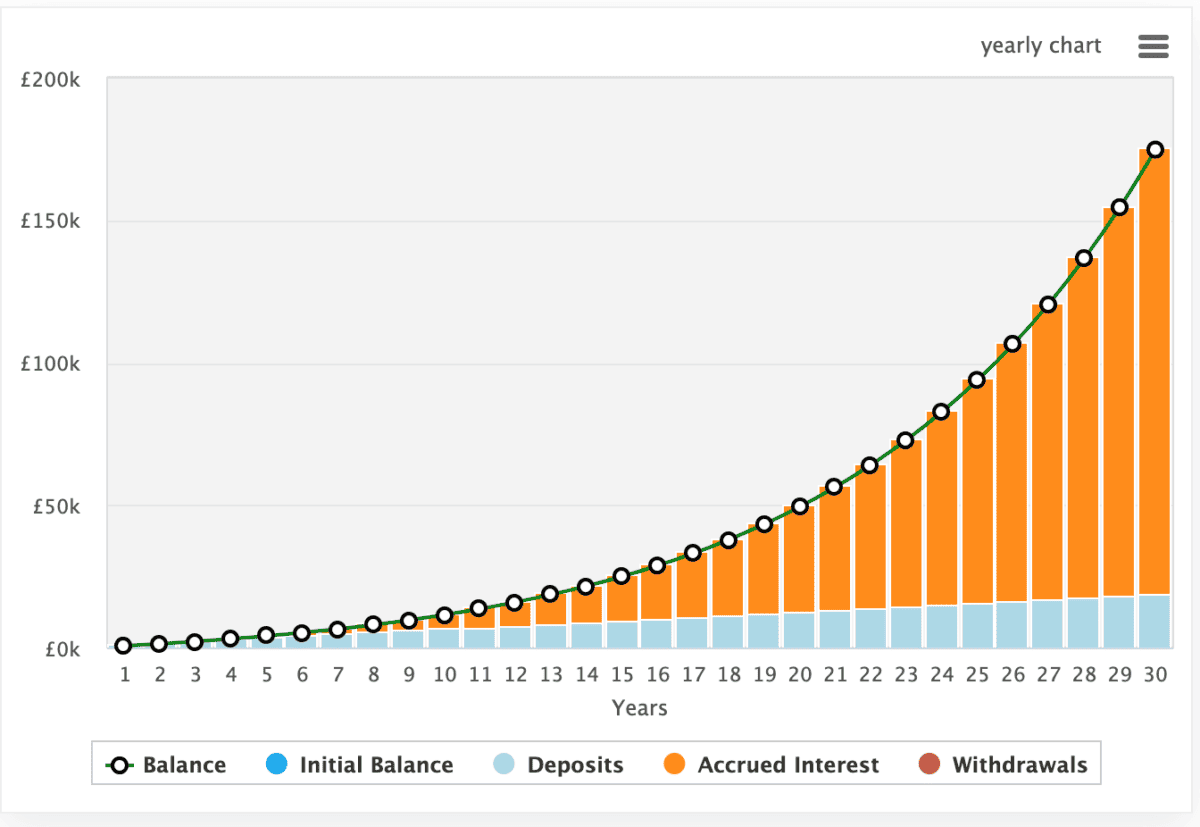

Created at thecalculatorsite.com

James Fox has no position in any of the shares mentioned. The Motley Fool UK has no position in any of the shares mentioned. Views expressed on the companies mentioned in this article are those of the writer and therefore may differ from the official recommendations we make in our subscription services such as Share Advisor, Hidden Winners and Pro. Here at The Motley Fool we believe that considering a diverse range of insights makes us better investors.

More on Investing Articles

Snowing on Jubilee Gardens in London at dusk
Investing Articles

Is it time to consider gobbling up these 3 FTSE 100 Christmas turkeys?

Our writer looks at the pros and cons of buying three of the FTSE 100’s (INDEXFTSE:UKX) worst performers over the…

Read more »

Investing Articles

Are Rolls-Royce shares a ticking time bomb after a 95% gain in 2025?

Rolls-Royce shares have been defying predictions of a fall for years now, while consistently smashing through analyst expectations.

Read more »

Hand of person putting wood cube block with word VALUE on wooden table
Investing Articles

I asked ChatGPT for a discounted cash flow analysis for Lloyds shares. This is what it said…

AI software can do complicated calculations in seconds. James Beard took advantage and asked ChatGPT for its opinion on the…

Read more »

UK financial background: share prices and stock graph overlaid on an image of the Union Jack
Investing Articles

Back to glory: is Aston Martin poised for growth stock stardom in 2026?

Growth stock hopes for Aston Martin quickly evaporated soon after flotation in 2018. But forecasts show losses narrowing sharply.

Read more »

British coins and bank notes scattered on a surface
Investing Articles

UK dividend stocks could look even more tempting if the Bank of England cuts rates this week!

Harvey Jones says returns on cash are likely to fall in the coming months, making the income paid by FTSE…

Read more »

Investing Articles

Up 115% with a 5.5% yield – are Aviva shares the ultimate FTSE 100 dividend growth machine?

Aviva shares have done brilliantly lately, and the dividend's been tip-top too. Harvey Jones asks if it's one of the…

Read more »

Investing Articles

How much do you need in a SIPP or ISA to target a second income of £36,000 a year in retirement?

Harvey Jones says a portfolio of FTSE 100 shares is a brilliant way to build a sustainable second income, and…

Read more »

Workers at Whiting refinery, US
Investing Articles

I own BP shares. Should I be embarrassed?

With more of a focus on ethical and overseas investing, James Beard considers whether it’s time to remove BP shares…

Read more »