
Here’s how the FTSE 100 breaks 9,000 in 2024

What does 2024 have in store for the FTSE 100? Could the index break 9,000 next year? Here’s how a monster Footsie year might be on the cards.

The content of this article was relevant at the time of publishing. Circumstances change continuously and caution should therefore be exercised when relying upon any content contained within this article.

You’re reading a free article with opinions that may differ from The Motley Fool’s Premium Investing Services. Become a Motley Fool member today to get instant access to our top analyst recommendations, in-depth research, investing resources, and more. Learn More.

2024 year number handwritten on a sandy beach at sunrise

Image source: Getty Images

Will the FTSE 100 reach 9,000 next year? That record number won’t be easy – it’s a 19% upswing. But stranger things have happened, so let’s look at how the index might surprise us all in 2024. 

Interest rates might have the biggest impact. With inflation fading, some have predicted five cuts to interest rates next year. Cheaper rates mean cheaper borrowing and more consumer spending. All of which could help the Footsie push higher.

If investor sentiment improves, a double-digit return isn’t much of a stretch. Since the FTSE 100’s inception in 1984, the index has returned 10% or more about half the time. Several of those years returned above 19% too.
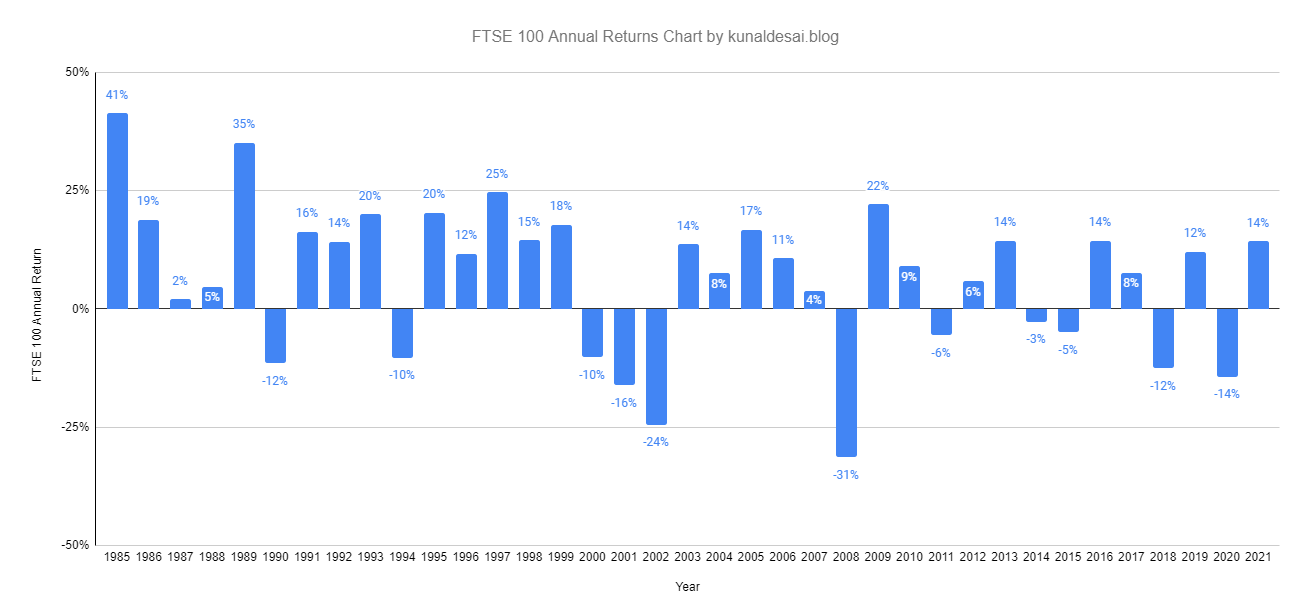
Source: kunaldesai.blog

The FTSE 100 annual returns in the above chart show an interesting trend. The biggest increases often follow a big decrease. This might seem obvious. After all, markets are volatile and sometimes stocks are cheaper than their true value. 

Well, the FTSE 100 looks astonishingly cheap at present. The index has an average price-to-earnings ratio of 11. Just 11 years of earnings to match the entire market capitalisation? That sounds low all on its own, but let’s put it into context. 

Cheap or pricey

The S&P 500 P/E ratio is around 25, comfortably more than double. Relative to its price, the average Footsie company is making over double the profit of a US counterpart. This chasm in valuations is why some of our best and brightest firms like ARM Holdings are listing across the pond. 

Okay, US stocks are expensive, but that’s been true for a while. Perhaps the US isn’t a fair comparison. What about other countries?

Well, the German DAX average P/E is around 15, the Japanese Nikkei is around 16, and the French CAC 40 is around 34. Wherever you look, the story is the same. Britain is home to unusually depressed valuations. 

Stocks haven’t always been this cheap either. The CAPE (cyclically adjusted price-to-earnings ratio) can help us compare valuations to past ones. The CAPE is an inflation-adjusted 10-year P/E ratio. 

The FTSE 100 CAPE is around 19 as I write. In other words, comparing current prices to the last 10 years, stocks look very, very cheap. 

No guarantees

Cheap stocks do often precede a rise in share prices, but it’s not guaranteed. Likewise, the Bank of England has made no promises about reducing rates in the near future. There are several big ifs here. 

Perhaps the biggest obstacle is that 9,000 is a long way away. A 19% rise over the next year has only happened a few times. The FTSE 100 is going to need a monster 2024. 

No one knows whether that will happen or not, but I’ll be crossing my fingers.

John Fieldsend has no position in any of the shares mentioned. The Motley Fool UK has no position in any of the shares mentioned. Views expressed on the companies mentioned in this article are those of the writer and therefore may differ from the official recommendations we make in our subscription services such as Share Advisor, Hidden Winners and Pro. Here at The Motley Fool we believe that considering a diverse range of insights makes us better investors.

More on Investing Articles

Front view of aircraft in flight.
Investing Articles

Should I buy Rolls-Royce shares after the 9% dip?

Up a mind-blowing 1,040% in five years, Rolls-Royce shares are taking a well-deserved breather. Is this my chance to be…

Read more »

Businesswoman calculating finances in an office
Investing Articles

Legal & General’s share price just fell 6%, pushing the dividend yield to 9%. Time to consider buying?

Legal & General's share price is now about 14% below its 2026 high. As a result, the dividend yield on…

Read more »

This way, That way, The other way - pointing in different directions
Investing Articles

Which are the best stocks to buy ahead of a potential market crash?

Should investors follow Warren Buffett and stop buying stocks to build cash reserves? Or are there better ways to prepare…

Read more »

British pound data
Investing Articles

This critical stock market indicator’s flashing red! Should investors be worried?

As a key sign of market overvaluation starts declining, our writer weighs up the likelihood of a stock market crash…

Read more »

Passive income text with pin graph chart on business table
Dividend Shares

1 FTSE 100 share for potent passive income!

I love earning passive income -- money made outside of work. Right now, I'm working on claiming a bigger share…

Read more »

A graph made of neon tubes in a room
Investing Articles

3 dividend shares tipped to increase payouts by 40% (or more) by 2028

Mark Hartley examines the forecasts of three dividend shares expected to make huge jumps in the coming three years. But…

Read more »

BUY AND HOLD spelled in letters on top of a pile of books. Alongside is a piggy bank in glasses. Buy and hold is a popular long term stock and shares strategy.
Investing Articles

A stock market crash could be a massive passive income opportunity

Passive income investors might be drawn towards the huge dividend yields on offer in a stock market crash. But is…

Read more »

Transparent umbrella under heavy rain against water drops splash background.
Investing Articles

Legal & General yields 8.9% — but how secure is the dividend?

Legal & General has increased its dividend per share again and launched a massive share buyback. The City seems lukewarm…

Read more »