
Could the beaten-down Lloyds share price hit 80p?

The Lloyds share price has suffered further in recent weeks despite an earnings beat. Currently, the highest target price is 80p. Is that achievable?

| More on:

The content of this article was relevant at the time of publishing. Circumstances change continuously and caution should therefore be exercised when relying upon any content contained within this article.

Businessman use electronic pen writing rising colorful graph from 2023 to 2024 year of business planning and stock investment growth concept.

Image source: Getty Images

You’re reading a free article with opinions that may differ from The Motley Fool’s Premium Investing Services. Become a Motley Fool member today to get instant access to our top analyst recommendations, in-depth research, investing resources, and more. Learn More.

The Lloyds (LSE:LLOY) share price is at its lowest point in two and a half years. At 40p, shares in the UK’s second largest bank are currently cheaper than they were after the Silicon Valley Bank fiasco that sent financial stocks into meltdown in March.

The vast majority of brokerages have ‘buy’ ratings on Lloyds. In fact, there’s been no ‘sell’ rating published in 2023. That’s a really positive sign.

The average price target is currently 60.7p, representing a 50% increase from the current position. However, Goldman Sach has a price target of 80p — 100% above the current share price.

So, is it realistic to imagine Lloyds hitting 80p? Let’s explore.

Medium-term tailwind

There are several reasons to assume that the next few years will be more lucrative with fewer default concerns.

That’s because interest rates appear to have peaked. And that means we’re likely to see central bank rates fall closer to the so-called Goldilock Zone.

Under normal economic conditions — that is, not a severe recession — lenders theoretically perform best when interest rates are between 2% and 3%.

That’s because they can still achieve strong margins when lending cash, but concerns about customers defaulting fall as interest repayments moderate.

In turn, banks can also benefit from something called a structural hedge. This is where banks allocate their resources to typically fixed income assets, in order to reduce the impact of interest rate fluctuations.

Additionally, this strategy provides an advantage when interest rates peak and start falling.

For instance, in the context of a bond portfolio, lower-yield bonds that mature can be replaced with higher-yield bonds, effectively creating a cushion against the impact of falling interest rates.

And we’re not talking small figures. The hedge boost is highlighted in the Hargreaves Lansdown research below.
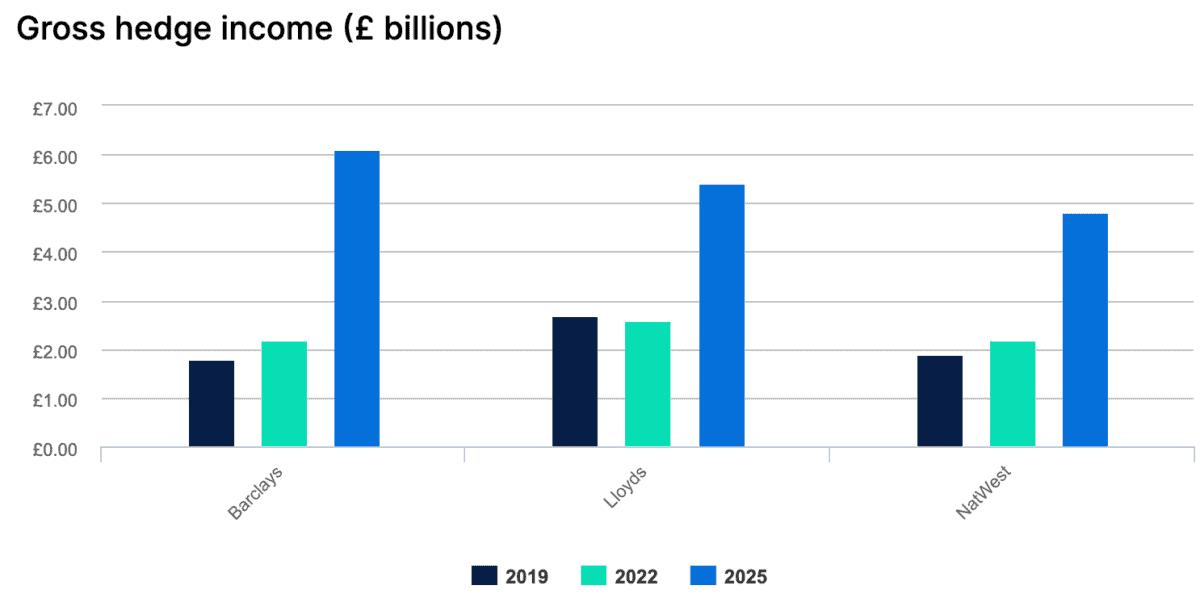
Source: Hargreaves Lansdown

Valuation

Lloyds shares are being pulled down for several reasons. This includes negative outlooks on the UK economy, unrealised bond losses, and the threat of widespread credit defaults.

Personally, I’m not concerned about unrealised bond losses. However, a recession in the UK could really do damage to the lending market.

Nonetheless, these risks, which I believe are rather overblown, contribute to the very attractive valuation of the company.

Let’s start by looking at the discount afforded to Lloyds versus peers HSBC and JP Morgan on a price-to-sales basis.
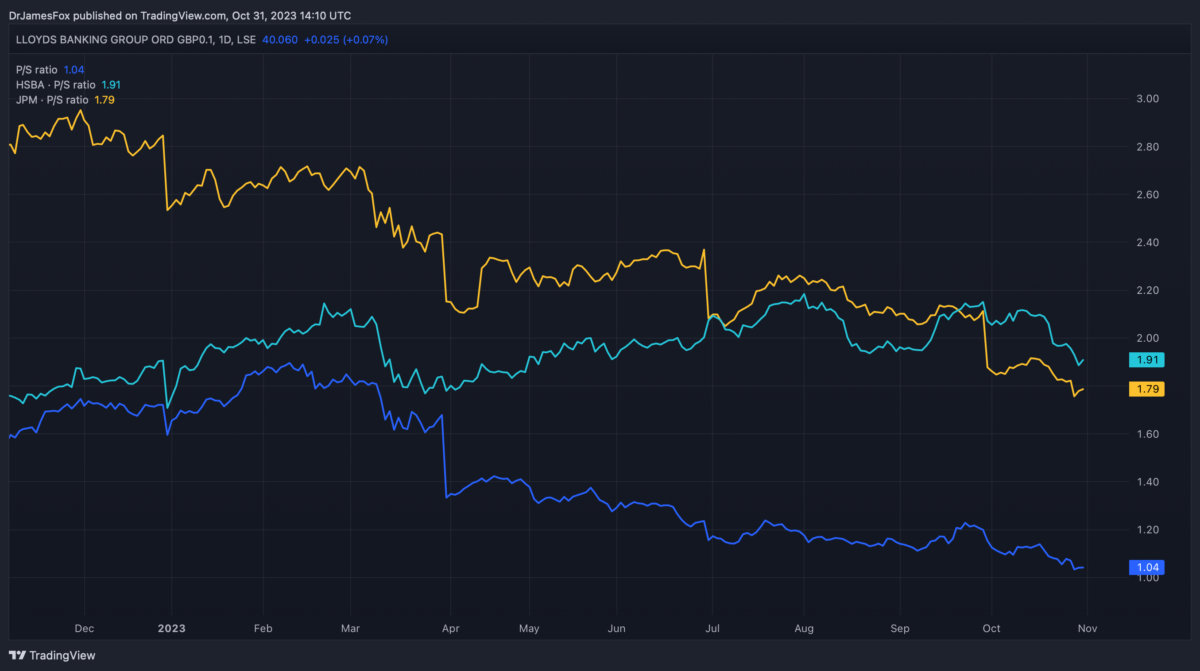
Created at TradingView

Moreover, it’s also apparent that this discount exists when we look at other metrics. Below we can see the same companies on a price-to-book comparison.
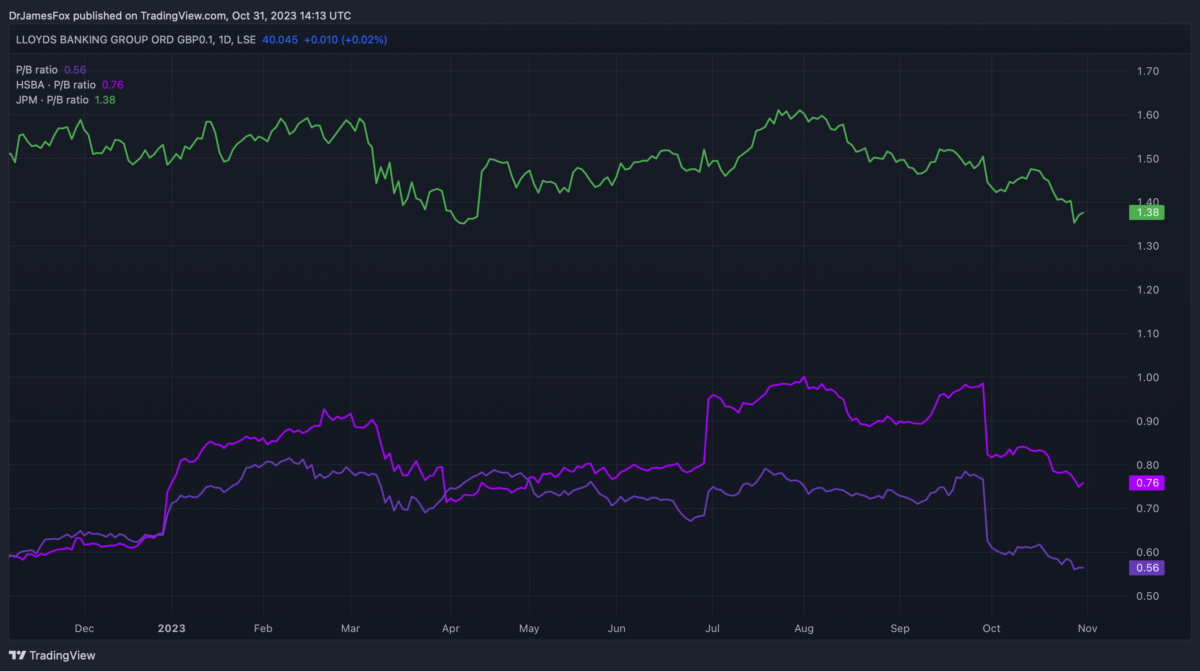
Created at TradingView

So, using some simple calculations based on these metrics, it’s not hard to see how Lloyds could be worth 80p. On a P/B and P/S basis, its broadly half the price of JP Morgan.

However, it’s not always that simple. For now, UK-focused banks are suffering from poor investor sentiment.

An improving UK economy — all of Lloyds loans are in the UK — and strengthening results in the medium term should remedy this.

Personally, I’m holding my Lloyds shares as a core part of my portfolio. If I had the capital, I’d buy more.


HSBC Holdings is an advertising partner of The Ascent, a Motley Fool company. JPMorgan Chase is an advertising partner of The Ascent, a Motley Fool company. James Fox has positions in Hargreaves Lansdown Plc and Lloyds Banking Group Plc. The Motley Fool UK has recommended HSBC Holdings, Hargreaves Lansdown Plc, and Lloyds Banking Group Plc. Views expressed on the companies mentioned in this article are those of the writer and therefore may differ from the official recommendations we make in our subscription services such as Share Advisor, Hidden Winners and Pro. Here at The Motley Fool we believe that considering a diverse range of insights makes us better investors.

More on Investing Articles

Illustration of flames over a black background
Investing Articles

Recently released: December’s higher-risk, high-reward stock recommendation [PREMIUM PICKS]

Fire ideas will tend to be more adventurous and are designed for investors who can stomach a bit more volatility.

Read more »

Abstract 3d arrows with rocket
Growth Shares

Will the SpaceX IPO send this FTSE 100 stock into orbit?

How can British investors get exposure to SpaceX? Here is one FTSE 100 stock that might be perfect for those…

Read more »

Array of piggy banks in saturated colours on high colour contrast background
Investing Articles

Could drip-feeding £500 into the FTSE 250 help you retire comfortably?

Returns from FTSE 250 shares have rocketed to 10.6% over the last year. Is now the time to plough money…

Read more »

Passive and Active: text from letters of the wooden alphabet on a green chalk board
Investing Articles

How much does one need in an ISA for £2,056 monthly passive income?

The passive income potential of the Stocks and Shares ISA is higher than perhaps all other investments. Here's how the…

Read more »

Finger clicking a button marked 'Buy' on a keyboard
Investing Articles

The best time to buy stocks is when they’re cheap. Here’s 1 from my list

Buying discounted stocks can be a great way to build wealth and earn passive income. But investors need to be…

Read more »

Bus waiting in front of the London Stock Exchange on a sunny day.
Investing Articles

Martin Lewis just explained the stock market’s golden rule

Unlike cash, the stock market can quietly turn lump sums into serious wealth. So, what’s the secret sauce that makes…

Read more »

Close-up of British bank notes
Investing Articles

£5,000 invested in Greggs shares at the start of 2025 is now worth…

This year's been extremely grim for FTSE 250-listed Greggs -- but having slumped more than 40%, could its shares be…

Read more »

Investing Articles

Looking for shares to buy as precious metals surge? 3 things to remember!

Gold prices have been on a tear. So has silver. So why isn't this writer hunting for shares to buy…

Read more »