
Will rising oil prices make FTSE 100 shares tank?

Oil prices are rising again. Our writer considers what the impact might be on FTSE 100 shares if this trend continues into this winter.

The content of this article was relevant at the time of publishing. Circumstances change continuously and caution should therefore be exercised when relying upon any content contained within this article.

Abstract 3d arrows with rocket

Image source: Getty Images

You’re reading a free article with opinions that may differ from The Motley Fool’s Premium Investing Services. Become a Motley Fool member today to get instant access to our top analyst recommendations, in-depth research, investing resources, and more. Learn More.

Oil prices have been rising for months. Largely as a result of production cuts, Brent crude is up 25% since 30 June. At $93, it’s still $40 below its 2022 peak. But, like many investors, I’ve always assumed that rising oil prices are generally bad for most FTSE 100 shares.

But history suggests I may be wrong.

The evidence

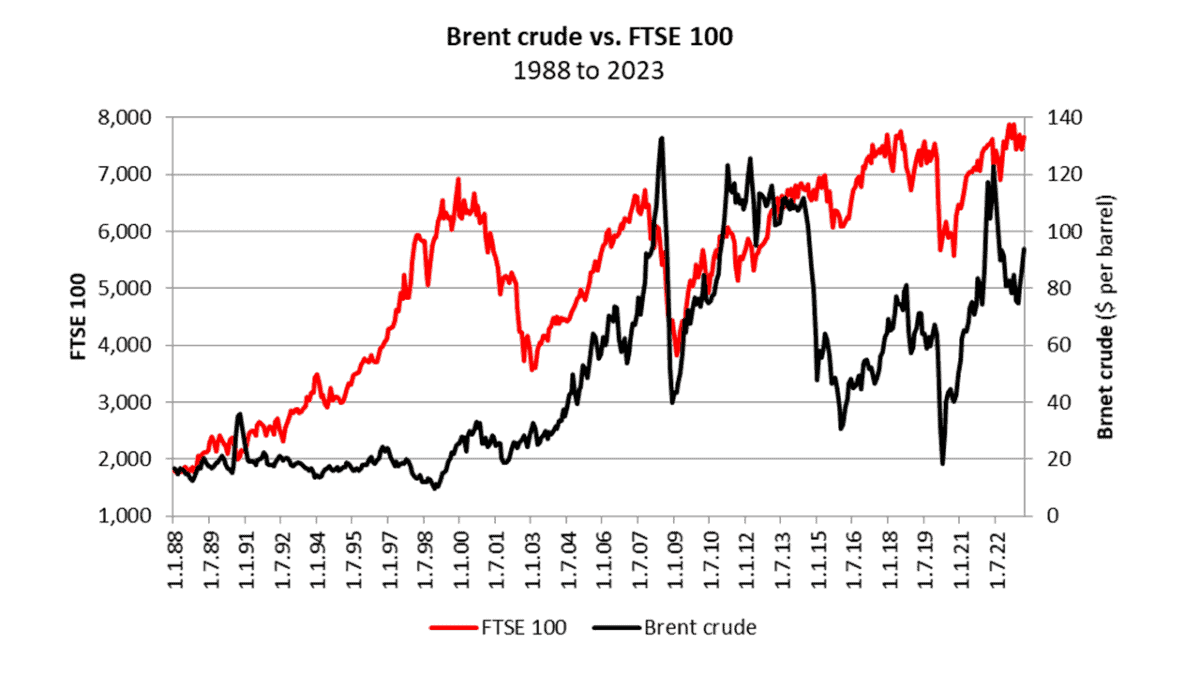
The chart below plots the month-end price of a barrel of oil, over the past 35 years, versus the FTSE 100. The data comes from the US Energy Information Administration.

To my surprise, there appears to be a reasonably strong correlation between the variables, particularly since 2003. When oil moves higher, so does the Footsie. And vice versa.
Caution

Of course, just because two factors appear to be closely related to one another, doesn’t necessarily mean that the movement in one causes changes in the other. As statisticians regularly remind us, correlation doesn’t imply causation.

For example, it’s been found there’s a 96% correlation (100% implies a perfect relationship) between the number of civil engineering degrees awarded by American universities, and the consumption of mozzarella cheese. Nobody believes these two factors are related in any way, but they do move in the same direction.

The data in my chart is 62% correlated. From 2018 to 2023, there’s a 75% match.

Possible explanations

Some of the movement can be explained by the presence of Shell and BP in the FTSE 100. But these two stocks only account for 13.1% of the total value of the index.

A more substantive explanation is that when the world economy grows, the profits of the UK’s largest listed companies will increase. That’s because approximately 70% of their revenues are earned overseas. At the same time, the price of oil will rise in line with demand.

Both variables are therefore probably reacting to changes in global economic conditions.

Whatever the reason, it appears that UK investors don’t have to fear rising oil prices.

Forecasts

World markets have always been manipulated by the actions of OPEC (The Organization of the Petroleum Exporting Countries) members.

But they need to be careful not to kill the goose that lays the golden egg. Keeping oil at elevated levels for an extended period, is likely to speed up the transition to renewable energy.

Saudi Arabia is currently producing 9m barrels a day, having reduced its output by 1m to keep prices high. But it would earn more producing 10m barrels at $85.

However, I’m not naive. High prices for an extended period will be damaging for UK shares. The rate of inflation could start to pick up once more, which will benefit very few.

But nobody’s expecting a return to the levels experienced after Russia invaded Ukraine in 2022.

Goldman Sachs is forecasting Brent crude to remain between $93 and $100 for the rest of the year. And $80-$105 in 2024.

If correct, I think BP and Shell will be the obvious winners. But the rest of the FTSE 100 won’t necessarily be losers.


James Beard has no position in any of the shares mentioned. The Motley Fool UK has no position in any of the shares mentioned. Views expressed on the companies mentioned in this article are those of the writer and therefore may differ from the official recommendations we make in our subscription services such as Share Advisor, Hidden Winners and Pro. Here at The Motley Fool we believe that considering a diverse range of insights makes us better investors.

More on Investing Articles

Investing Articles

Will the S&P 500 crash in 2026?

The S&P 500 delivered impressive gains in 2025, but valuations are now running high. Are US stocks stretched to breaking…

Read more »

Teenage boy is walking back from the shop with his grandparent. He is carrying the shopping bag and they are linking arms.
Investing Articles

How much do you need in a SIPP to generate a brilliant second income of £2,000 a month?

Harvey Jones crunches the numbers to show how investors can generate a high and rising passive income from a portfolio…

Read more »

Investing Articles

Will Lloyds shares rise 76% again in 2026?

What needs to go right for Lloyds shares to post another 76% rise? Our Foolish author dives into what might…

Read more »

Investing Articles

How much passive income will I get from investing £10,000 in an ISA for 10 years?

Harvey Jones shows how he plans to boost the amount of passive income he gets when he retires, from FTSE…

Read more »

Investing Articles

Down 34% in 2025 — but could this be one of the UK’s top growth stocks for 2026?

With clarity over research funding on the horizon, could Judges Scientific be one of the UK’s best growth stocks to…

Read more »

piggy bank, searching with binoculars
Investing Articles

Can the rampant Barclays share price beat Lloyds in 2026?

Harvey Jones says the Barclays share price was neck and neck with Lloyds over the last year, and checks out…

Read more »

Investing Articles

Here’s how Rolls-Royce shares could hit £25 in 2026

If Rolls-Royce shares continue their recent performance, then £25 might be on the cards for 2026. Let's take a look…

Read more »

Departure & Arrival sign, representing selling and buying in a portfolio
Investing Articles

Prediction: in 2026 the red-hot Rolls-Royce share price could turn £10,000 into…

Harvey Jones can't believe how rapidlly the Rolls-Royce share price has climbed. Now he looks at the FTSE 100 growth…

Read more »