
Are BP shares undervalued? Here’s what the charts say!

The fluctuation of BP shares is highly correlated to the price of energy. But the stock trades at a discount to its supermajor peers. So, why is this?

| More on:

The content of this article was relevant at the time of publishing. Circumstances change continuously and caution should therefore be exercised when relying upon any content contained within this article.

You’re reading a free article with opinions that may differ from The Motley Fool’s Premium Investing Services. Become a Motley Fool member today to get instant access to our top analyst recommendations, in-depth research, investing resources, and more. Learn More.

Young Asian man drinking coffee at home and looking at his phone

Image source: Getty Images

BP (LSE:BP) shares have remained relatively flat this summer, with a buyback policy making up for an earnings disappointment. In terms of performance, BP has largely been performing in line with other oil supermajors. However, its valuation indicates a significant discount. Let’s explore.

Performance

BP reported a significant earnings miss on August 1. Profit for the quarter came in at £1.8bn, down from $8.2bn in the first quarter. The earnings per share followed suit, experiencing a notable descent from $27.74 to $14.77.

However, this wasn’t hugely surprising. BP was the last of the supermajors to report earnings. ExxonMobil and Shell noted profits falling by 56%, while TotalEnergies said earnings fell by 49%.

Falling earnings across the sector reflected softening demand for hydrocarbons products and narrowing margins across the value chain. During the quarter oil prices fell 10% and natural gas prices by almost 30%.

Of course, this highlights a risk of investing in BP, as well as its peers. And if the environment deteriorates, and energy prices fall, the stocks could tumble.

Dividends and buybacks

In its recent earnings report, BP announced a plan to repurchase $1.5bn worth of shares before the Q3 results announcement later this year. This amounts to about 1.4% of the shares that were available at the time of the announcement. Notably, BP has reduced the number of its shares by 8.4% over the past 10 years, a pivotal aspect of its investment strategy.

BP’s dividend yield stands at 4.12%, which is higher than the average for the index. This dividend is also quite dependable. The company has only cut it twice in the last 15 years. The first time was after the Deepwater Horizon oil spill, when BP had to pay fines. The second time was during the pandemic. Additionally, its coverage ratio is 4.24 times, indicating that, based on previous earnings at least, the dividend seems sustainable.

Valuation

BP has historically had the lowest gross profit margin of the supermajors, standing at 30.7% at the end of Q1. This may not be the case for long, however. BP highlighted in its Q2 report that the acquisition of TravelCenters of America – a deal that will add a network of 288 sites located on US highways – should almost double its global convenience gross margin.

However, more importantly, when we look at valuation metrics, BP retains a significant discount. At present, BP’s P/E stands at 5.9, with a forward P/E of 6.5 based on projected earnings for the year.

As we can see in the chart below, this represents a significant discount versus peers. It’s also a discount versus BP’s five-year average P/E of 8.3.
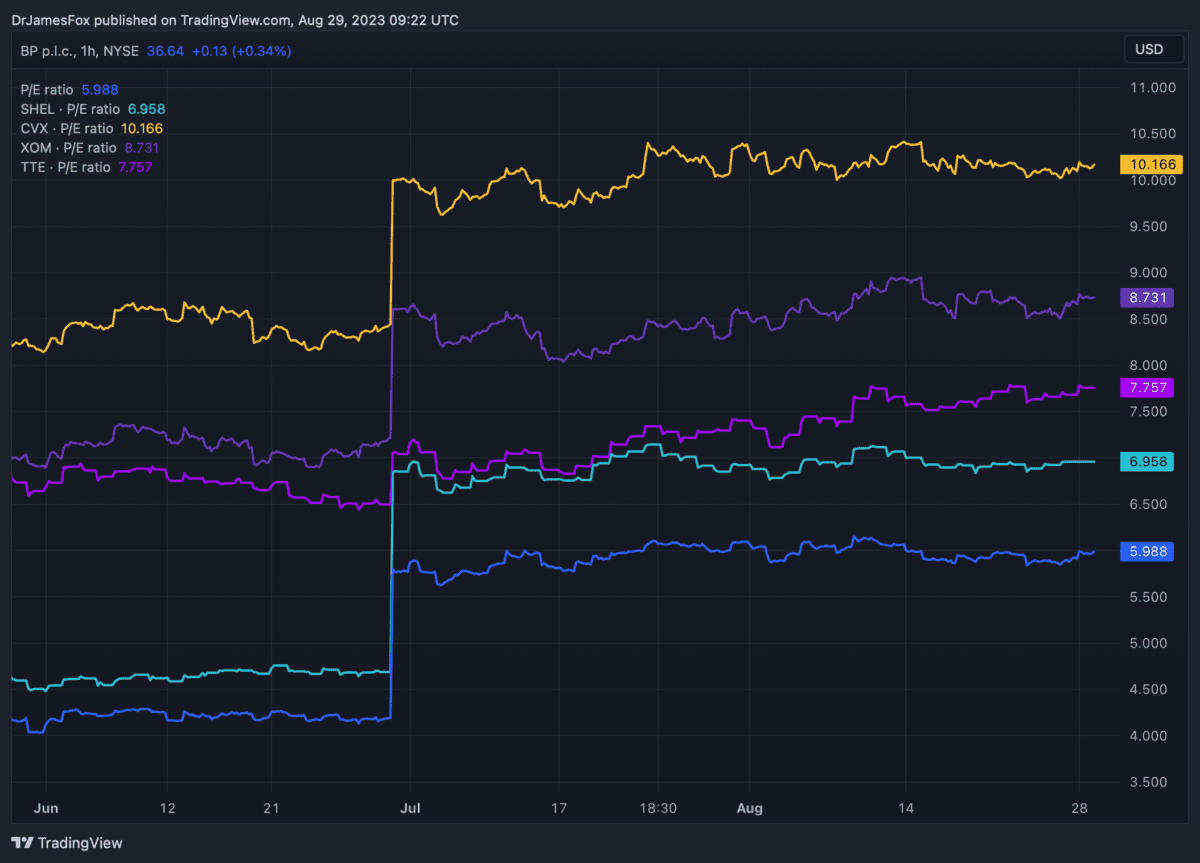
Created at TradingView

We can see that Shell is the closest company by valuation, and this highlights the discount afforded to UK stocks. But we also know that debt is another reason for the relatively low valuation.

BP’s debt-to-equity ratio is around 0.59 – Exxon 0.2, Chevron 0.14, and Shell 0.44. In turn this is a drag on profitably. However, it’s evident that this does not fully account for the discount. As such, BP appears undervalued.


James Fox has no position in any of the shares mentioned. The Motley Fool UK has no position in any of the shares mentioned. Views expressed on the companies mentioned in this article are those of the writer and therefore may differ from the official recommendations we make in our subscription services such as Share Advisor, Hidden Winners and Pro. Here at The Motley Fool we believe that considering a diverse range of insights makes us better investors.

More on Investing Articles

Asian man looking concerned while studying paperwork at his desk in an office
Investing Articles

How on earth is this FTSE 100 household name trading at 6 times earnings?

A recent downturn has made some FTSE 100 stocks look bizarrely cheap, perhaps none more so than this well-known airline…

Read more »

Calendar showing the date of 5th April on desk in a house
Investing Articles

How much do you need in a Stocks and Shares ISA for a £100 monthly passive income?

ISA season has come round again! What kind of total might budding Stocks and Shares ISA investors need for a…

Read more »

Stack of British pound coins falling on list of share prices
Investing Articles

I’m considering 2 explosive UK penny stocks while they’re still cheap!

Mark Hartley considers the investment case for two London-listed companies with soaring prices. They might not be in the penny…

Read more »

Investing Articles

£7,500 invested in Nvidia stock 18 months ago is now worth…

Nvidia (NASDAQ:NVDA) stock has run out of steam lately despite profits still soaring. Could this be a lucrative buying opportunity…

Read more »

Picture of an easyJet plane taking off.
Investing Articles

Should I buy easyJet shares near 52-week lows on a P/E ratio of 5.6?

easyJet shares have tanked amid the Iran conflict and the associated spike in oil prices. Is there a value investing…

Read more »

Happy African American Man Hugging New Car In Auto Dealership
Investing Articles

Below 40p, Aston Martin’s shares are sinking fast. How low could they go?

Aston Martin’s share price has crashed 98% since IPO. Could it hit zero, or will something come along and change…

Read more »

This way, That way, The other way - pointing in different directions
Investing Articles

This FTSE 100 stock has an above-average yield and sells on a P/E ratio of 6. Why?

Is this FTSE 100 stock the apparent bargain it seems? Or could events beyond its control hurt profits and potentially…

Read more »

A pastel colored growing graph with rising rocket.
Investing Articles

Here’s why 8.8%-yielding Legal & General shares remain my top pick for a high-income retirement portfolio

Legal & General shares have delivered years of rising income for my family — and new forecasts suggest the payouts…

Read more »