
Barclays shares vs Lloyds shares. Which are best? Here’s what the charts say

Barclays shares are among the cheapest on the FTSE 100 on several metrics. But how do they compare to Lloyds? Dr James Fox explores.

| More on:

The content of this article was relevant at the time of publishing. Circumstances change continuously and caution should therefore be exercised when relying upon any content contained within this article.

Young woman working at modern office. Technical price graph and indicator, red and green candlestick chart and stock trading computer screen background.

Image source: Getty Images

You’re reading a free article with opinions that may differ from The Motley Fool’s Premium Investing Services. Become a Motley Fool member today to get instant access to our top analyst recommendations, in-depth research, investing resources, and more. Learn More.

Barclays (LSE:BARC) shares are broadly unloved by investors. Just like Lloyds (LSE:LLOY). The market hasn’t been keen on banks since the financial crash. For me, they’re both overlooked and undervalued. But which one is best? Let’s take a closer look.

Business models

Barclays operates as a universal bank, a strategic advantage that bolsters income diversification. With a diverse portfolio of services spanning retail, commercial, investment, and corporate banking, Barclays can tap into various revenue streams across different economic conditions.

This wide-ranging approach reduces reliance on a single source of income and provides resilience in a dynamic market landscape.

On the other hand, Lloyds lacks an investment arm, which means its income streams are relatively more concentrated within the retail and commercial banking domains. This renders Lloyds more sensitive to fluctuations in interest rates, as changes in rates can directly impact its profitability.

While this can amplify profitability during periods of rising rates, it also exposes the bank to potential downturns when rates decline.

Both positions carry their share of advantages and disadvantages. Barclays’ diversified income stream mitigates risks but may require additional resources for management. Conversely, Lloyds’ focused approach offers simplicity but leaves it more susceptible to interest rate changes.

Understanding these trade-offs is crucial for investors seeking to assess each bank’s positioning within the market.

Performance

Over the past 12 months, both banks have experienced a tailwind in the form of higher interest rates. However, this could quickly turn into a headwind as very high interest rates could engender a wave of defaults.

Over the period, we’ve also seen customers move their money out of current accounts and into savings accounts — the latter isn’t so profitable for banks. Lloyds has seen a 1.6% reduction in current account balances over 12 months while Barclays saw a 2.3% reduction.

Loss provisions are another major factor. Lloyds impairments have come in 33% above expectation, while Barclays impairments have been 28% less than expected at the half way point.

On the topic of performance, it’s also worth looking at a recent bank stress test. Under the worst case scenario, Lloyds came out on second from top with CET1 (Common Equity Tier 1) levels only falling to 11.6%. Meanwhile, Barclays came bottom, with 8.6% — still way above the threshold.

Valuation

Firstly, we can observe that both stocks are cheap. Barclays trades at 4.6 times earnings while Lloyds trades at 5.5 times earnings. This put them both significantly below the index average.

However, when we look at the price-to-book ratio, we can see that Barclays has a huge 59% discount versus its net asset value. By comparison, Lloyds has a significant, yet smaller, 27% discount.
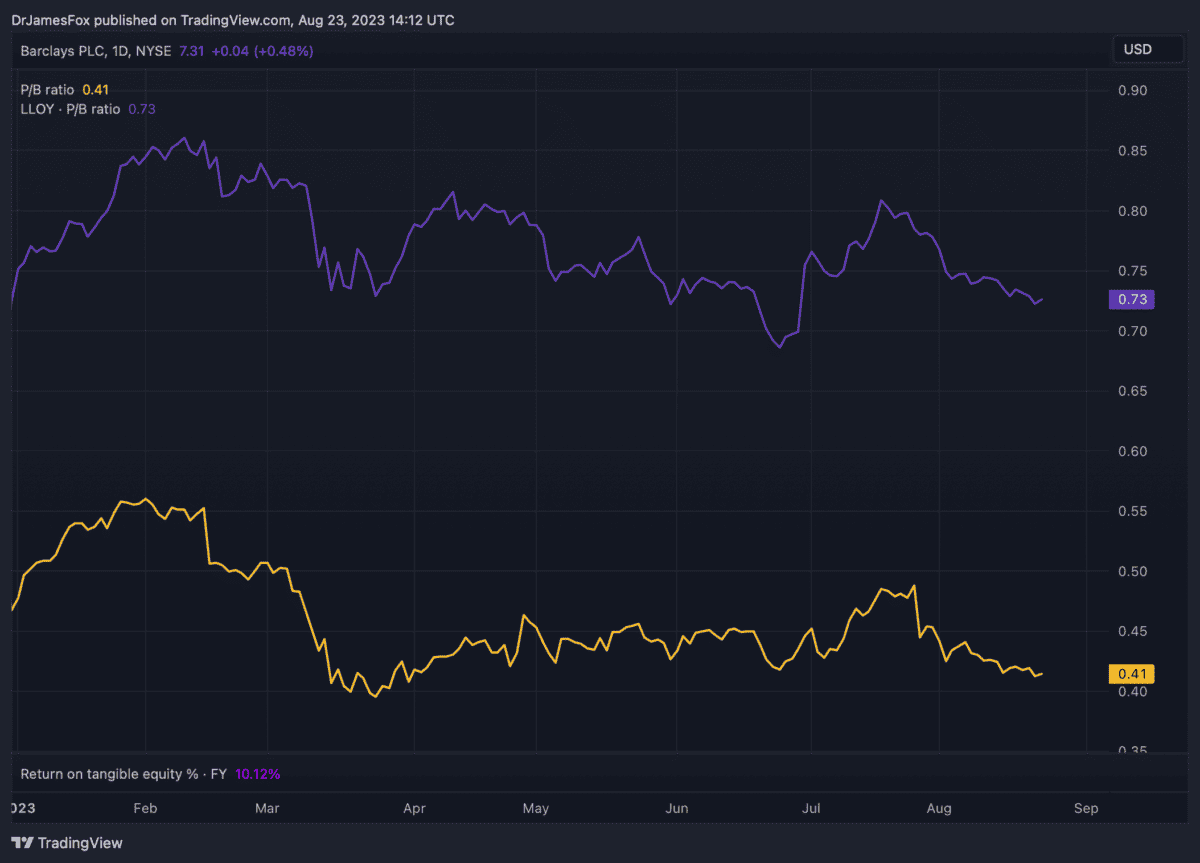
Created at TradingView

Barclays exhibits comparatively lower return efficiency when compared to Lloyds, as well as other peers. This is evidenced by its below-average Return on Tangible Equity (RoTE).

This financial measure gauges a company’s profitability relative to its tangible equity, essentially reflecting how effectively the company generates profits using its tangible assets.
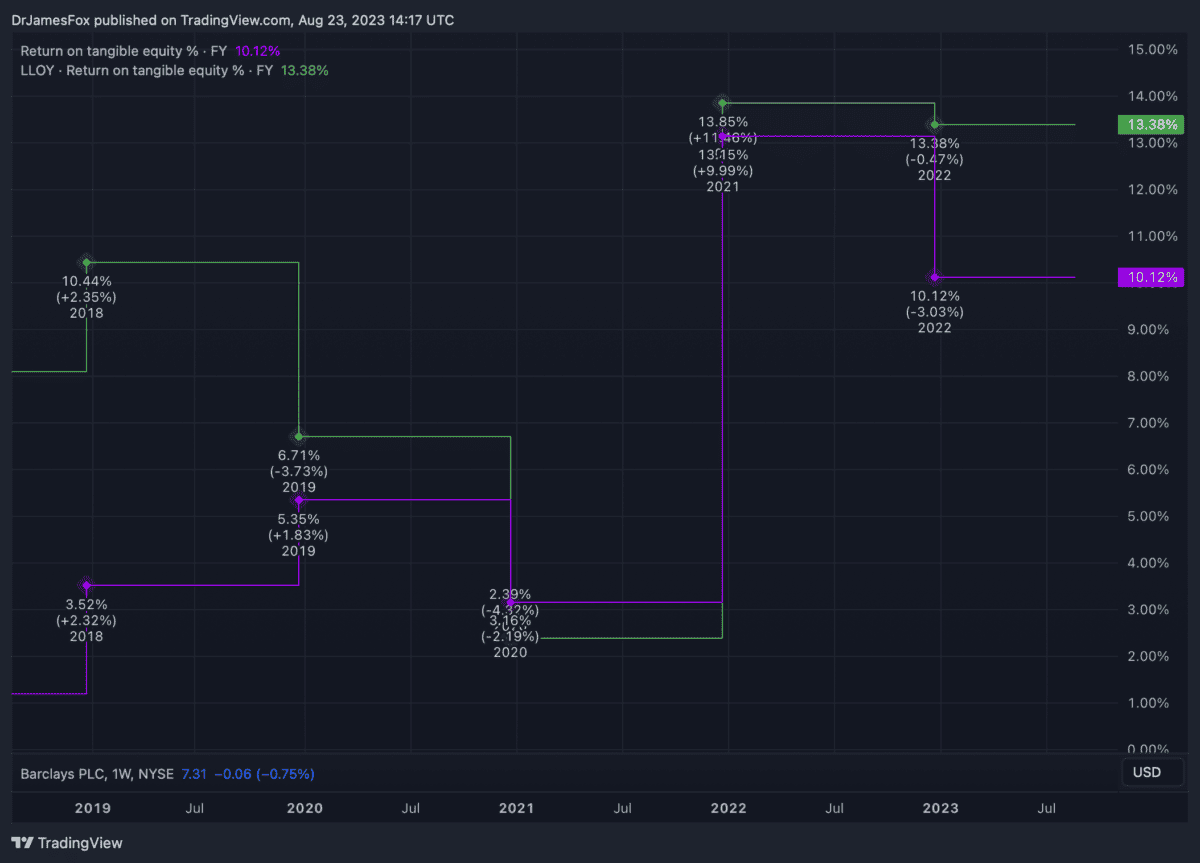
Created at TradingView

Both these banks look very attractive to me. Yes, there’s a considerable downside if interest rates cause mass defaults. However, given the possibilities at play, I think these stocks remain undervalued.

If I had to pick one — which I don’t — I’d go for Barclays.

James Fox has positions in Barclays Plc and Lloyds Banking Group Plc. The Motley Fool UK has recommended Barclays Plc and Lloyds Banking Group Plc. Views expressed on the companies mentioned in this article are those of the writer and therefore may differ from the official recommendations we make in our subscription services such as Share Advisor, Hidden Winners and Pro. Here at The Motley Fool we believe that considering a diverse range of insights makes us better investors.

More on Investing Articles

Investing Articles

7%+ yields! Here are 3 major UK dividend share forecasts for 2026 and beyond

Mark Hartley checks forecasts and considers the long-term passive income potential of three of the UK's most popular dividend shares.

Read more »

Hand is turning a dice and changes the direction of an arrow symbolizing that the value of an ETF (Exchange Traded Fund) is going up (or vice versa)
Investing Articles

2 top ETFs to consider for an ISA in 2026

Here are two very different ETFs -- one set to ride the global robotics boom, the other offering a juicy…

Read more »

Investing Articles

Down 35% in 2 months! Should I buy NIO stock at $5?

NIO stock has plunged in recent weeks, losing a third of its market value despite surging sales. Is this EV…

Read more »

Two employees sat at desk welcoming customer to a Tesla car showroom
Investing Articles

Could 2026 be the year when Tesla stock implodes?

Tesla's 2025 business performance has been uneven. But Tesla stock has performed well overall and more than doubled since April.…

Read more »

Portrait of elderly man wearing white denim shirt and glasses looking up with hand on chin. Thoughtful senior entrepreneur, studio shot against grey background.
Investing Articles

Could these FTSE 100 losers be among the best stocks to buy in 2026?

In the absence of any disasters, Paul Summers wonders if some of the worst-performing shares in FTSE 100 this year…

Read more »

Midnight is celebrated along the River Thames in London with a spectacular and colourful firework display.
Investing Articles

Up 184% this year, what might this FTSE 100 share do in 2026?

This FTSE 100 share has almost tripled in value since the start of the year. Our writer explains why --…

Read more »

Close-up as a woman counts out modern British banknotes.
Investing Articles

You can save £100 a month for 30 years to target a £2,000 a year second income, or…

It’s never too early – or too late – to start working on building a second income. But there’s a…

Read more »

Hydrogen testing at DLR Cologne
Investing Articles

Forget Rolls-Royce shares! 2 FTSE 100 stocks tipped to soar in 2026

Rolls-Royce's share price is expected to slow rapidly after 2025's stunning gains. Here are two top FTSE 100 shares now…

Read more »