
Is Lloyds’ share price NOW the FTSE 100’s best bargain?

The Lloyds share price looks dirt cheap considering its P/E ratio and dividend yield. So should I add the FTSE 100 bank to my portfolio?

| More on:

The content of this article was relevant at the time of publishing. Circumstances change continuously and caution should therefore be exercised when relying upon any content contained within this article.

Asian man looking concerned while studying paperwork at his desk in an office

Image source: Getty Images

You’re reading a free article with opinions that may differ from The Motley Fool’s Premium Investing Services. Become a Motley Fool member today to get instant access to our top analyst recommendations, in-depth research, investing resources, and more. Learn More.

Rising interest rates are a double-edged sword for banks. It’s why the Lloyds Banking Group (LSE:LLOY) share price has dropped 9% since the beginning of 2023.

Higher rates boost the difference between the interest rates banks offer to savers and borrowers. However, Bank of England (BoE) policy tightening can also hit economic growth. In fact, 14 rate hikes since late 2021 have threatened to send the UK economy into a tailspin.
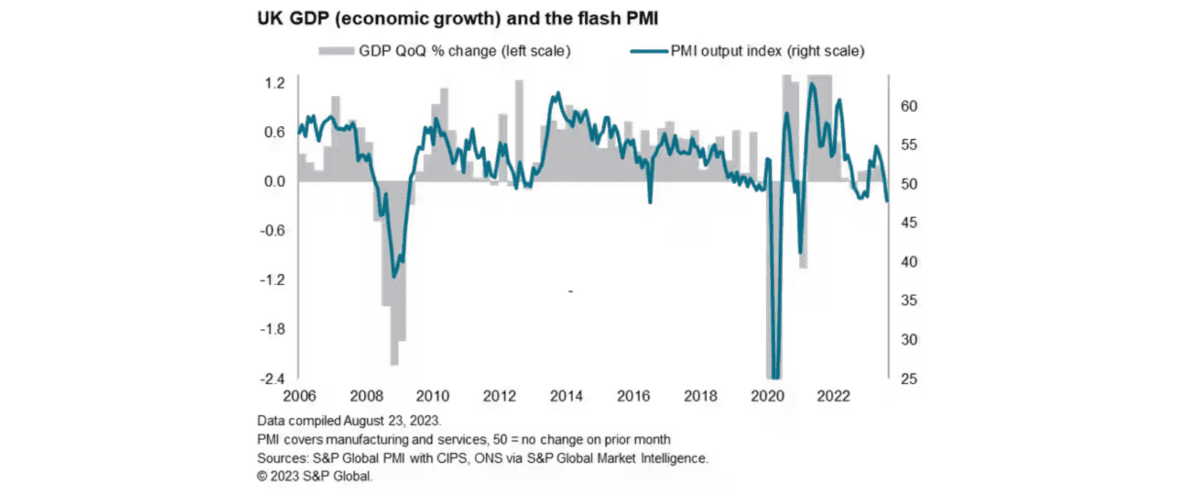
Graph showing UK GDP and flash PMI.

This was evident in latest S&P Global/CIPS UK Purchasing Managers’ Index data this week (shown in the chart above). Following the data, S&P chief business economist Chris Williamson said: “The fight against inflation appears to be carrying a heavy cost in terms of heightened recession risks.”

The index dropped back below the benchmark of 50 that separates expansion from contraction in August. In fact, at 47.8, it was the worst reading since the middle of 2020.

That led to Williamson adding that the numbers “signal a renewed contraction of the UK economy, as an increasingly severe manufacturing downturn is accompanied by a further faltering of the service sector’s spring revival.”

Good news, bad news

So the decision to buy Lloyds shares is — in the near term — a trade-off between the boost higher interest rates provide to the bank’s net interest margins (NIMs), and the carnage they bring in terms of lower revenues and greater loan impairments.

Since the BoE started raising rates things have largely been going well at Britain’s banks. Between January and June, Lloyds’ net income rose 11% year on year to £9.2bn, while profit leapt by almost a quarter to £3.9bn.

However, the bank’s update also revealed a sharp uptick in bad loans. Credit impairments soared 76% from the same 2022 period, to £662m.

The FTSE bank has already set aside a gigantic £2.2bn since the start of 2021 to cover bad loans. This is a worrying figure given that the worst is still to come for Britain’s economy. Signs of a possible housing market implosion are especially concerning for Britain’s largest home loan provider.

Cheap but risky

Many investors argue that this danger is now reflected in Lloyds’ low share price. Today, the firm trades on a forward price-to-earnings (P/E) ratio of 5.5 times.

But this low rating — nor the bank’s large 6.9% dividend yield — are enough to tempt me to invest. As well as those near-term dangers, the company faces extreme challenges to grow long term profits, including:

  • Rising competition from digital banks, challenger banks and building societies
  • Calls from the Financial Conduct Authority for banks to pay better savings rates
  • Pressure to keep branches and ATMs open as the pushback against a cashless society grows
  • Brexit-related threats the UK economy and the way the financial services industry operates

On balance, I’d rather buy other cheap FTSE 100 shares for my portfolio following recent market volatility.


Royston Wild has no position in any of the shares mentioned. The Motley Fool UK has recommended Lloyds Banking Group Plc. Views expressed on the companies mentioned in this article are those of the writer and therefore may differ from the official recommendations we make in our subscription services such as Share Advisor, Hidden Winners and Pro. Here at The Motley Fool we believe that considering a diverse range of insights makes us better investors.

More on Investing Articles

Hydrogen testing at DLR Cologne
Growth Shares

Will the soaring Rolls-Royce share price spike another 38% in 2026?

Rolls-Royce's share price has almost doubled this year. Can the FTSE 100 engineer repeat the trick in 2026? Or is…

Read more »

Portrait Of Senior Couple Climbing Hill On Hike Through Countryside In Lake District UK Together
Investing Articles

How much do you need in a Stocks & Shares ISA for a £3,333 monthly passive income?

Buying dividend stocks can supercharge your passive income from a Stocks and Shares ISA. Consider this investing strategy for retirement…

Read more »

Entrepreneur on the phone.
Investing Articles

At a 95p share price, is now the time to invest in Lloyds?

The Lloyds share price is up 73.7% since January as earnings and profit margins surge, but can it do it…

Read more »

Close-up image depicting a woman in her 70s taking British bank notes from her colourful leather wallet.
Investing Articles

£10,000 invested in Barclays shares last Christmas is now worth…

Barclays shares have been on one hell of a run. Dr James Fox takes a closer look at their performance…

Read more »

Investing Articles

I asked ChatGPT to build the best passive income ISA portfolio for 2026. Here’s what it said!

Generating passive income from dividend stocks is one of my key investment goals for next year, so I turned to…

Read more »

Investing Articles

Could Rolls-Royce shares climb as high as £20 in 2026?

Heading into 2026, analysts are already setting even higher price targets for Rolls-Royce shares on the back of upbeat guidance.

Read more »

Percy Pig Ocado van outside distribution centre
Investing Articles

When it comes to the Ocado share price, is it a case of ‘bye bye’ or ‘buy buy’?

Since the online retailer and technology group listed in July 2010, Ocado’s share price has been a huge disappointment. But…

Read more »

Young Caucasian man making doubtful face at camera
Investing Articles

£20,000 in savings? Here’s how you can use that to target a £5,755 yearly second income

It might sound farfetched to turn £20k in savings into a £5k second income I can rely on come rain…

Read more »