
Share your opinion and earn yourself a free Motley Fool premium report!

We are looking for Fools to join a 75 minute online independent market research forum on 15th / 16th December.

To find out more and express your interest please click here

Was buying bank shares my biggest mistake?

Bank shares have been tumbling on the back of SVB’s collapse. With fears of a contagion event, have I made a mistake investing in banks?

The content of this article was relevant at the time of publishing. Circumstances change continuously and caution should therefore be exercised when relying upon any content contained within this article.

Photo of a man going through financial problems

Image source: Getty Images

You’re reading a free article with opinions that may differ from The Motley Fool’s Premium Investing Services. Become a Motley Fool member today to get instant access to our top analyst recommendations, in-depth research, investing resources, and more. Learn More.

Bank stocks have wiped out their gains from earlier this year. This stems from the collapse of one of the largest US banks, Silicon Valley Bank (SVB). This sparked contagion fears about other banks and whether they’re actually safe investments. So, have I made a mistake investing in bank shares?

Losing credibility

Due to the inherently different business model of banks, compared to other companies, investing in them can be rather risky. That’s because they operate on leverage. In other words, banks use their customers’ deposits to finance their assets, such as loans and investments, and earn profits from them.

This is risky because in the event that those assets lose their value, and customers come asking for their money, the bank may have to sell those assets at a loss. And if enough of those assets are liquidated, the bank may collapse, as was the case with SVB and Signature Bank earlier this month.

As such, banking as an industry is only as strong as the customers’ confidence. Once that’s lost, banks can very quickly and easily plunge, no matter how strong their fundamentals are.

Thus, it’s no surprise to see the recent sell-off in bank shares. Investors fear that the dominos won’t stop falling, with bigger banks to come next — and Credit Suisse‘s recent demise has only worsened the sentiment.

High risk, low reward?

There is a notion that taking high risks has the potential to produce high rewards. However, that’s not always the case, and banks are a prime example of this. Even the FTSE 100‘s best-performing bank stock (Lloyds) comes nowhere close to replicating the success of the S&P 500 over the past five years.

This is because bank shares tend to be cyclical in nature, meaning they only perform well when certain economic and trading conditions are right.

Lenders tend to do better in a thriving economy and when interest rates are higher. But with a slow-growing economy and interest rates staying at almost zero over the past decade, it’s no wonder Lloyds shares have stayed flat.

Therefore, if rates remain in the goldilocks zone (2%-3%) over the medium to long term, bank shares could start riding upwards. This is when interest rates are high enough to generate interest income, and low enough to spur economic growth.

Are bank shares worth a buy?

That said, it doesn’t change the fact that banks are still risky investments. Their financials are complex, and their balance sheets may have many unrealised losses that aren’t disclosed. For that reason, it’s important to invest in banks with strong liquidity and low-risk deposit bases, such as the ones in the UK.

This is due to the fact that UK banks are more strictly regulated. They hold a significantly lower number of risk-weighted assets, and a larger chunk of customers’ deposits are insured, by the Financial Services Compensation Scheme. This means a bank run is less likely to occur.
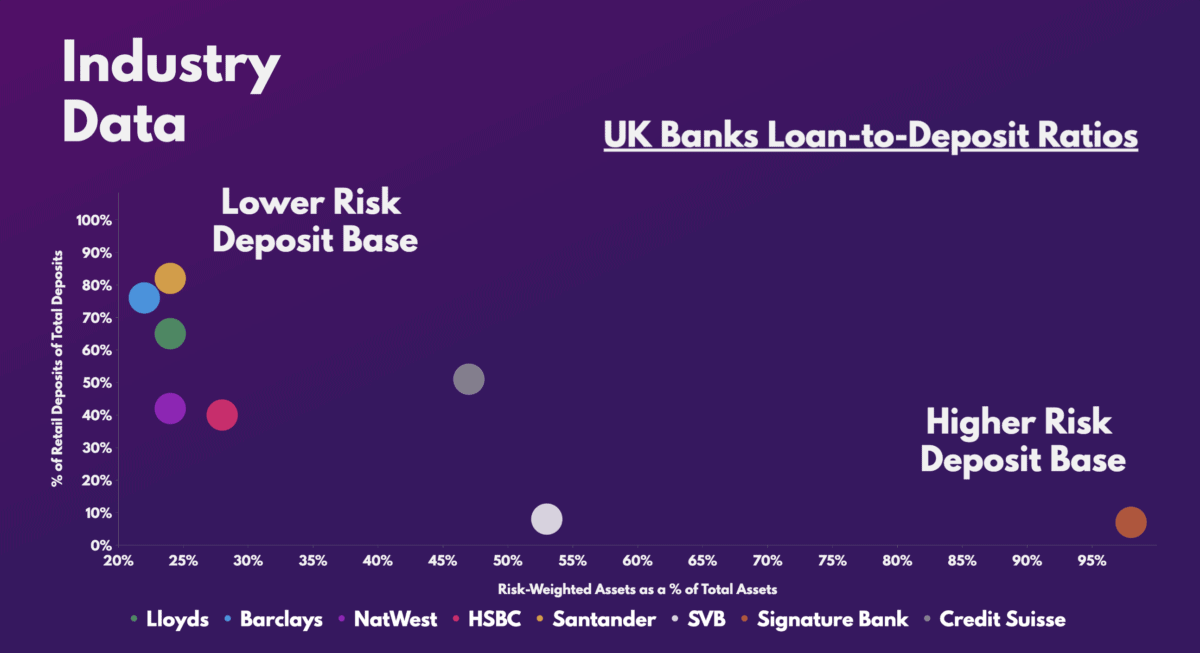
UK Banks Loan to Deposit Ratios.
Data sources: Lloyds, Barclays, NatWest, HSBC, Santander UK, Credit Suisse, SVB, Signature Bank

Although bank shares haven’t always been my cup of tea, I think the recent sell-off has presented buying opportunities I can’t ignore.

Most of their valuation multiples are at decade lows, and given the margin of safety, the risk-reward proposition is certainly attractive. Hence, I don’t think investing in bank shares have been a mistake — at least not yet — and is why I’ll be looking to add more to my Lloyds position and buy names like Barclays.

MetricsLloydsBarclaysNatWestHSBCSantanderIndustry average
Price-to-book (P/B) ratio0.60.30.70.70.60.7
Price-to-earnings (P/E) ratio6.14.37.08.96.09.0
Forward price-to-earnings (FP/E) ratio6.54.56.05.45.75.6
Data source: Google Finance

HSBC Holdings is an advertising partner of The Ascent, a Motley Fool company. John Choong has positions in Lloyds Banking Group Plc. The Motley Fool UK has recommended Barclays Plc, HSBC Holdings, and Lloyds Banking Group Plc. Views expressed on the companies mentioned in this article are those of the writer and therefore may differ from the official recommendations we make in our subscription services such as Share Advisor, Hidden Winners and Pro. Here at The Motley Fool we believe that considering a diverse range of insights makes us better investors.

More on Dividend Shares

View of Lake District. English countryside with fields in the foreground and a lake and hills behind.
Investing Articles

With a 3.2% yield, has the FTSE 100 become a wasteland for passive income investors?

With dividend yields where they are at the moment, should passive income investors take a look at the bond market…

Read more »

Fathers Walking With Their Little Boy
Investing Articles

Forget buy-to-let and think about buying REITs for passive income instead!

With tax hikes on buy-to-let, Zaven Boyrazian explains a sneaky loophole for earning rental real estate passive income entirely tax-free…

Read more »

UK coloured flags waving above large crowd on a stadium sport match.
Investing Articles

1 FTSE 100 stock on my ‘best stocks to buy now’ list

Zaven Boyrazian highlights one under-the-radar FTSE 100 stock offering a 6.6% dividend yield that’s on his ‘best stocks to buy’…

Read more »

Housing development near Dunstable, UK
Investing Articles

Taylor Wimpey has a 9.2% dividend yield, but its share price is down 21%, so should I buy the stock?

Taylor Wimpey’s share price has dropped significantly in 2025, but with a 9.2% dividend yield, is it now a passive-income-generating…

Read more »

Close-up of a woman holding modern polymer ten, twenty and fifty pound notes.
Investing Articles

With 7.5%+ dividend yields, are these 3 UK stocks too great to ignore?

The dividend yields on these UK stocks range from 7.5% to almost 11%. Royston Wild explains whether they're deserving of…

Read more »

Close-up of British bank notes
Investing Articles

No savings? Consider building a powerful income with dividend stocks

Discover how you could generate a regular passive income of almost £40,000 a year by regularly investing and buying dividend…

Read more »

Light trails from traffic moving down The Mound in central Edinburgh, Scotland during December
Investing Articles

Prediction: here are the Taylor Wimpey share price and the dividend forecast for next Christmas 

The Taylor Wimpey share price has had a bumpy 2025 but Harvey Jones hopes the FTSE 250 ultra-high yielder-will feel…

Read more »

Tesco employee helping female customer
Investing Articles

Is Tesco a second income gem after its 12.9% dividend boost?

As a shareholder, our writer was happy to see Tesco raise dividends -- again. Is it finally a serious contender…

Read more »